# Zero Bubble Distributed RL Framework for Language Model Fine-Tuning
This folder contains code for the Zero Bubble distributed RL framework. It currently supports **GRPO** and **DAPO**. See the [main README](../README.md) for general installation instructions and usage.
**Note:** This project is under active development — expect changes.
## 🛠 Installation
1. Follow the general installation guide in the [main README](../README.md).
2. Install [pygloo](https://github.com/ray-project/pygloo). Build pygloo for Ray from source following the instructions in its repository README.
## Design idea
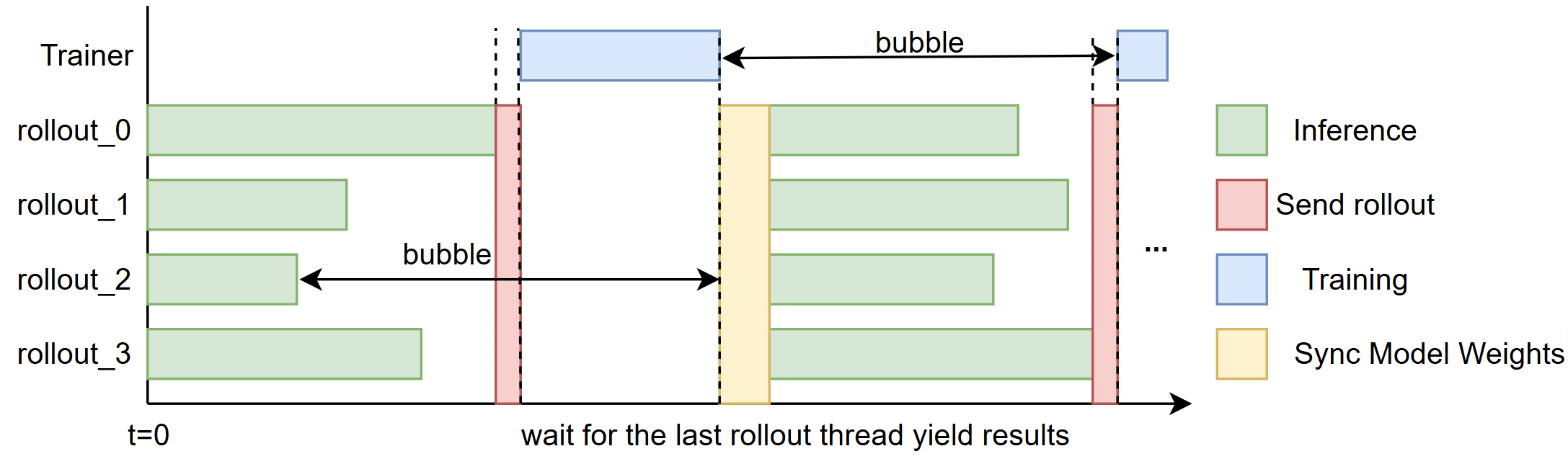
We aim to reduce the *“bubble”* — the idle time that occurs between rollouts and training steps (illustrated in Fig. 1).
**Fig. 1** - In an all-sync online RL framework, rollout workers wait for the trainer to finish training and synchronize weights, and the trainer waits for rollouts. This causes large GPU idle time.
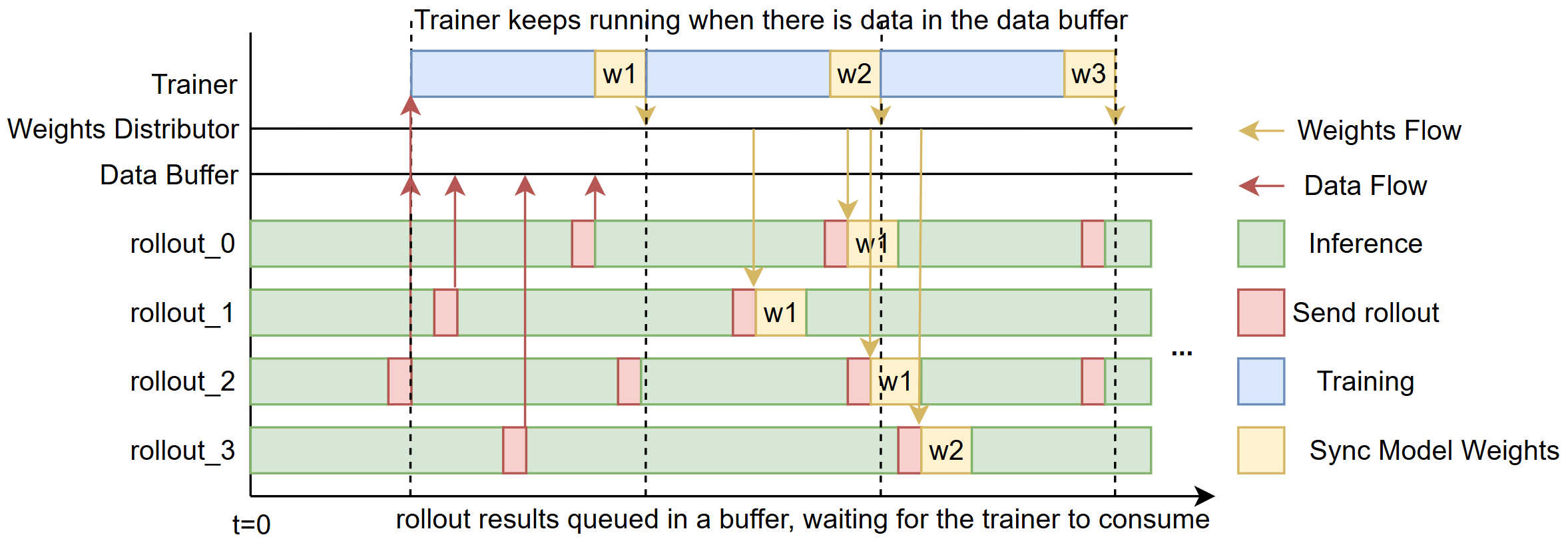
**Fig. 2** - Our Zero Bubble pipeline follows a producer–consumer pattern:
* A global **data buffer** temporarily stores rollouts produced by inference workers.
* A **weights distributor** buffers updated model weights and distributes them to inference workers.
* When the data buffer has enough data, the trainer continuously consumes from it and pushes updated weights to the weights distributor.
* After finishing a mini-batch, each inference worker checks the weights distributor and synchronizes to a newer weight version if available.
Under ideal conditions (inference workers produce data at the same rate the trainer consumes it), the pipeline eliminates idle time. We call it *zero bubble* because, with an unlimited data buffer, inference and training can run indefinitely without waiting. In practice, to avoid wasted compute and stale/off-policy data, we set a bounded buffer size so inference workers will briefly wait when the buffer is full.
## Usage
In addition to the general parameters (see the main README), the Zero Bubble pipeline introduces one additional parameter:
* **`data_actor_buffer_size_limit`** - Maximum number of rollout batches the data buffer may hold. Defaults to **twice** the trainer’s mini-batch size. Avoid setting this too large — a very large buffer increases off-policy training. For DAPO, since only effective prompts count, you may need to raise `data_actor_buffer_size_limit` depending on sample utility.
Example: RL training on 8 GPUs with Zero Bubble (zero2)
```bash
python rl_example_zero_bubble.py \
--dataset /path/to/your/dataset.jsonl \
--model /path/to/your/model \
-t 4 -i 4 -b vllm -a DAPO \
-imbs 8 -ibs 8 -tbs 8 -e 2 -rt boxed \
-si 25 -s "Please reason step by step, and put your final answer within \\boxed{}." \
-tMbs 2 -tmbs 2 -p Rebase_Experiments -zero 2 -mpt 512 -mnt 3584
```
## Performance
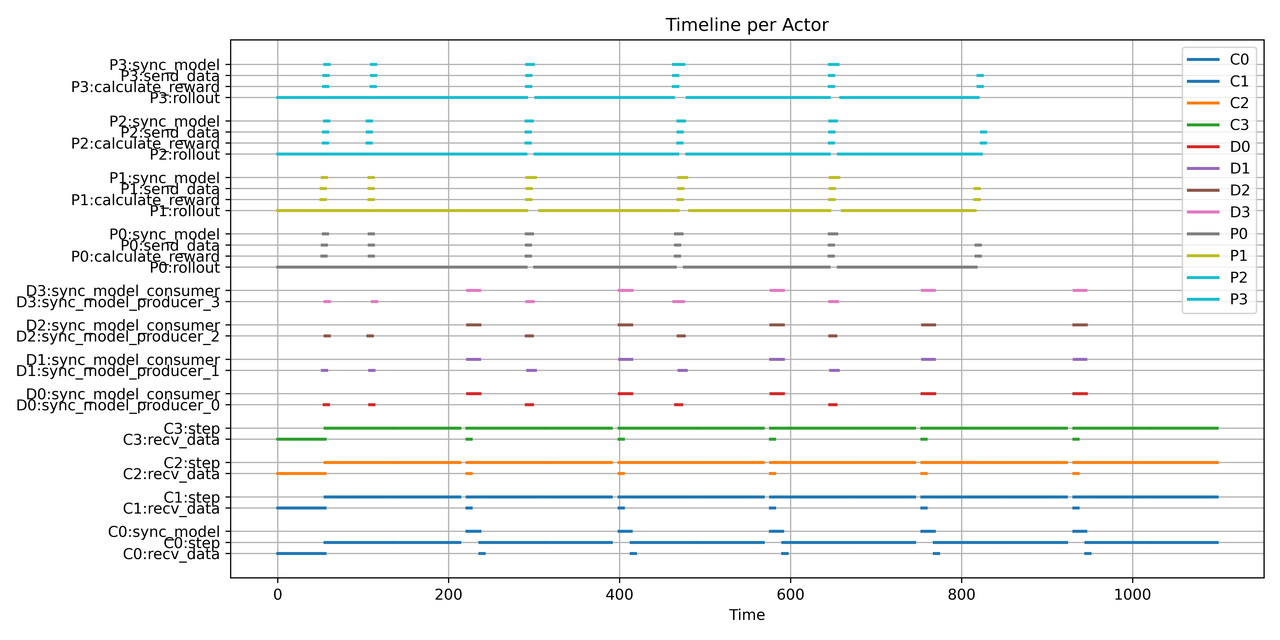
**Fig. 3** - Performance of the Zero Bubble pipeline tested with an unlimited buffer size.