 741bb1ffa1
https://github.com/langchain-ai/langchain/pull/31286 included an update
to the return type for `BaseChatModel.(a)stream`, from
`Iterator[BaseMessageChunk]` to `Iterator[BaseMessage]`.

This change is correct, because when streaming is disabled, the stream
methods return an iterator of `BaseMessage`, and the inheritance is such
that an `BaseMessage` is not a `BaseMessageChunk` (but the reverse is
true).

However, LangChain includes a pattern throughout its docs of [summing
BaseMessageChunks](https://python.langchain.com/docs/how_to/streaming/#llms-and-chat-models)
to accumulate a chat model stream. This pattern is implemented in tests
for most integration packages and appears in application code. So
https://github.com/langchain-ai/langchain/pull/31286 introduces mypy
errors throughout the ecosystem (or maybe more accurately, it reveals
that this pattern does not account for use of the `.stream` method when
streaming is disabled).

Here we revert just the change to the stream return type to unblock
things. A fix for this should address docs + integration packages (or if
we elect to just force people to update code, be explicit about that).
🦜🍎️ LangChain Core


Quick Install
pip install langchain-core
What is it?
LangChain Core contains the base abstractions that power the rest of the LangChain ecosystem.
These abstractions are designed to be as modular and simple as possible. Examples of these abstractions include those for language models, document loaders, embedding models, vectorstores, retrievers, and more.
The benefit of having these abstractions is that any provider can implement the required interface and then easily be used in the rest of the LangChain ecosystem.
For full documentation see the API reference.
1️⃣ Core Interface: Runnables
The concept of a Runnable is central to LangChain Core – it is the interface that most LangChain Core components implement, giving them
- a common invocation interface (invoke, batch, stream, etc.)
- built-in utilities for retries, fallbacks, schemas and runtime configurability
- easy deployment with LangServe
For more check out the runnable docs. Examples of components that implement the interface include: LLMs, Chat Models, Prompts, Retrievers, Tools, Output Parsers.
You can use LangChain Core objects in two ways:
-
imperative, ie. call them directly, eg.
model.invoke(...) -
declarative, with LangChain Expression Language (LCEL)
-
or a mix of both! eg. one of the steps in your LCEL sequence can be a custom function
| Feature | Imperative | Declarative |
|---|---|---|
| Syntax | All of Python | LCEL |
| Tracing | ✅ – Automatic | ✅ – Automatic |
| Parallel | ✅ – with threads or coroutines | ✅ – Automatic |
| Streaming | ✅ – by yielding | ✅ – Automatic |
| Async | ✅ – by writing async functions | ✅ – Automatic |
⚡️ What is LangChain Expression Language?
LangChain Expression Language (LCEL) is a declarative language for composing LangChain Core runnables into sequences (or DAGs), covering the most common patterns when building with LLMs.
LangChain Core compiles LCEL sequences to an optimized execution plan, with automatic parallelization, streaming, tracing, and async support.
For more check out the LCEL docs.
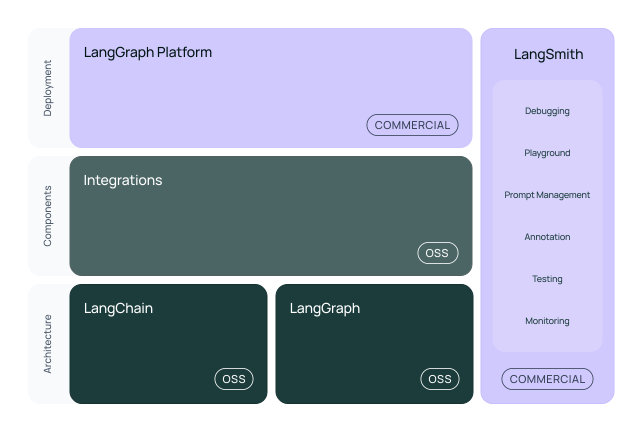
For more advanced use cases, also check out LangGraph, which is a graph-based runner for cyclic and recursive LLM workflows.
📕 Releases & Versioning
langchain-core is currently on version 0.1.x.
As langchain-core contains the base abstractions and runtime for the whole LangChain ecosystem, we will communicate any breaking changes with advance notice and version bumps. The exception for this is anything in langchain_core.beta. The reason for langchain_core.beta is that given the rate of change of the field, being able to move quickly is still a priority, and this module is our attempt to do so.
Minor version increases will occur for:
- Breaking changes for any public interfaces NOT in
langchain_core.beta
Patch version increases will occur for:
- Bug fixes
- New features
- Any changes to private interfaces
- Any changes to
langchain_core.beta
💁 Contributing
As an open-source project in a rapidly developing field, we are extremely open to contributions, whether it be in the form of a new feature, improved infrastructure, or better documentation.
For detailed information on how to contribute, see the Contributing Guide.
⛰️ Why build on top of LangChain Core?
The whole LangChain ecosystem is built on top of LangChain Core, so you're in good company when building on top of it. Some of the benefits:
- Modularity: LangChain Core is designed around abstractions that are independent of each other, and not tied to any specific model provider.
- Stability: We are committed to a stable versioning scheme, and will communicate any breaking changes with advance notice and version bumps.
- Battle-tested: LangChain Core components have the largest install base in the LLM ecosystem, and are used in production by many companies.
- Community: LangChain Core is developed in the open, and we welcome contributions from the community.