 18c64aed6d
This PR fixes the PostgreSQL NUL byte issue that causes
`psycopg.DataError` when inserting documents containing `\x00` bytes
into PostgreSQL-based vector stores.

## Problem

PostgreSQL text fields cannot contain NUL (0x00) bytes. When documents
with such characters are processed by PGVector or langchain-postgres
implementations, they fail with:

```
(psycopg.DataError) PostgreSQL text fields cannot contain NUL (0x00) bytes
```

This commonly occurs when processing PDFs, documents from various
loaders, or text extracted by libraries like unstructured that may
contain embedded NUL bytes.

## Solution

Added `sanitize_for_postgres()` utility function to
`langchain_core.utils.strings` that removes or replaces NUL bytes from
text content.

### Key Features

- **Simple API**: `sanitize_for_postgres(text, replacement="")`
- **Configurable**: Replace NUL bytes with empty string (default) or
space for readability
- **Comprehensive**: Handles all problematic examples from the original
issue
- **Well-tested**: Complete unit tests with real-world examples
- **Backward compatible**: No breaking changes, purely additive

### Usage Example

```python
from langchain_core.utils import sanitize_for_postgres
from langchain_core.documents import Document

# Before: This would fail with DataError
problematic_content = "Getting\x00Started with embeddings"

# After: Clean the content before database insertion
clean_content = sanitize_for_postgres(problematic_content)
# Result: "GettingStarted with embeddings"

# Or preserve readability with spaces
readable_content = sanitize_for_postgres(problematic_content, " ")
# Result: "Getting Started with embeddings"

# Use in Document processing
doc = Document(page_content=clean_content, metadata={...})
```

### Integration Pattern

PostgreSQL vector store implementations should sanitize content before
insertion:

```python
def add_documents(self, documents: List[Document]) -> List[str]:
    # Sanitize documents before insertion
    sanitized_docs = []
    for doc in documents:
        sanitized_content = sanitize_for_postgres(doc.page_content, " ")
        sanitized_doc = Document(
            page_content=sanitized_content,
            metadata=doc.metadata,
            id=doc.id
        )
        sanitized_docs.append(sanitized_doc)

    return self._insert_documents_to_db(sanitized_docs)
```

## Changes Made

- Added `sanitize_for_postgres()` function in
`langchain_core/utils/strings.py`
- Updated `langchain_core/utils/__init__.py` to export the new function
- Added comprehensive unit tests in
`tests/unit_tests/utils/test_strings.py`
- Validated against all examples from the original issue report

## Testing

All tests pass, including:
- Basic NUL byte removal and replacement
- Multiple consecutive NUL bytes
- Empty string handling
- Real examples from the GitHub issue
- Backward compatibility with existing string utilities

This utility enables PostgreSQL integrations in both langchain-community
and langchain-postgres packages to handle documents with NUL bytes
reliably.

Fixes #26033.

<!-- START COPILOT CODING AGENT TIPS -->
---

💬 Share your feedback on Copilot coding agent for the chance to win a
$200 gift card! Click
[here](https://survey.alchemer.com/s3/8343779/Copilot-Coding-agent) to
start the survey.

---------

Co-authored-by: copilot-swe-agent[bot] <198982749+Copilot@users.noreply.github.com>
Co-authored-by: mdrxy <61371264+mdrxy@users.noreply.github.com>
Co-authored-by: Mason Daugherty <github@mdrxy.com>
🦜🍎️ LangChain Core


Quick Install
pip install langchain-core
What is it?
LangChain Core contains the base abstractions that power the rest of the LangChain ecosystem.
These abstractions are designed to be as modular and simple as possible. Examples of these abstractions include those for language models, document loaders, embedding models, vectorstores, retrievers, and more.
The benefit of having these abstractions is that any provider can implement the required interface and then easily be used in the rest of the LangChain ecosystem.
For full documentation see the API reference.
1️⃣ Core Interface: Runnables
The concept of a Runnable is central to LangChain Core – it is the interface that most LangChain Core components implement, giving them
- a common invocation interface (invoke, batch, stream, etc.)
- built-in utilities for retries, fallbacks, schemas and runtime configurability
- easy deployment with LangServe
For more check out the runnable docs. Examples of components that implement the interface include: LLMs, Chat Models, Prompts, Retrievers, Tools, Output Parsers.
You can use LangChain Core objects in two ways:
-
imperative, ie. call them directly, eg.
model.invoke(...) -
declarative, with LangChain Expression Language (LCEL)
-
or a mix of both! eg. one of the steps in your LCEL sequence can be a custom function
| Feature | Imperative | Declarative |
|---|---|---|
| Syntax | All of Python | LCEL |
| Tracing | ✅ – Automatic | ✅ – Automatic |
| Parallel | ✅ – with threads or coroutines | ✅ – Automatic |
| Streaming | ✅ – by yielding | ✅ – Automatic |
| Async | ✅ – by writing async functions | ✅ – Automatic |
⚡️ What is LangChain Expression Language?
LangChain Expression Language (LCEL) is a declarative language for composing LangChain Core runnables into sequences (or DAGs), covering the most common patterns when building with LLMs.
LangChain Core compiles LCEL sequences to an optimized execution plan, with automatic parallelization, streaming, tracing, and async support.
For more check out the LCEL docs.
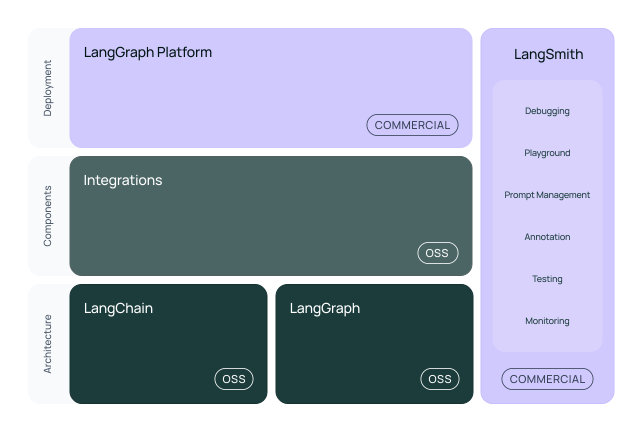
For more advanced use cases, also check out LangGraph, which is a graph-based runner for cyclic and recursive LLM workflows.
📕 Releases & Versioning
langchain-core is currently on version 0.1.x.
As langchain-core contains the base abstractions and runtime for the whole LangChain ecosystem, we will communicate any breaking changes with advance notice and version bumps. The exception for this is anything in langchain_core.beta. The reason for langchain_core.beta is that given the rate of change of the field, being able to move quickly is still a priority, and this module is our attempt to do so.
Minor version increases will occur for:
- Breaking changes for any public interfaces NOT in
langchain_core.beta
Patch version increases will occur for:
- Bug fixes
- New features
- Any changes to private interfaces
- Any changes to
langchain_core.beta
💁 Contributing
As an open-source project in a rapidly developing field, we are extremely open to contributions, whether it be in the form of a new feature, improved infrastructure, or better documentation.
For detailed information on how to contribute, see the Contributing Guide.
⛰️ Why build on top of LangChain Core?
The whole LangChain ecosystem is built on top of LangChain Core, so you're in good company when building on top of it. Some of the benefits:
- Modularity: LangChain Core is designed around abstractions that are independent of each other, and not tied to any specific model provider.
- Stability: We are committed to a stable versioning scheme, and will communicate any breaking changes with advance notice and version bumps.
- Battle-tested: LangChain Core components have the largest install base in the LLM ecosystem, and are used in production by many companies.
- Community: LangChain Core is developed in the open, and we welcome contributions from the community.