Thank you for contributing to LangChain!
- [x] **PR title**: "package: description"
- Where "package" is whichever of langchain, community, core,
experimental, etc. is being modified. Use "docs: ..." for purely docs
changes, "templates: ..." for template changes, "infra: ..." for CI
changes.
- Example: "community: add foobar LLM"
- [x] **PR message**:
- **Description:** Updated dead link referencing chroma docs in Chroma
notebook under vectorstores
…s and Opensearch Semantic Cache
Thank you for contributing to LangChain!
- [ ] **PR title**: "package: description"
- Where "package" is whichever of langchain, community, core,
experimental, etc. is being modified. Use "docs: ..." for purely docs
changes, "templates: ..." for template changes, "infra: ..." for CI
changes.
- Example: "community: add foobar LLM"
- [ ] **PR message**: ***Delete this entire checklist*** and replace
with
- **Description:** a description of the change
- **Issue:** the issue # it fixes, if applicable
- **Dependencies:** any dependencies required for this change
- **Twitter handle:** if your PR gets announced, and you'd like a
mention, we'll gladly shout you out!
- [ ] **Add tests and docs**: If you're adding a new integration, please
include
1. a test for the integration, preferably unit tests that do not rely on
network access,
2. an example notebook showing its use. It lives in
`docs/docs/integrations` directory.
- [ ] **Lint and test**: Run `make format`, `make lint` and `make test`
from the root of the package(s) you've modified. See contribution
guidelines for more: https://python.langchain.com/docs/contributing/
Additional guidelines:
- Make sure optional dependencies are imported within a function.
- Please do not add dependencies to pyproject.toml files (even optional
ones) unless they are required for unit tests.
- Most PRs should not touch more than one package.
- Changes should be backwards compatible.
- If you are adding something to community, do not re-import it in
langchain.
If no one reviews your PR within a few days, please @-mention one of
baskaryan, efriis, eyurtsev, ccurme, vbarda, hwchase17.
---------
Co-authored-by: Bagatur <baskaryan@gmail.com>
- [ ] **Packages affected**:
- community: fix `cosine_similarity` to support simsimd beyond 3.7.7
- partners/milvus: fix `cosine_similarity` to support simsimd beyond
3.7.7
- partners/mongodb: fix `cosine_similarity` to support simsimd beyond
3.7.7
- partners/pinecone: fix `cosine_similarity` to support simsimd beyond
3.7.7
- partners/qdrant: fix `cosine_similarity` to support simsimd beyond
3.7.7
- [ ] **Broadcast operation failure while using simsimd beyond v3.7.7**:
- **Description:** I was using simsimd 4.3.1 and the unsupported operand
type issue popped up. When I checked out the repo and ran the tests,
they failed as well (have attached a screenshot for that). Looks like it
is a variant of https://github.com/langchain-ai/langchain/issues/18022 .
Prior to 3.7.7, simd.cdist returned an ndarray but now it returns
simsimd.DistancesTensor which is ineligible for a broadcast operation
with numpy. With this change, it also remove the need to explicitly cast
`Z` to numpy array
- **Issue:** #19905
- **Dependencies:** No
- **Twitter handle:** https://x.com/GetzJoydeep
<img width="1622" alt="Screenshot 2024-05-29 at 2 50 00 PM"
src="https://github.com/langchain-ai/langchain/assets/31132555/fb27b383-a9ae-4a6f-b355-6d503b72db56">
- [ ] **Considerations**:
1. I started with community but since similar changes were there in
Milvus, MongoDB, Pinecone, and QDrant so I modified their files as well.
If touching multiple packages in one PR is not the norm, then I can
remove them from this PR and raise separate ones
2. I have run and verified that the tests work. Since, only MongoDB had
tests, I ran theirs and verified it works as well. Screenshots attached
:
<img width="1573" alt="Screenshot 2024-05-29 at 2 52 13 PM"
src="https://github.com/langchain-ai/langchain/assets/31132555/ce87d1ea-19b6-4900-9384-61fbc1a30de9">
<img width="1614" alt="Screenshot 2024-05-29 at 3 33 51 PM"
src="https://github.com/langchain-ai/langchain/assets/31132555/6ce1d679-db4c-4291-8453-01028ab2dca5">
I have added a test for simsimd. I feel it may not go well with the
CI/CD setup as installing simsimd is not a dependency requirement. I
have just imported simsimd to ensure simsimd cosine similarity is
invoked. However, its not a good approach. Suggestions are welcome and I
can make the required changes on the PR. Please provide guidance on the
same as I am new to the community.
---------
Co-authored-by: Bagatur <baskaryan@gmail.com>
Co-authored-by: Bagatur <22008038+baskaryan@users.noreply.github.com>
### Description
Add tools implementation to `ChatEdenAI`:
- `bind_tools()`
- `with_structured_output()`
### Documentation
Updated `docs/docs/integrations/chat/edenai.ipynb`
### Notes
We don´t support stream with tools as of yet. If stream is called with
tools we directly yield the whole message from `generate` (implemented
the same way as Anthropic did).
- [x] **PR title**: Update docstrings for OpenAI base.py
-**Description:** Updated the docstring of few OpenAI functions for a
better understanding of the function.
- **Issue:** #21983
---------
Co-authored-by: Bagatur <baskaryan@gmail.com>
Noticing errors logged in some situations when tracing with Langsmith:
```python
from langchain_core.pydantic_v1 import BaseModel
from langchain_anthropic import ChatAnthropic
class AnswerWithJustification(BaseModel):
"""An answer to the user question along with justification for the answer."""
answer: str
justification: str
llm = ChatAnthropic(model="claude-3-haiku-20240307")
structured_llm = llm.with_structured_output(AnswerWithJustification)
list(structured_llm.stream("What weighs more a pound of bricks or a pound of feathers"))
```
```
Error in LangChainTracer.on_chain_end callback: AttributeError("'NoneType' object has no attribute 'append'")
[AnswerWithJustification(answer='A pound of bricks and a pound of feathers weigh the same amount.', justification='This is because a pound is a unit of mass, not volume. By definition, a pound of any material, whether bricks or feathers, will weigh the same - one pound. The physical size or volume of the materials does not matter when measuring by mass. So a pound of bricks and a pound of feathers both weigh exactly one pound.')]
```
Thank you for contributing to LangChain!
- [ ] **PR title**: "package: description"
- Where "package" is whichever of langchain, community, core,
experimental, etc. is being modified. Use "docs: ..." for purely docs
changes, "templates: ..." for template changes, "infra: ..." for CI
changes.
- Example: "community: add foobar LLM"
- [ ] **PR message**: ***Delete this entire checklist*** and replace
with
- **Description:** a description of the change
- **Issue:** the issue # it fixes, if applicable
- **Dependencies:** any dependencies required for this change
- **Twitter handle:** if your PR gets announced, and you'd like a
mention, we'll gladly shout you out!
- [ ] **Add tests and docs**: If you're adding a new integration, please
include
1. a test for the integration, preferably unit tests that do not rely on
network access,
2. an example notebook showing its use. It lives in
`docs/docs/integrations` directory.
- [ ] **Lint and test**: Run `make format`, `make lint` and `make test`
from the root of the package(s) you've modified. See contribution
guidelines for more: https://python.langchain.com/docs/contributing/
Additional guidelines:
- Make sure optional dependencies are imported within a function.
- Please do not add dependencies to pyproject.toml files (even optional
ones) unless they are required for unit tests.
- Most PRs should not touch more than one package.
- Changes should be backwards compatible.
- If you are adding something to community, do not re-import it in
langchain.
If no one reviews your PR within a few days, please @-mention one of
baskaryan, efriis, eyurtsev, ccurme, vbarda, hwchase17.
The Vectorstore's API `as_retriever` doesn't expose explicitly the
parameters `search_type` and `search_kwargs` and so these are not well
documented.
This PR improves `as_retriever` for the Cassandra VectorStore by making
these parameters explicit.
NB: An alternative would have been to modify `as_retriever` in
`Vectorstore`. But there's probably a good reason these were not exposed
in the first place ? Is it because implementations may decide to not
support them and have fixed values when creating the
VectorStoreRetriever ?
- **Description:** Added support for using HuggingFacePipeline in
ChatHuggingFace (previously it was only usable with API endpoints,
probably by oversight).
- **Issue:** #19997
- **Dependencies:** none
- **Twitter handle:** none
---------
Co-authored-by: Bagatur <baskaryan@gmail.com>
Co-authored-by: Bagatur <22008038+baskaryan@users.noreply.github.com>
This PR introduces namespace support for Upstash Vector Store, which
would allow users to partition their data in the vector index.
---------
Co-authored-by: Bagatur <baskaryan@gmail.com>
Co-authored-by: Bagatur <22008038+baskaryan@users.noreply.github.com>
- **Description:**
This PR fixes a rendering issue in the docs (Python notebook) of HANA
Cloud Vector Engine.
- **Issue:** N/A
- **Dependencies:** no new dependencies added
File of the fixed notebook:
`docs/docs/integrations/vectorstores/hanavector.ipynb`
## Description
This PR allows passing the HTMLSectionSplitter paths to xslt files. It
does so by fixing two trivial bugs with how passed paths were being
handled. It also changes the default value of the param `xslt_path` to
`None` so the special case where the file was part of the langchain
package could be handled.
## Issue
#22175
- [X] **PR title**: "community: added optional params to Airtable
table.all()"
- [X] **PR message**:
- **Description:** Add's **kwargs to AirtableLoader to allow for kwargs:
https://pyairtable.readthedocs.io/en/latest/api.html#pyairtable.Table.all
- **Issue:** N/A
- **Dependencies:** N/A
- **Twitter handle:** parakoopa88
- [X] **Add tests and docs**: If you're adding a new integration, please
include
1. a test for the integration, preferably unit tests that do not rely on
network access,
2. an example notebook showing its use. It lives in
`docs/docs/integrations` directory.
- [X] **Lint and test**: Run `make format`, `make lint` and `make test`
from the root of the package(s) you've modified. See contribution
guidelines for more: https://python.langchain.com/docs/contributing/
If no one reviews your PR within a few days, please @-mention one of
baskaryan, efriis, eyurtsev, ccurme, vbarda, hwchase17.
---------
Co-authored-by: Bagatur <baskaryan@gmail.com>
Co-authored-by: Bagatur <22008038+baskaryan@users.noreply.github.com>
Thank you for contributing to LangChain!
- [ ] **PR title**: "package: description"
- Where "package" is whichever of langchain, community, core,
experimental, etc. is being modified. Use "docs: ..." for purely docs
changes, "templates: ..." for template changes, "infra: ..." for CI
changes.
- Example: "community: add foobar LLM"
"community/embeddings: update oracleai.py"
- [ ] **PR message**: ***Delete this entire checklist*** and replace
with
- **Description:** a description of the change
- **Issue:** the issue # it fixes, if applicable
- **Dependencies:** any dependencies required for this change
- **Twitter handle:** if your PR gets announced, and you'd like a
mention, we'll gladly shout you out!
Adding oracle VECTOR_ARRAY_T support.
- [ ] **Add tests and docs**: If you're adding a new integration, please
include
1. a test for the integration, preferably unit tests that do not rely on
network access,
2. an example notebook showing its use. It lives in
`docs/docs/integrations` directory.
Tests are not impacted.
- [ ] **Lint and test**: Run `make format`, `make lint` and `make test`
from the root of the package(s) you've modified. See contribution
guidelines for more: https://python.langchain.com/docs/contributing/
Done.
Additional guidelines:
- Make sure optional dependencies are imported within a function.
- Please do not add dependencies to pyproject.toml files (even optional
ones) unless they are required for unit tests.
- Most PRs should not touch more than one package.
- Changes should be backwards compatible.
- If you are adding something to community, do not re-import it in
langchain.
If no one reviews your PR within a few days, please @-mention one of
baskaryan, efriis, eyurtsev, ccurme, vbarda, hwchase17.
- **Description:** When I was running the SparkLLMTextEmbeddings,
app_id, api_key and api_secret are all correct, but it cannot run
normally using the current URL.
```python
# example
from langchain_community.embeddings import SparkLLMTextEmbeddings
embedding= SparkLLMTextEmbeddings(
spark_app_id="my-app-id",
spark_api_key="my-api-key",
spark_api_secret="my-api-secret"
)
embedding= "hello"
print(spark.embed_query(text1))
```

So I updated the url and request body parameters according to
[Embedding_api](https://www.xfyun.cn/doc/spark/Embedding_api.html), now
it is runnable.
**Description:** [IPEX-LLM](https://github.com/intel-analytics/ipex-llm)
is a PyTorch library for running LLM on Intel CPU and GPU (e.g., local
PC with iGPU, discrete GPU such as Arc, Flex and Max) with very low
latency. This PR adds ipex-llm integrations to langchain for BGE
embedding support on both Intel CPU and GPU.
**Dependencies:** `ipex-llm`, `sentence-transformers`
**Contribution maintainer**: @Oscilloscope98
**tests and docs**:
- langchain/docs/docs/integrations/text_embedding/ipex_llm.ipynb
- langchain/docs/docs/integrations/text_embedding/ipex_llm_gpu.ipynb
-
langchain/libs/community/tests/integration_tests/embeddings/test_ipex_llm.py
---------
Co-authored-by: Shengsheng Huang <shannie.huang@gmail.com>
Anthropic's streaming treats tool calls as different content parts
(streamed back with a different index) from normal content in the
`content`.
This means that we need to update our chunk-merging logic to handle
chunks with multi-part content. The alternative is coerceing Anthropic's
responses into a string, but we generally like to preserve model
provider responses faithfully when we can. This will also likely be
useful for multimodal outputs in the future.
This current PR does unfortunately make `index` a magic field within
content parts, but Anthropic and OpenAI both use it at the moment to
determine order anyway. To avoid cases where we have content arrays with
holes and to simplify the logic, I've also restricted merging to chunks
in order.
TODO: tests
CC @baskaryan @ccurme @efriis
- This fixes all the tracing issues with people still using
get_relevant_docs, and a change we need for 0.3 anyway
Thank you for contributing to LangChain!
- [ ] **PR title**: "package: description"
- Where "package" is whichever of langchain, community, core,
experimental, etc. is being modified. Use "docs: ..." for purely docs
changes, "templates: ..." for template changes, "infra: ..." for CI
changes.
- Example: "community: add foobar LLM"
- [ ] **PR message**: ***Delete this entire checklist*** and replace
with
- **Description:** a description of the change
- **Issue:** the issue # it fixes, if applicable
- **Dependencies:** any dependencies required for this change
- **Twitter handle:** if your PR gets announced, and you'd like a
mention, we'll gladly shout you out!
- [ ] **Add tests and docs**: If you're adding a new integration, please
include
1. a test for the integration, preferably unit tests that do not rely on
network access,
2. an example notebook showing its use. It lives in
`docs/docs/integrations` directory.
- [ ] **Lint and test**: Run `make format`, `make lint` and `make test`
from the root of the package(s) you've modified. See contribution
guidelines for more: https://python.langchain.com/docs/contributing/
Additional guidelines:
- Make sure optional dependencies are imported within a function.
- Please do not add dependencies to pyproject.toml files (even optional
ones) unless they are required for unit tests.
- Most PRs should not touch more than one package.
- Changes should be backwards compatible.
- If you are adding something to community, do not re-import it in
langchain.
If no one reviews your PR within a few days, please @-mention one of
baskaryan, efriis, eyurtsev, ccurme, vbarda, hwchase17.
- **Description:** The `ApifyWrapper` class expects `apify_api_token` to
be passed as a named parameter or set as an environment variable. But
the corresponding field was missing in the class definition causing the
argument to be ignored when passed as a named param. This patch fixes
that.
- This is a pattern that shows up occasionally in langgraph questions,
people chain a graph to something else after, and want to pass the graph
some kwargs (eg. stream_mode)
- [x] How to: use a vector store to retrieve data
- [ ] How to: generate multiple queries to retrieve data for
- [x] How to: use contextual compression to compress the data retrieved
- [x] How to: write a custom retriever class
- [x] How to: add similarity scores to retriever results
^ done last month
- [x] How to: combine the results from multiple retrievers
- [x] How to: reorder retrieved results to mitigate the "lost in the
middle" effect
- [x] How to: generate multiple embeddings per document
^ this PR
- [ ] How to: retrieve the whole document for a chunk
- [ ] How to: generate metadata filters
- [ ] How to: create a time-weighted retriever
- [ ] How to: use hybrid vector and keyword retrieval
^ todo
1/ added section at start with full code
2/ removed retriever tool (was just distracting)
3/ added section on starting a new conversation
---------
Co-authored-by: Erick Friis <erick@langchain.dev>
LangSmith and LangChain context var handling evolved in parallel since
originally we didn't expect people to want to interweave the decorator
and langchain code.
Once we get a new langsmith release, this PR will let you seemlessly
hand off between @traceable context and runnable config context so you
can arbitrarily nest code.
It's expected that this fails right now until we get another release of
the SDK
### Issue: #22299
### descriptions
The documentation appears to be wrong. When the user actually sets this
parameter "asynchronous" to be True, it fails because the __init__
function of FAISS class doesn't allow this parameter. In fact, most of
the class/instance functions of this class have both the sync/async
version, so it looks like what we need is just to remove this parameter
from the doc.
Thank you for contributing to LangChain!
- [x] **PR title**: "package: description"
- Where "package" is whichever of langchain, community, core,
experimental, etc. is being modified. Use "docs: ..." for purely docs
changes, "templates: ..." for template changes, "infra: ..." for CI
changes.
- Example: "community: add foobar LLM"
- [x] **PR message**: ***Delete this entire checklist*** and replace
with
- **Description:** a description of the change
- **Issue:** the issue # it fixes, if applicable
- **Dependencies:** any dependencies required for this change
- **Twitter handle:** if your PR gets announced, and you'd like a
mention, we'll gladly shout you out!
- [ ] **Add tests and docs**: If you're adding a new integration, please
include
1. a test for the integration, preferably unit tests that do not rely on
network access,
2. an example notebook showing its use. It lives in
`docs/docs/integrations` directory.
- [ ] **Lint and test**: Run `make format`, `make lint` and `make test`
from the root of the package(s) you've modified. See contribution
guidelines for more: https://python.langchain.com/docs/contributing/
Additional guidelines:
- Make sure optional dependencies are imported within a function.
- Please do not add dependencies to pyproject.toml files (even optional
ones) unless they are required for unit tests.
- Most PRs should not touch more than one package.
- Changes should be backwards compatible.
- If you are adding something to community, do not re-import it in
langchain.
If no one reviews your PR within a few days, please @-mention one of
baskaryan, efriis, eyurtsev, ccurme, vbarda, hwchase17.
Co-authored-by: Lifu Wu <lifu@nextbillion.ai>
- [x] Docs Update: Ollama
- llm/ollama
- Switched to using llama3 as model with reference to templating and
prompting
- Added concurrency notes to llm/ollama docs
- chat_models/ollama
- Added concurrency notes to llm/ollama docs
- text_embedding/ollama
- include example for specific embedding models from Ollama
- **Description:** This PR contains a bugfix which result in malfunction
of multi-turn conversation in QianfanChatEndpoint and adaption for
ToolCall and ToolMessage
ChatOpenAI supports a kwarg `stream_options` which can take values
`{"include_usage": True}` and `{"include_usage": False}`.
Setting include_usage to True adds a message chunk to the end of the
stream with usage_metadata populated. In this case the final chunk no
longer includes `"finish_reason"` in the `response_metadata`. This is
the current default and is not yet released. Because this could be
disruptive to workflows, here we remove this default. The default will
now be consistent with OpenAI's API (see parameter
[here](https://platform.openai.com/docs/api-reference/chat/create#chat-create-stream_options)).
Examples:
```python
from langchain_openai import ChatOpenAI
llm = ChatOpenAI()
for chunk in llm.stream("hi"):
print(chunk)
```
```
content='' id='run-8cff4721-2acd-4551-9bf7-1911dae46b92'
content='Hello' id='run-8cff4721-2acd-4551-9bf7-1911dae46b92'
content='!' id='run-8cff4721-2acd-4551-9bf7-1911dae46b92'
content='' response_metadata={'finish_reason': 'stop'} id='run-8cff4721-2acd-4551-9bf7-1911dae46b92'
```
```python
for chunk in llm.stream("hi", stream_options={"include_usage": True}):
print(chunk)
```
```
content='' id='run-39ab349b-f954-464d-af6e-72a0927daa27'
content='Hello' id='run-39ab349b-f954-464d-af6e-72a0927daa27'
content='!' id='run-39ab349b-f954-464d-af6e-72a0927daa27'
content='' response_metadata={'finish_reason': 'stop'} id='run-39ab349b-f954-464d-af6e-72a0927daa27'
content='' id='run-39ab349b-f954-464d-af6e-72a0927daa27' usage_metadata={'input_tokens': 8, 'output_tokens': 9, 'total_tokens': 17}
```
```python
llm = ChatOpenAI().bind(stream_options={"include_usage": True})
for chunk in llm.stream("hi"):
print(chunk)
```
```
content='' id='run-59918845-04b2-41a6-8d90-f75fb4506e0d'
content='Hello' id='run-59918845-04b2-41a6-8d90-f75fb4506e0d'
content='!' id='run-59918845-04b2-41a6-8d90-f75fb4506e0d'
content='' response_metadata={'finish_reason': 'stop'} id='run-59918845-04b2-41a6-8d90-f75fb4506e0d'
content='' id='run-59918845-04b2-41a6-8d90-f75fb4506e0d' usage_metadata={'input_tokens': 8, 'output_tokens': 9, 'total_tokens': 17}
```
Add kwargs in add_documents function
**langchain**: Add **kwargs in parent_document_retriever"
- **Add kwargs for `add_document` in `parent_document_retriever.py`**
If no one reviews your PR within a few days, please @-mention one of
baskaryan, efriis, eyurtsev, ccurme, vbarda, hwchase17.
Issue: The `arXiv` page is missing the arxiv paper references from the
`langchain/cookbook`.
PR: Added the cookbook references.
Result: `Found 29 arXiv references in the 3 docs, 21 API Refs, 5
Templates, and 18 Cookbooks.` - much more references are visible now.
**Description:** Update langchainhub integration test dependency and add
an integration test for pulling private prompt
**Dependencies:** langchainhub 0.1.16
Change 'FIREWALL' to 'FIRECRAWL' as I believe this may have been in
error. Other docs refer to 'FIRECRAWL_API_KEY'.
Thank you for contributing to LangChain!
- [ ] **PR title**: "package: description"
- Where "package" is whichever of langchain, community, core,
experimental, etc. is being modified. Use "docs: ..." for purely docs
changes, "templates: ..." for template changes, "infra: ..." for CI
changes.
- Example: "community: add foobar LLM"
- [ ] **PR message**: ***Delete this entire checklist*** and replace
with
- **Description:** a description of the change
- **Issue:** the issue # it fixes, if applicable
- **Dependencies:** any dependencies required for this change
- **Twitter handle:** if your PR gets announced, and you'd like a
mention, we'll gladly shout you out!
- [ ] **Add tests and docs**: If you're adding a new integration, please
include
1. a test for the integration, preferably unit tests that do not rely on
network access,
2. an example notebook showing its use. It lives in
`docs/docs/integrations` directory.
- [ ] **Lint and test**: Run `make format`, `make lint` and `make test`
from the root of the package(s) you've modified. See contribution
guidelines for more: https://python.langchain.com/docs/contributing/
Additional guidelines:
- Make sure optional dependencies are imported within a function.
- Please do not add dependencies to pyproject.toml files (even optional
ones) unless they are required for unit tests.
- Most PRs should not touch more than one package.
- Changes should be backwards compatible.
- If you are adding something to community, do not re-import it in
langchain.
If no one reviews your PR within a few days, please @-mention one of
baskaryan, efriis, eyurtsev, ccurme, vbarda, hwchase17.
---------
Co-authored-by: Bagatur <baskaryan@gmail.com>
# Description
## Problem
`Runnable.get_graph` fails when `InputType` or `OutputType` property
raises `TypeError`.
-
003c98e5b4/libs/core/langchain_core/runnables/base.py (L250-L274)
-
003c98e5b4/libs/core/langchain_core/runnables/base.py (L394-L396)
This problem prevents getting a graph of `Runnable` objects whose
`InputType` or `OutputType` property raises `TypeError` but whose
`invoke` works well, such as `langchain.output_parsers.RegexParser`,
which I have already pointed out in #19792 that a `TypeError` would
occur.
## Solution
- Add `try-except` syntax to handle `TypeError` to the codes which get
`input_node` and `output_node`.
# Issue
- #19801
# Twitter Handle
- [hmdev3](https://twitter.com/hmdev3)
---------
Co-authored-by: Bagatur <baskaryan@gmail.com>
- [ ] **PR title**: "Fix list handling in Clova embeddings example
documentation"
- Description:
Fixes a bug in the Clova Embeddings example documentation where
document_text was incorrectly wrapped in an additional list.
- Rationale
The embed_documents method expects a list, but the previous example
wrapped document_text in an unnecessary additional list, causing an
error. The updated example correctly passes document_text directly to
the method, ensuring it functions as intended.
Added the missing verb "is" and a comma to the text in the Prompt
Templates description within the Build a Simple LLM Application tutorial
for more clarity.
- **Description:** updated documentation for llama, falcona and gemma on
Vertex AI Model garden
- **Issue:** NA
- **Dependencies:** NA
- **Twitter handle:** NA
@lkuligin for review
---------
Co-authored-by: adityarane@google.com <adityarane@google.com>
Thank you for contributing to LangChain!
- [x] **PR title**: community: Add Zep Cloud components + docs +
examples
- [x] **PR message**:
We have recently released our new zep-cloud sdks that are compatible
with Zep Cloud (not Zep Open Source). We have also maintained our Cloud
version of langchain components (ChatMessageHistory, VectorStore) as
part of our sdks. This PRs goal is to port these components to langchain
community repo, and close the gap with the existing Zep Open Source
components already present in community repo (added
ZepCloudMemory,ZepCloudVectorStore,ZepCloudRetriever).
Also added a ZepCloudChatMessageHistory components together with an
expression language example ported from our repo. We have left the
original open source components intact on purpose as to not introduce
any breaking changes.
- **Issue:** -
- **Dependencies:** Added optional dependency of our new cloud sdk
`zep-cloud`
- **Twitter handle:** @paulpaliychuk51
- [x] **Add tests and docs**
- [x] **Lint and test**: Run `make format`, `make lint` and `make test`
from the root of the package(s) you've modified. See contribution
guidelines for more: https://python.langchain.com/docs/contributing/
Additional guidelines:
- Make sure optional dependencies are imported within a function.
- Please do not add dependencies to pyproject.toml files (even optional
ones) unless they are required for unit tests.
- Most PRs should not touch more than one package.
- Changes should be backwards compatible.
- If you are adding something to community, do not re-import it in
langchain.
If no one reviews your PR within a few days, please @-mention one of
baskaryan, efriis, eyurtsev, hwchase17.
3 fixes of DuckDB vector store:
- unify defaults in constructor and from_texts (users no longer have to
specify `vector_key`).
- include search similarity into output metadata (fixes#20969)
- significantly improve performance of `from_documents`
Dependencies: added Pandas to speed up `from_documents`.
I was thinking about CSV and JSON options, but I expect trouble loading
JSON values this way and also CSV and JSON options require storing data
to disk.
Anyway, the poetry file for langchain-community already contains a
dependency on Pandas.
---------
Co-authored-by: Bagatur <baskaryan@gmail.com>
Co-authored-by: Harrison Chase <hw.chase.17@gmail.com>
Co-authored-by: ccurme <chester.curme@gmail.com>
Generates release notes based on a `git log` command with title names
Aiming to improve to splitting out features vs. bugfixes using
conventional commits in the coming weeks.
Will work for any monorepo packages
- **Description:** this PR gives clickhouse client the ability to use a
secure connection to the clickhosue server
- **Issue:** fixes#22082
- **Dependencies:** -
- **Twitter handle:** `_codingcoffee_`
Signed-off-by: Ameya Shenoy <shenoy.ameya@gmail.com>
Co-authored-by: Shresth Rana <shresth@grapevine.in>
OpenAI recently added a `stream_options` parameter to its chat
completions API (see [release
notes](https://platform.openai.com/docs/changelog/added-chat-completions-stream-usage)).
When this parameter is set to `{"usage": True}`, an extra "empty"
message is added to the end of a stream containing token usage. Here we
propagate token usage to `AIMessage.usage_metadata`.
We enable this feature by default. Streams would now include an extra
chunk at the end, **after** the chunk with
`response_metadata={'finish_reason': 'stop'}`.
New behavior:
```
[AIMessageChunk(content='', id='run-4b20dbe0-3817-4f62-b89d-03ef76f25bde'),
AIMessageChunk(content='Hello', id='run-4b20dbe0-3817-4f62-b89d-03ef76f25bde'),
AIMessageChunk(content='!', id='run-4b20dbe0-3817-4f62-b89d-03ef76f25bde'),
AIMessageChunk(content='', response_metadata={'finish_reason': 'stop'}, id='run-4b20dbe0-3817-4f62-b89d-03ef76f25bde'),
AIMessageChunk(content='', id='run-4b20dbe0-3817-4f62-b89d-03ef76f25bde', usage_metadata={'input_tokens': 8, 'output_tokens': 9, 'total_tokens': 17})]
```
Old behavior (accessible by passing `stream_options={"include_usage":
False}` into (a)stream:
```
[AIMessageChunk(content='', id='run-1312b971-c5ea-4d92-9015-e6604535f339'),
AIMessageChunk(content='Hello', id='run-1312b971-c5ea-4d92-9015-e6604535f339'),
AIMessageChunk(content='!', id='run-1312b971-c5ea-4d92-9015-e6604535f339'),
AIMessageChunk(content='', response_metadata={'finish_reason': 'stop'}, id='run-1312b971-c5ea-4d92-9015-e6604535f339')]
```
From what I can tell this is not yet implemented in Azure, so we enable
only for ChatOpenAI.
Thank you for contributing to LangChain!
- [X] **PR title**: community: Updated langchain-community PremAI
documentation
- [X] **Lint and test**: Run `make format`, `make lint` and `make test`
from the root of the package(s) you've modified. See contribution
guidelines for more: https://python.langchain.com/docs/contributing/
Hey, I'm Sasha. The SDK engineer from [Comet](https://comet.com).
This PR updates the CometTracer class.
Added metadata to CometTracerr. From now on, both chains and spans will
send it.
* Lint for usage of standard xml library
* Add forced opt-in for quip client
* Actual security issue is with underlying QuipClient not LangChain
integration (since the client is doing the parsing), but adding
enforcement at the LangChain level.
- **Description:** I've added a tab on embedding text with LangChain
using Hugging Face models to here:
https://python.langchain.com/v0.2/docs/how_to/embed_text/. HF was
mentioned in the running text, but not in the tabs, which I thought was
odd.
- **Issue:** N/A
- **Dependencies:** N/A
- **Twitter handle:** No need, this is tiny :)
Also, I had a ton of issues with the poetry docs/lint install, so I
haven't linted this. Apologies for that.
cc @Jofthomas
- Tom Aarsen
If tool_use blocks and tool_calls with overlapping IDs are present,
prefer the values of the tool_calls. Allows for mutating AIMessages just
via tool_calls.
**PR message**:
Update `hub.pull("rlm/map-prompt")` to `hub.pull("rlm/reduce-prompt")`
in summarization.ipynb
**Description:**
Fix typo in prompt hub link from `reduce_prompt =
hub.pull("rlm/map-prompt")` to `reduce_prompt =
hub.pull("rlm/reduce-prompt")` following next issue
**Issue:** #22014
Co-authored-by: Bagatur <22008038+baskaryan@users.noreply.github.com>
```python
class UsageMetadata(TypedDict):
"""Usage metadata for a message, such as token counts.
Attributes:
input_tokens: (int) count of input (or prompt) tokens
output_tokens: (int) count of output (or completion) tokens
total_tokens: (int) total token count
"""
input_tokens: int
output_tokens: int
total_tokens: int
```
```python
class AIMessage(BaseMessage):
...
usage_metadata: Optional[UsageMetadata] = None
"""If provided, token usage information associated with the message."""
...
```
- **Description:** When I was running the sparkllm, I found that the
default parameters currently used could no longer run correctly.
- original parameters & values:
- spark_api_url: "wss://spark-api.xf-yun.com/v3.1/chat"
- spark_llm_domain: "generalv3"
```python
# example
from langchain_community.chat_models import ChatSparkLLM
spark = ChatSparkLLM(spark_app_id="my_app_id",
spark_api_key="my_api_key", spark_api_secret="my_api_secret")
spark.invoke("hello")
```

So I updated them to 3.5 (same as sparkllm official website). After the
update, they can be used normally.
- new parameters & values:
- spark_api_url: "wss://spark-api.xf-yun.com/v3.5/chat"
- spark_llm_domain: "generalv3.5"
This pull request addresses and fixes exception handling in the
UpstageLayoutAnalysisParser and enhances the test coverage by adding
error exception tests for the document loader. These improvements ensure
robust error handling and increase the reliability of the system when
dealing with external API calls and JSON responses.
### Changes Made
1. Fix Request Exception Handling:
- Issue: The existing implementation of UpstageLayoutAnalysisParser did
not properly handle exceptions thrown by the requests library, which
could lead to unhandled exceptions and potential crashes.
- Solution: Added comprehensive exception handling for
requests.RequestException to catch any request-related errors. This
includes logging the error details and raising a ValueError with a
meaningful error message.
2. Add Error Exception Tests for Document Loader:
- New Tests: Introduced new test cases to verify the robustness of the
UpstageLayoutAnalysisLoader against various error scenarios. The tests
ensure that the loader gracefully handles:
- RequestException: Simulates network issues or invalid API requests to
ensure appropriate error handling and user feedback.
- JSONDecodeError: Simulates scenarios where the API response is not a
valid JSON, ensuring the system does not crash and provides clear error
messaging.
**Description:**
- Added propagation of document metadata from O365BaseLoader to
FileSystemBlobLoader (O365BaseLoader uses FileSystemBlobLoader under the
hood).
- This is done by passing dictionary `metadata_dict`: key=filename and
value=dictionary containing document's metadata
- Modified `FileSystemBlobLoader` to accept the `metadata_dict`, use
`mimetype` from it (if available) and pass metadata further into blob
loader.
**Issue:**
- `O365BaseLoader` under the hood downloads documents to temp folder and
then uses `FileSystemBlobLoader` on it.
- However metadata about the document in question is lost in this
process. In particular:
- `mime_type`: `FileSystemBlobLoader` guesses `mime_type` from the file
extension, but that does not work 100% of the time.
- `web_url`: this is useful to keep around since in RAG LLM we might
want to provide link to the source document. In order to work well with
document parsers, we pass the `web_url` as `source` (`web_url` is
ignored by parsers, `source` is preserved)
**Dependencies:**
None
**Twitter handle:**
@martintriska1
Please review @baskaryan
---------
Co-authored-by: Bagatur <22008038+baskaryan@users.noreply.github.com>
Co-authored-by: Eugene Yurtsev <eyurtsev@gmail.com>
Thank you for contributing to LangChain!
- [ ] **PR title**: "Add CloudBlobLoader"
- community: Add CloudBlobLoader
- [ ] **PR message**: Add cloud blob loader
- **Description:**
Langchain provides several approaches to read different file formats:
Specific loaders (`CVSLoader`) or blob-compatible loaders
(`FileSystemBlobLoader`). The only implementation proposed for
BlobLoader is `FileSystemBlobLoader`.
Many projects retrieve files from cloud storage. We propose a new
implementation of `BlobLoader` to read files from the three cloud
storage systems. The interface is strictly identical to
`FileSystemBlobLoader`. The only difference is the constructor, which
takes a cloud "url" object such as `s3://my-bucket`, `az://my-bucket`,
or `gs://my-bucket`.
By streamlining the process, this novel implementation eliminates the
requirement to pre-download files from cloud storage to local temporary
files (which are seldom removed).
The code relies on the
[CloudPathLib](https://cloudpathlib.drivendata.org/stable/) library to
interpret cloud URLs. This has been added as an optional dependency.
```Python
loader = CloudBlobLoader("s3://mybucket/id")
for blob in loader.yield_blobs():
print(blob)
```
- [X] **Dependencies:** CloudPathLib
- [X] **Twitter handle:** pprados
- [X] **Add tests and docs**: Add unit test, but it's easy to convert to
integration test, with some files in a cloud storage (see
`test_cloud_blob_loader.py`)
- [X] **Lint and test**: Run `make format`, `make lint` and `make test`
from the root of the package(s) you've modified.
Hello from Paris @hwchase17. Can you review this PR?
---------
Co-authored-by: Eugene Yurtsev <eugene@langchain.dev>
This PR contains 4 added functions:
- max_marginal_relevance_search_by_vector
- amax_marginal_relevance_search_by_vector
- max_marginal_relevance_search
- amax_marginal_relevance_search
I'm no langchain expert, but tried do inspect other vectorstore sources
like chroma, to build these functions for SurrealDB. If someone has some
changes for me, please let me know. Otherwise I would be happy, if these
changes are added to the repository, so that I can use the orignal repo
and not my local monkey patched version.
---------
Co-authored-by: Harrison Chase <hw.chase.17@gmail.com>
Co-authored-by: Bagatur <baskaryan@gmail.com>
Thank you for contributing to LangChain!
- [ ] **PR title**: "package: description"
- Where "package" is whichever of langchain, community, core,
experimental, etc. is being modified. Use "docs: ..." for purely docs
changes, "templates: ..." for template changes, "infra: ..." for CI
changes.
- Example: "community: add foobar LLM"
- [ ] **PR message**: ***Delete this entire checklist*** and replace
with
- **Description:** a description of the change
- **Issue:** the issue # it fixes, if applicable
- **Dependencies:** any dependencies required for this change
- **Twitter handle:** if your PR gets announced, and you'd like a
mention, we'll gladly shout you out!
- [ ] **Add tests and docs**: If you're adding a new integration, please
include
1. a test for the integration, preferably unit tests that do not rely on
network access,
2. an example notebook showing its use. It lives in
`docs/docs/integrations` directory.
- [ ] **Lint and test**: Run `make format`, `make lint` and `make test`
from the root of the package(s) you've modified. See contribution
guidelines for more: https://python.langchain.com/docs/contributing/
Additional guidelines:https://github.com/arpitkumar980/langchain.git
- Make sure optional dependencies are imported within a function.
- Please do not add dependencies to pyproject.toml files (even optional
ones) unless they are required for unit tests.
- Most PRs should not touch more than one package.
- Changes should be backwards compatible.
- If you are adding something to community, do not re-import it in
langchain.
If no one reviews your PR within a few days, please @-mention one of
baskaryan, efriis, eyurtsev, hwchase17.
---------
Co-authored-by: Harrison Chase <hw.chase.17@gmail.com>
Co-authored-by: Bagatur <baskaryan@gmail.com>
Co-authored-by: Bagatur <22008038+baskaryan@users.noreply.github.com>
- **Description:** Fixed `AzureSearchVectorStoreRetriever` to account
for search_kwargs. More explanation is in the mentioned issue.
- **Issue:** #21492
---------
Co-authored-by: MAC <mac@MACs-MacBook-Pro.local>
Co-authored-by: Massimiliano Pronesti <massimiliano.pronesti@gmail.com>
Co-authored-by: Bagatur <baskaryan@gmail.com>
Thank you for contributing to LangChain!
- [X] **PR title**: "docs: Chroma docstrings update"
- Where "package" is whichever of langchain, community, core,
experimental, etc. is being modified. Use "docs: ..." for purely docs
changes, "templates: ..." for template changes, "infra: ..." for CI
changes.
- Example: "community: add foobar LLM"
- [X] **PR message**:
- **Description:** Added and updated Chroma docstrings
- **Issue:** https://github.com/langchain-ai/langchain/issues/21983
- [X] **Add tests and docs**: If you're adding a new integration, please
include
1. a test for the integration, preferably unit tests that do not rely on
network access,
2. an example notebook showing its use. It lives in
`docs/docs/integrations` directory.
- only docs
- [X] **Lint and test**: Run `make format`, `make lint` and `make test`
from the root of the package(s) you've modified. See contribution
guidelines for more: https://python.langchain.com/docs/contributing/
Additional guidelines:
- Make sure optional dependencies are imported within a function.
- Please do not add dependencies to pyproject.toml files (even optional
ones) unless they are required for unit tests.
- Most PRs should not touch more than one package.
- Changes should be backwards compatible.
- If you are adding something to community, do not re-import it in
langchain.
If no one reviews your PR within a few days, please @-mention one of
baskaryan, efriis, eyurtsev, ccurme, vbarda, hwchase17.
Description: This change adds args_schema (pydantic BaseModel) to
WikipediaQueryRun for correct schema formatting on LLM function calls
Issue: currently using WikipediaQueryRun with OpenAI function calling
returns the following error "TypeError: WikipediaQueryRun._run() got an
unexpected keyword argument '__arg1' ". This happens because the schema
sent to the LLM is "input: '{"__arg1":"Hunter x Hunter"}'" while the
method should be called with the "query" parameter.
---------
Co-authored-by: Bagatur <22008038+baskaryan@users.noreply.github.com>
Co-authored-by: Bagatur <baskaryan@gmail.com>
Added [Scrapfly](https://scrapfly.io/) Web Loader integration. Scrapfly
is a web scraping API that allows extracting web page data into
accessible markdown or text datasets.
- __Description__: Added Scrapfly web loader for retrieving web page
data as markdown or text.
- Dependencies: scrapfly-sdk
- Twitter: @thealchemi1st
---------
Co-authored-by: Bagatur <baskaryan@gmail.com>
Thank you for contributing to LangChain!
- [x] **PR title**: "package: description"
- Where "package" is whichever of langchain, community, core,
experimental, etc. is being modified. Use "docs: ..." for purely docs
changes, "templates: ..." for template changes, "infra: ..." for CI
changes.
- Example: "community: add foobar LLM"
- [x] **PR message**: ***Delete this entire checklist*** and replace
with
- **Description:** Updates Meilisearch vectorstore for compatibility
with v1.8. Adds [”showRankingScore”:
true”](https://www.meilisearch.com/docs/reference/api/search#ranking-score)
in the search parameters and replaces `_semanticScore` field with `
_rankingScore`
- [ ] **Add tests and docs**: If you're adding a new integration, please
include
1. a test for the integration, preferably unit tests that do not rely on
network access,
2. an example notebook showing its use. It lives in
`docs/docs/integrations` directory.
- [x] **Lint and test**: Run `make format`, `make lint` and `make test`
from the root of the package(s) you've modified. See contribution
guidelines for more: https://python.langchain.com/docs/contributing/
Additional guidelines:
- Make sure optional dependencies are imported within a function.
- Please do not add dependencies to pyproject.toml files (even optional
ones) unless they are required for unit tests.
- Most PRs should not touch more than one package.
- Changes should be backwards compatible.
- If you are adding something to community, do not re-import it in
langchain.
If no one reviews your PR within a few days, please @-mention one of
baskaryan, efriis, eyurtsev, ccurme, vbarda, hwchase17.
**Description:**
- Extend AzureSearch with `maximal_marginal_relevance` (for vector and
hybrid search)
- Add construction `from_embeddings` - if the user has already embedded
the texts
- Add `add_embeddings`
- Refactor common parts (`_simple_search`, `_results_to_documents`,
`_reorder_results_with_maximal_marginal_relevance`)
- Add `vector_search_dimensions` as a parameter to the constructor to
avoid extra calls to `embed_query` (most of the time the user applies
the same model and knows the dimension)
**Issue:** none
**Dependencies:** none
- [x] **Add tests and docs**: The docstrings have been added to the new
functions, and unified for the existing ones. The example notebook is
great in illustrating the main usage of AzureSearch, adding the new
methods would only dilute the main content.
- [x] **Lint and test**
---------
Co-authored-by: Oleksii Pokotylo <oleksii.pokotylo@pwc.com>
Co-authored-by: Bagatur <22008038+baskaryan@users.noreply.github.com>
Co-authored-by: Bagatur <baskaryan@gmail.com>
**Description:** Backwards compatible extension of the initialisation
interface of HanaDB to allow the user to specify
specific_metadata_columns that are used for metadata storage of selected
keys which yields increased filter performance. Any not-mentioned
metadata remains in the general metadata column as part of a JSON
string. Furthermore switched to executemany for batch inserts into
HanaDB.
**Issue:** N/A
**Dependencies:** no new dependencies added
**Twitter handle:** @sapopensource
---------
Co-authored-by: Martin Kolb <martin.kolb@sap.com>
Co-authored-by: Bagatur <baskaryan@gmail.com>
**Description:** Added extra functionality to `CharacterTextSplitter`,
`TextSplitter` classes.
The user can select whether to append the separator to the previous
chunk with `keep_separator='end' ` or else prepend to the next chunk.
Previous functionality prepended by default to next chunk.
**Issue:** Fixes#20908
---------
Co-authored-by: Bagatur <22008038+baskaryan@users.noreply.github.com>
Integrate RankLLM reranker (https://github.com/castorini/rank_llm) into
LangChain
An example notebook is given in
`docs/docs/integrations/retrievers/rankllm-reranker.ipynb`
---------
Co-authored-by: Harrison Chase <hw.chase.17@gmail.com>
- **Bug code**: In
langchain_community/document_loaders/csv_loader.py:100
- **Description**: currently, when 'CSVLoader' reads the column as None
in the 'csv' file, it will report an error because the 'CSVLoader' does
not verify whether the column is of str type and does not consider how
to handle the corresponding 'row_data' when the column is' None 'in the
csv. This pr provides a solution.
- **Issue:** Fix#20699
- **thinking:**
1. Refer to the processing method for
'langchain_community/document_loaders/csv_loader.py:100' when **'v'**
equals'None', and apply the same method to '**k**'.
(Reference`csv.DictReader` ,**'k'** will only be None when `
len(columns) < len(number_row_data)` is established)
2. **‘k’** equals None only holds when it is the last column, and its
corresponding **'v'** type is a list. Therefore, I referred to the data
format in 'Document' and used ',' to concatenated the elements in the
list.(But I'm not sure if you accept this form, if you have any other
ideas, communicate)
---------
Co-authored-by: Bagatur <22008038+baskaryan@users.noreply.github.com>
**Description:** Added revision_example prompt template to include the
revision request and revision examples in the revision chain.
**Issue:** Not Applicable
**Dependencies:** Not Applicable
**Twitter handle:** @nithinjp09
## Description
The existing public interface for `langchain_community.emeddings` is
broken. In this file, `__all__` is statically defined, but is
subsequently overwritten with a dynamic expression, which type checkers
like pyright do not support. pyright actually gives the following
diagnostic on the line I am requesting we remove:
[reportUnsupportedDunderAll](https://github.com/microsoft/pyright/blob/main/docs/configuration.md#reportUnsupportedDunderAll):
```
Operation on "__all__" is not supported, so exported symbol list may be incorrect
```
Currently, I get the following errors when attempting to use publicablly
exported classes in `langchain_community.emeddings`:
```python
import langchain_community.embeddings
langchain_community.embeddings.HuggingFaceEmbeddings(...) # error: "HuggingFaceEmbeddings" is not exported from module "langchain_community.embeddings" (reportPrivateImportUsage)
```
This is solved easily by removing the dynamic expression.
Thank you for contributing to LangChain!
- [X] **PR title**: "package: description"
- Where "package" is whichever of langchain, community, core,
experimental, etc. is being modified. Use "docs: ..." for purely docs
changes, "templates: ..." for template changes, "infra: ..." for CI
changes.
- Example: "community: add foobar LLM"
**Description:**
Fix ChatDatabricsk in case that streaming response doesn't have role
field in delta chunk
- [ ] **Add tests and docs**: If you're adding a new integration, please
include
1. a test for the integration, preferably unit tests that do not rely on
network access,
2. an example notebook showing its use. It lives in
`docs/docs/integrations` directory.
- [X] **Lint and test**: Run `make format`, `make lint` and `make test`
from the root of the package(s) you've modified. See contribution
guidelines for more: https://python.langchain.com/docs/contributing/
Additional guidelines:
- Make sure optional dependencies are imported within a function.
- Please do not add dependencies to pyproject.toml files (even optional
ones) unless they are required for unit tests.
- Most PRs should not touch more than one package.
- Changes should be backwards compatible.
- If you are adding something to community, do not re-import it in
langchain.
If no one reviews your PR within a few days, please @-mention one of
baskaryan, efriis, eyurtsev, hwchase17.
---------
Signed-off-by: Weichen Xu <weichen.xu@databricks.com>
Updates docs so the example doesn't lead to a warning:
```
LangChainDeprecationWarning: Importing tools from langchain is deprecated. Importing from langchain will no longer be supported as of langchain==0.2.0. Please import from langchain-community instead:
`from langchain_community.tools import WikipediaQueryRun`.
To install langchain-community run `pip install -U langchain-community`.
```
## 'raise_for_status' parameter of WebBaseLoader works in sync load but
not in async load.
In webBaseLoader:
Sync load is calling `_scrape` and has `raise_for_status` properly
handled.
```
def _scrape(
self,
url: str,
parser: Union[str, None] = None,
bs_kwargs: Optional[dict] = None,
) -> Any:
from bs4 import BeautifulSoup
if parser is None:
if url.endswith(".xml"):
parser = "xml"
else:
parser = self.default_parser
self._check_parser(parser)
html_doc = self.session.get(url, **self.requests_kwargs)
if self.raise_for_status:
html_doc.raise_for_status()
if self.encoding is not None:
html_doc.encoding = self.encoding
elif self.autoset_encoding:
html_doc.encoding = html_doc.apparent_encoding
return BeautifulSoup(html_doc.text, parser, **(bs_kwargs or {}))
```
Async load is calling `_fetch` but missing `raise_for_status` logic.
```
async def _fetch(
self, url: str, retries: int = 3, cooldown: int = 2, backoff: float = 1.5
) -> str:
async with aiohttp.ClientSession() as session:
for i in range(retries):
try:
async with session.get(
url,
headers=self.session.headers,
ssl=None if self.session.verify else False,
cookies=self.session.cookies.get_dict(),
) as response:
return await response.text()
```
Co-authored-by: kefan.you <darkfss@sina.com>
Thank you for contributing to LangChain!
- [x] **PR title**: "update IBM WatsonxLLM docs with deprecated
LLMChain"
- [x] **PR message**:
- **Description:** update IBM WatsonxLLM docs with deprecated LLMChain
- [x] **Lint and test**: Run `make format`, `make lint` and `make test`
from the root of the package(s) you've modified. See contribution
guidelines for more: https://python.langchain.com/docs/contributing/
**Title**: "langchain: OpenAI Assistants v2 api support"
***Descriptions***
- [x] "attachments" support added along with backward compatibility of
"file_ids"
- [x] "tool_resources" support added while creating new assistant
- [ ] "tool_choice" parameter support
- [ ] Streaming support
- **Dependencies:** OpenAI v2 API (openai>=1.23.0)
- **Twitter handle:** @skanta_rath
---------
Co-authored-by: Chester Curme <chester.curme@gmail.com>
- Updated docs to have an example to use Jamba instead of J2
---------
Co-authored-by: Asaf Gardin <asafg@ai21.com>
Co-authored-by: Erick Friis <erick@langchain.dev>
- **Description:** Tongyi uses different client for chat model and
vision model. This PR chooses proper client based on model name to
support both chat model and vision model. Reference [tongyi
document](https://help.aliyun.com/zh/dashscope/developer-reference/tongyi-qianwen-vl-plus-api?spm=a2c4g.11186623.0.0.27404c9a7upm11)
for details.
```
from langchain_core.messages import HumanMessage
from langchain_community.chat_models import ChatTongyi
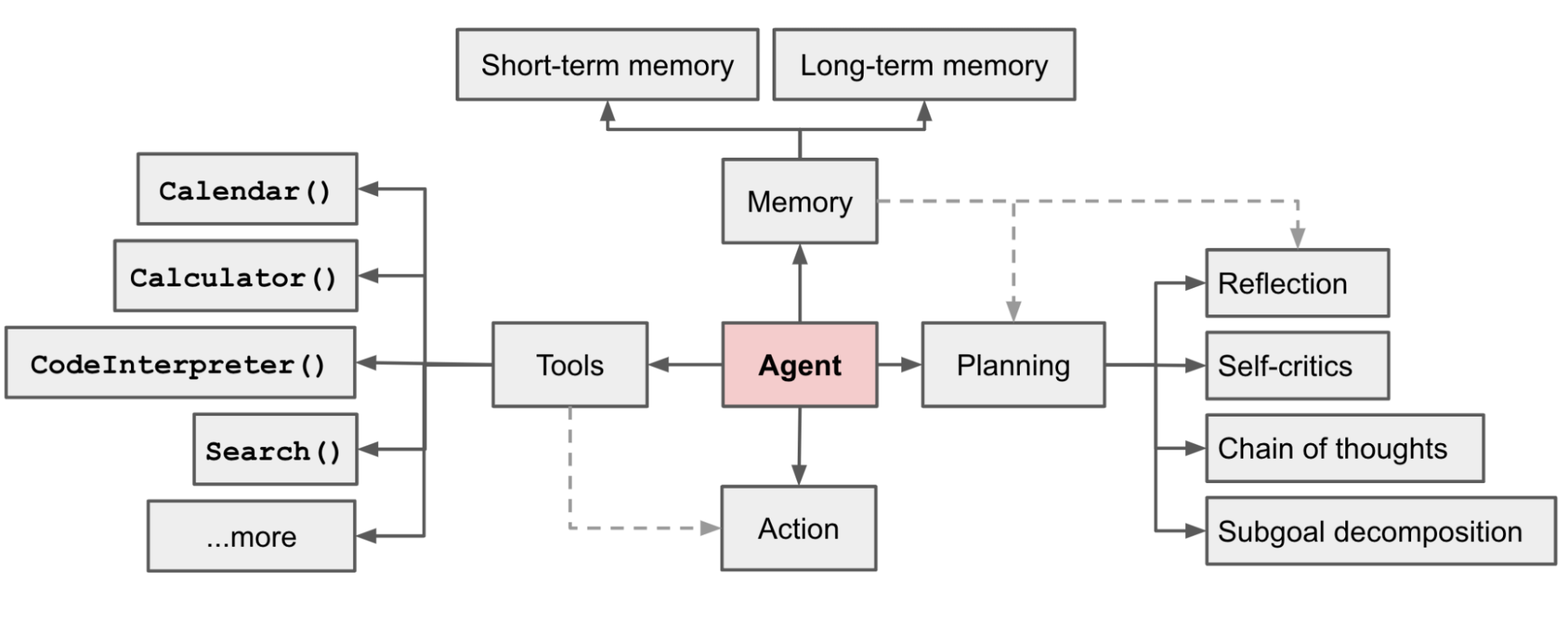
llm = ChatTongyi(model_name='qwen-vl-max')
image_message = {
"image": "https://lilianweng.github.io/posts/2023-06-23-agent/agent-overview.png"
}
text_message = {
"text": "summarize this picture",
}
message = HumanMessage(content=[text_message, image_message])
llm.invoke([message])
```
- **Issue:** None
- **Dependencies:** None
- **Twitter handle:** None
- if tap_output_iter/aiter is called multiple times for the same run
issue events only once
- if chat model run is tapped don't issue duplicate on_llm_new_token
events
- if first chunk arrives after run has ended do not emit it as a stream
event
---------
Co-authored-by: Eugene Yurtsev <eyurtsev@gmail.com>
Thank you for contributing to LangChain!
- [ ] **PR title**: "package: description"
- Where "package" is whichever of langchain, community, core,
experimental, etc. is being modified. Use "docs: ..." for purely docs
changes, "templates: ..." for template changes, "infra: ..." for CI
changes.
- Example: "community: add foobar LLM"
- [ ] **PR message**: ***Delete this entire checklist*** and replace
with
- **Description:** a description of the change
- **Issue:** the issue # it fixes, if applicable
- **Dependencies:** any dependencies required for this change
- **Twitter handle:** if your PR gets announced, and you'd like a
mention, we'll gladly shout you out!
- [ ] **Add tests and docs**: If you're adding a new integration, please
include
1. a test for the integration, preferably unit tests that do not rely on
network access,
2. an example notebook showing its use. It lives in
`docs/docs/integrations` directory.
- [ ] **Lint and test**: Run `make format`, `make lint` and `make test`
from the root of the package(s) you've modified. See contribution
guidelines for more: https://python.langchain.com/docs/contributing/
Additional guidelines:
- Make sure optional dependencies are imported within a function.
- Please do not add dependencies to pyproject.toml files (even optional
ones) unless they are required for unit tests.
- Most PRs should not touch more than one package.
- Changes should be backwards compatible.
- If you are adding something to community, do not re-import it in
langchain.
If no one reviews your PR within a few days, please @-mention one of
baskaryan, efriis, eyurtsev, ccurme, vbarda, hwchase17.
- `llm_chain` becomes `Union[LLMChain, Runnable]`
- `.from_llm` creates a runnable
tested by verifying that docs/how_to/MultiQueryRetriever.ipynb runs
unchanged with sync/async invoke (and that it runs if we specifically
instantiate with LLMChain).
We add a tool and retriever for the [AskNews](https://asknews.app)
platform with example notebooks.
The retriever can be invoked with:
```py
from langchain_community.retrievers import AskNewsRetriever
retriever = AskNewsRetriever(k=3)
retriever.invoke("impact of fed policy on the tech sector")
```
To retrieve 3 documents in then news related to fed policy impacts on
the tech sector. The included notebook also includes deeper details
about controlling filters such as category and time, as well as
including the retriever in a chain.
The tool is quite interesting, as it allows the agent to decide how to
obtain the news by forming a query and deciding how far back in time to
look for the news:
```py
from langchain_community.tools.asknews import AskNewsSearch
from langchain import hub
from langchain.agents import AgentExecutor, create_openai_functions_agent
from langchain_openai import ChatOpenAI
tool = AskNewsSearch()
instructions = """You are an assistant."""
base_prompt = hub.pull("langchain-ai/openai-functions-template")
prompt = base_prompt.partial(instructions=instructions)
llm = ChatOpenAI(temperature=0)
asknews_tool = AskNewsSearch()
tools = [asknews_tool]
agent = create_openai_functions_agent(llm, tools, prompt)
agent_executor = AgentExecutor(
agent=agent,
tools=tools,
verbose=True,
)
agent_executor.invoke({"input": "How is the tech sector being affected by fed policy?"})
```
---------
Co-authored-by: Emre <e@emre.pm>
Please let me know if you see any possible areas of improvement. I would
very much appreciate your constructive criticism if time allows.
**Description:**
- Added a aerospike vector store integration that utilizes
[Aerospike-Vector-Search](https://aerospike.com/products/vector-database-search-llm/)
add-on.
- Added both unit tests and integration tests
- Added a docker compose file for spinning up a test environment
- Added a notebook
**Dependencies:** any dependencies required for this change
- aerospike-vector-search
**Twitter handle:**
- No twitter, you can use my GitHub handle or LinkedIn if you'd like
Thanks!
---------
Co-authored-by: Jesse Schumacher <jschumacher@aerospike.com>
Co-authored-by: Bagatur <baskaryan@gmail.com>
Closes#20561
This PR fixes MLX LLM stream `AttributeError`.
Recently, `mlx-lm` changed the token decoding logic, which affected the
LC+MLX integration.
Additionally, I made minor fixes such as: docs example broken link and
enforcing pipeline arguments (max_tokens, temp and etc) for invoke.
- **Issue:** #20561
- **Twitter handle:** @Prince_Canuma
Related to #20085
@baskaryan
Thank you for contributing to LangChain!
community:sparkllm[patch]: standardized init args
updated `spark_api_key` so that aliased to `api_key`. Added integration
test for `sparkllm` to test that it continues to set the same underlying
attribute.
updated temperature with Pydantic Field, added to the integration test.
Ran `make format`,`make test`, `make lint`, `make spell_check`
UpTrain has a new dashboard now that makes it easier to view projects
and evaluations. Using this requires specifying both project_name and
evaluation_name when performing evaluations. I have updated the code to
support it.
Thank you for contributing to LangChain!
- [x] **PR title**: "community: enable SupabaseVectorStore to support
extended table fields"
- [x] **PR message**:
- Added extension fields to the function _add_vectors so that users can
add other custom fields when insert a record into the database. eg:

---------
Co-authored-by: Bagatur <baskaryan@gmail.com>
**Description**:
- Reference to `Collection` object is set to `None` when deleting a
collection `delete_collection()`
- Added utility method `reset_collection()` to allow recreating the
collection
- Moved collection creation out of `__init__` into
`__ensure_collection()` to be reused by object init and
`reset_collection()`
- `_collection` is now a property to avoid breaking changes
**Issues**:
- chroma-core/chroma#2213
**Twitter**: @t_azarov
Example error message:
line 206, in _get_python_function_required_args
if is_function_type and required[0] == "self":
~~~~~~~~^^^
IndexError: list index out of range
Thank you for contributing to LangChain!
- [x] **PR title**: "package: description"
- Where "package" is whichever of langchain, community, core,
experimental, etc. is being modified. Use "docs: ..." for purely docs
changes, "templates: ..." for template changes, "infra: ..." for CI
changes.
- Example: "community: add foobar LLM"
- [x] **PR message**: ***Delete this entire checklist*** and replace
with
- **Description:** a description of the change
- **Issue:** the issue # it fixes, if applicable
- **Dependencies:** any dependencies required for this change
- **Twitter handle:** if your PR gets announced, and you'd like a
mention, we'll gladly shout you out!
- [x] **Add tests and docs**: If you're adding a new integration, please
include
1. a test for the integration, preferably unit tests that do not rely on
network access,
2. an example notebook showing its use. It lives in
`docs/docs/integrations` directory.
- [x] **Lint and test**: Run `make format`, `make lint` and `make test`
from the root of the package(s) you've modified. See contribution
guidelines for more: https://python.langchain.com/docs/contributing/
Additional guidelines:
- Make sure optional dependencies are imported within a function.
- Please do not add dependencies to pyproject.toml files (even optional
ones) unless they are required for unit tests.
- Most PRs should not touch more than one package.
- Changes should be backwards compatible.
- If you are adding something to community, do not re-import it in
langchain.
If no one reviews your PR within a few days, please @-mention one of
baskaryan, efriis, eyurtsev, hwchase17.
---------
Co-authored-by: Bagatur <baskaryan@gmail.com>
While integrating the xinference_embedding, we observed that the
downloaded dependency package is quite substantial in size. With a focus
on resource optimization and efficiency, if the project requirements are
limited to its vector processing capabilities, we recommend migrating to
the xinference_client package. This package is more streamlined,
significantly reducing the storage space requirements of the project and
maintaining a feature focus, making it particularly suitable for
scenarios that demand lightweight integration. Such an approach not only
boosts deployment efficiency but also enhances the application's
maintainability, rendering it an optimal choice for our current context.
---------
Co-authored-by: Bagatur <baskaryan@gmail.com>
**Description:** Add `Origin/langchain` to Apify's client's user-agent
to attribute API activity to LangChain (at Apify, we aim to monitor our
integrations to evaluate whether we should invest more in the LangChain
integration regarding functionality and content)
**Issue:** None
**Dependencies:** None
**Twitter handle:** None
## Description
This PR implements local and dynamic mode in the Nomic Embed integration
using the inference_mode and device parameters. They work as documented
[here](https://docs.nomic.ai/reference/python-api/embeddings#local-inference).
<!-- If no one reviews your PR within a few days, please @-mention one
of baskaryan, efriis, eyurtsev, hwchase17. -->
---------
Co-authored-by: Erick Friis <erickfriis@gmail.com>
These packages all import `LangSmithParams` which was released in
langchain-core==0.2.0.
N.B. we will need to release `openai` and then bump `langchain-openai`
in `together` and `upstage`.
Thank you for contributing to LangChain!
- [x] **PR title**: "docs: update notebook for latest Pinecone API +
serverless"
- [x] **PR message**: Published notebook is incompatible with latest
`pinecone-client` and not runnable. Updated for use with latest Pinecone
Python SDK. Also updated to be compatible with serverless indexes (only
index type available on Pinecone free tier).
- [x] **Add tests and docs**: N/A (tested in Colab)
- [x] **Lint and test**: Run `make format`, `make lint` and `make test`
from the root of the package(s) you've modified. See contribution
guidelines for more: https://python.langchain.com/docs/contributing/
Additional guidelines:
- Make sure optional dependencies are imported within a function.
- Please do not add dependencies to pyproject.toml files (even optional
ones) unless they are required for unit tests.
- Most PRs should not touch more than one package.
- Changes should be backwards compatible.
- If you are adding something to community, do not re-import it in
langchain.
If no one reviews your PR within a few days, please @-mention one of
baskaryan, efriis, eyurtsev, hwchase17.
---
- To see the specific tasks where the Asana app for GitHub is being
used, see below:
- https://app.asana.com/0/0/1207328087952499
Thank you for contributing to LangChain!
- [x] **PR title**: "docs: update notebook for new Pinecone API +
serverless"
- [x] **PR message**: The published notebook is not runnable after
`pinecone-client` v2, which is deprecated. `langchain-pinecone` is not
compatible with the latest `pinecone-client` (v4), so I hardcoded it to
the last v3. Also updated for serverless indexes (only index type
available on Pinecone free plan).
- [x] **Add tests and docs**: N/A (tested in Colab)
- [x] **Lint and test**: Run `make format`, `make lint` and `make test`
from the root of the package(s) you've modified. See contribution
guidelines for more: https://python.langchain.com/docs/contributing/
Additional guidelines:
- Make sure optional dependencies are imported within a function.
- Please do not add dependencies to pyproject.toml files (even optional
ones) unless they are required for unit tests.
- Most PRs should not touch more than one package.
- Changes should be backwards compatible.
- If you are adding something to community, do not re-import it in
langchain.
If no one reviews your PR within a few days, please @-mention one of
baskaryan, efriis, eyurtsev, hwchase17.
---
- To see the specific tasks where the Asana app for GitHub is being
used, see below:
- https://app.asana.com/0/0/1207328087952500
This PR fixes two mistakes in the import paths from community for the
json data aiding the cli migration to 0.2.
It is intended as a quick follow-up to
https://github.com/langchain-ai/langchain/pull/21913 .
@nicoloboschi FYI
ChatOpenaAI --> ChatOpenAI
Thank you for contributing to LangChain!
- [ ] **PR title**: "package: description"
- Where "package" is whichever of langchain, community, core,
experimental, etc. is being modified. Use "docs: ..." for purely docs
changes, "templates: ..." for template changes, "infra: ..." for CI
changes.
- Example: "community: add foobar LLM"
- [ ] **PR message**: ***Delete this entire checklist*** and replace
with
- **Description:** a description of the change
- **Issue:** the issue # it fixes, if applicable
- **Dependencies:** any dependencies required for this change
- **Twitter handle:** if your PR gets announced, and you'd like a
mention, we'll gladly shout you out!
- [ ] **Add tests and docs**: If you're adding a new integration, please
include
1. a test for the integration, preferably unit tests that do not rely on
network access,
2. an example notebook showing its use. It lives in
`docs/docs/integrations` directory.
- [ ] **Lint and test**: Run `make format`, `make lint` and `make test`
from the root of the package(s) you've modified. See contribution
guidelines for more: https://python.langchain.com/docs/contributing/
Additional guidelines:
- Make sure optional dependencies are imported within a function.
- Please do not add dependencies to pyproject.toml files (even optional
ones) unless they are required for unit tests.
- Most PRs should not touch more than one package.
- Changes should be backwards compatible.
- If you are adding something to community, do not re-import it in
langchain.
If no one reviews your PR within a few days, please @-mention one of
baskaryan, efriis, eyurtsev, hwchase17.
Thank you for contributing to LangChain!
Remove unnecessary print from voyageai embeddings
- [x] **Lint and test**: Run `make format`, `make lint` and `make test`
from the root of the package(s) you've modified. See contribution
guidelines for more: https://python.langchain.com/docs/contributing/
If no one reviews your PR within a few days, please @-mention one of
baskaryan, efriis, eyurtsev, hwchase17.
- bind_tools interface is a better alternative.
- openai doesn't use functions but tools in its API now.
- the underlying content appears in some redirects, so will need to
investigate if we can remove.
Thank you for contributing to LangChain!
- [ ] **PR title**: "package: description"
- Where "package" is whichever of langchain, community, core,
experimental, etc. is being modified. Use "docs: ..." for purely docs
changes, "templates: ..." for template changes, "infra: ..." for CI
changes.
- Example: "community: add foobar LLM"
- [ ] **PR message**: ***Delete this entire checklist*** and replace
with
- **Description:** a description of the change
- **Issue:** the issue # it fixes, if applicable
- **Dependencies:** any dependencies required for this change
- **Twitter handle:** if your PR gets announced, and you'd like a
mention, we'll gladly shout you out!
- [ ] **Add tests and docs**: If you're adding a new integration, please
include
1. a test for the integration, preferably unit tests that do not rely on
network access,
2. an example notebook showing its use. It lives in
`docs/docs/integrations` directory.
- [ ] **Lint and test**: Run `make format`, `make lint` and `make test`
from the root of the package(s) you've modified. See contribution
guidelines for more: https://python.langchain.com/docs/contributing/
Additional guidelines:
- Make sure optional dependencies are imported within a function.
- Please do not add dependencies to pyproject.toml files (even optional
ones) unless they are required for unit tests.
- Most PRs should not touch more than one package.
- Changes should be backwards compatible.
- If you are adding something to community, do not re-import it in
langchain.
If no one reviews your PR within a few days, please @-mention one of
baskaryan, efriis, eyurtsev, hwchase17.
Check if event stream is closed in memory loop.
Using try/except here to avoid race condition, but this may incur a
small overhead in versions prios to 3.11
Update tool calling using prompts.
- Add required concepts
- Update names of tool invoking function.
- Add doc-string to function, and add information about `config` (which
users often forget)
- Remove steps that show how to use single function only. This makes the
how-to guide a bit shorter and more to the point.
- Add diagram from another how-to guide that shows how the thing works
overall.
Since the LangChain based on many research papers, the LC documentation
has several references to the arXiv papers. It would be beneficial to
create a single page with all referenced papers.
PR:
1. Developed code to search the arXiv references in the LangChain
Documentation and the LangChain code base. Those references are included
in a newly generated documentation page.
2. Page is linked to the Docs menu.
Controversial:
1. The `arxiv_references` page is automatically generated. But this
generation now started only manually. It is not included in the doc
generation scripts. The reason for this is simple. I don't want to
mangle into the current documentation refactoring. If you think, we need
to regenerate this page in each build, let me know. Note: This script
has a dependency on the `arxiv` package.
2. The link for this page in the menu is not obvious.
---------
Co-authored-by: Eugene Yurtsev <eyurtsev@gmail.com>
- **Code:** langchain_community/embeddings/baichuan.py:82
- **Description:** When I make an error using 'baichuan embeddings', the
printed error message is wrapped (there is actually no need to wrap)
```python
# example
from langchain_community.embeddings import BaichuanTextEmbeddings
# error key
BAICHUAN_API_KEY = "sk-xxxxxxxxxxxxx"
embeddings = BaichuanTextEmbeddings(baichuan_api_key=BAICHUAN_API_KEY)
text_1 = "今天天气不错"
query_result = embeddings.embed_query(text_1)
```

There are 2 issues fixed here:
* In the notebook pandas dataframes are formatted as HTML in the cells.
On the documentation site the renderer that converts notebooks
incorrectly displays the raw HTML. I can't find any examples of where
this is working and so I am formatting the dataframes as text.
* Some incorrect table names were referenced resulting in errors.
The only change is replacing the word "operators" with "operates," to
make the sentence grammatically correct.
Thank you for contributing to LangChain!
- [x] **PR title**: "docs: Made a grammatical correction in
streaming.ipynb to use the word "operates" instead of the word
"operators""
- [x] **PR message**:
- **Description:** The use of the word "operators" was incorrect, given
the context and grammar of the sentence. This PR updates the
documentation to use the word "operates" instead of the word
"operators".
- **Issue:** Makes the documentation more easily understandable.
- **Dependencies:** -no dependencies-
- **Twitter handle:** --
- [x] **Add tests and docs**: Since no new integration is being made, no
new tests/example notebooks are required.
- [x] **Lint and test**: Run `make format`, `make lint` and `make test`
from the root of the package(s) you've modified. See contribution
guidelines for more: https://python.langchain.com/docs/contributing/
- **No formatting changes made to the documentation**
Additional guidelines:
- Make sure optional dependencies are imported within a function.
- Please do not add dependencies to pyproject.toml files (even optional
ones) unless they are required for unit tests.
- Most PRs should not touch more than one package.
- Changes should be backwards compatible.
- If you are adding something to community, do not re-import it in
langchain.
If no one reviews your PR within a few days, please @-mention one of
baskaryan, efriis, eyurtsev, hwchase17.
- Remove double implementations of functions. The single input is just
taking up space.
- Added tool specific information for `async + showing invoke vs.
ainvoke.
- Added more general information about about `async` (this should live
in a different place eventually since it's not specific to tools).
- Changed ordering of custom tools (StructuredTool is simpler and should
appear before the inheritance)
- Improved the error handling section (not convinced it should be here
though)
- Add information about naitve tool calling capabilities
- Add information about standard langchain interface for tool calling
- Update description for tools
---------
Co-authored-by: ccurme <chester.curme@gmail.com>
This PR improves on the `CassandraCache` and `CassandraSemanticCache`
classes, mainly in the constructor signature, and also introduces
several minor improvements around these classes.
### Init signature
A (sigh) breaking change is tentatively introduced to the constructor.
To me, the advantages outweigh the possible discomfort: the new syntax
places the DB-connection objects `session` and `keyspace` later in the
param list, so that they can be given a default value. This is what
enables the pattern of _not_ specifying them, provided one has
previously initialized the Cassandra connection through the versatile
utility method `cassio.init(...)`.
In this way, a much less unwieldy instantiation can be done, such as
`CassandraCache()` and `CassandraSemanticCache(embedding=xyz)`,
everything else falling back to defaults.
A downside is that, compared to the earlier signature, this might turn
out to be breaking for those doing positional instantiation. As a way to
mitigate this problem, this PR typechecks its first argument trying to
detect the legacy usage.
(And to make this point less tricky in the future, most arguments are
left to be keyword-only).
If this is considered too harsh, I'd like guidance on how to further
smoothen this transition. **Our plan is to make the pattern of optional
session/keyspace a standard across all Cassandra classes**, so that a
repeatable strategy would be ideal. A possibility would be to keep
positional arguments for legacy reasons but issue a deprecation warning
if any of them is actually used, to later remove them with 0.2 - please
advise on this point.
### Other changes
- class docstrings: enriched, completely moved to class level, added
note on `cassio.init(...)` pattern, added tiny sample usage code.
- semantic cache: revised terminology to never mention "distance" (it is
in fact a similarity!). Kept the legacy constructor param with a
deprecation warning if used.
- `llm_caching` notebook: uniform flow with the Cassandra and Astra DB
separate cases; better and Cassandra-first description; all imports made
explicit and from community where appropriate.
- cache integration tests moved to community (incl. the imported tools),
env var bugfix for `CASSANDRA_CONTACT_POINTS`.
---------
Co-authored-by: Erick Friis <erick@langchain.dev>
## Patch Summary
community:openai[patch]: standardize init args
## Details
I made changes to the OpenAI Chat API wrapper test in the Langchain
open-source repository
- **File**: `libs/community/tests/unit_tests/chat_models/test_openai.py`
- **Changes**:
- Updated `max_retries` with Pydantic Field
- Updated the corresponding unit test
- **Related Issues**: #20085
- Updated max_retries with Pydantic Field, updated the unit test.
---------
Co-authored-by: JuHyung Son <sonju0427@gmail.com>
Thank you for contributing to LangChain!
- [x] **PR title**: "community: updated Browserbase loader"
- [x] **PR message**:
Updates the Browserbase loader with more options and improved docs.
- [x] **Lint and test**: Run `make format`, `make lint` and `make test`
from the root of the package(s) you've modified. See contribution
guidelines for more: https://python.langchain.com/docs/contributing/
Do not prefix function signature
---
* Reason for this is that information is already present with tool
calling models.
* This will save on tokens for those models, and makes it more obvious
what the description is!
* The @tool can get more parameters to allow a user to re-introduce the
the signature if we want
To permit proper coercion of objects like the following:
```python
class MyAsyncCallable:
async def __call__(self, foo):
return await ...
class MyAsyncGenerator:
async def __call__(self, foo):
await ...
yield
```
This PR introduces a v2 implementation of astream events that removes
intermediate abstractions and fixes some issues with v1 implementation.
The v2 implementation significantly reduces relevant code that's
associated with the astream events implementation together with
overhead.
After this PR, the astream events implementation:
- Uses an async callback handler
- No longer relies on BaseTracer
- No longer relies on json patch
As a result of this re-write, a number of issues were discovered with
the existing implementation.
## Changes in V2 vs. V1
### on_chat_model_end `output`
The outputs associated with `on_chat_model_end` changed depending on
whether it was within a chain or not.
As a root level runnable the output was:
```python
"data": {"output": AIMessageChunk(content="hello world!", id='some id')}
```
As part of a chain the output was:
```
"data": {
"output": {
"generations": [
[
{
"generation_info": None,
"message": AIMessageChunk(
content="hello world!", id=AnyStr()
),
"text": "hello world!",
"type": "ChatGenerationChunk",
}
]
],
"llm_output": None,
}
},
```
After this PR, we will always use the simpler representation:
```python
"data": {"output": AIMessageChunk(content="hello world!", id='some id')}
```
**NOTE** Non chat models (i.e., regular LLMs) are still associated with
the more verbose format.
### Remove some `_stream` events
`on_retriever_stream` and `on_tool_stream` events were removed -- these
were not real events, but created as an artifact of implementing on top
of astream_log.
The same information is already available in the `x_on_end` events.
### Propagating Names
Names of runnables have been updated to be more consistent
```python
model = GenericFakeChatModel(messages=infinite_cycle).configurable_fields(
messages=ConfigurableField(
id="messages",
name="Messages",
description="Messages return by the LLM",
)
)
```
Before:
```python
"name": "RunnableConfigurableFields",
```
After:
```python
"name": "GenericFakeChatModel",
```
### on_retriever_end
on_retriever_end will always return `output` which is a list of
documents (rather than a dict containing a key called "documents")
### Retry events
Removed the `on_retry` callback handler. It was incorrectly showing that
the failed function being retried has invoked `on_chain_end`
https://github.com/langchain-ai/langchain/pull/21638/files#diff-e512e3f84daf23029ebcceb11460f1c82056314653673e450a5831147d8cb84dL1394
Add unit tests that show differences between sync / async versions when
streaming.
The inner on_chain_chunk event is missing if mixing sync and async
functionality. Likely due to missing tap_output_iter implementation on
the sync variant of `_transform_stream_with_config`
0.2 is not a breaking release for core (but it is for langchain and
community)
To keep the core+langchain+community packages in sync at 0.2, we will
relax deps throughout the ecosystem to tolerate `langchain-core` 0.2
## Description
This PR introduces the new `langchain-qdrant` partner package, intending
to deprecate the community package.
## Changes
- Moved the Qdrant vector store implementation `/libs/partners/qdrant`
with integration tests.
- The conditional imports of the client library are now regular with
minor implementation improvements.
- Added a deprecation warning to
`langchain_community.vectorstores.qdrant.Qdrant`.
- Replaced references/imports from `langchain_community` with either
`langchain_core` or by moving the definitions to the `langchain_qdrant`
package itself.
- Updated the Qdrant vector store documentation to reflect the changes.
## Testing
- `QDRANT_URL` and
[`QDRANT_API_KEY`](583e36bf6b)
env values need to be set to [run integration
tests](d608c93d1f)
in the [cloud](https://cloud.qdrant.tech).
- If a Qdrant instance is running at `http://localhost:6333`, the
integration tests will use it too.
- By default, tests use an
[`in-memory`](https://github.com/qdrant/qdrant-client?tab=readme-ov-file#local-mode)
instance(Not comprehensive).
---------
Co-authored-by: Erick Friis <erick@langchain.dev>
Co-authored-by: Erick Friis <erickfriis@gmail.com>
This PR makes some small updates for `KuzuQAChain` for graph QA.
- Updated Cypher generation prompt (we now support `WHERE EXISTS`) and
generalize it more
- Support different LLMs for Cypher generation and QA
- Update docs and examples
- Adds Techniques section
- Moves function calling, retrieval types to Techniques
- Removes Installation section (not conceptual)
- Reorders a few things (chat models before llms, package descriptions
before diagram)
- Add text splitter types to Techniques
First Pr for the langchain_huggingface partner Package
- Moved some of the hugging face related class from `community` to the
new `partner package`
Still needed :
- Documentation
- Tests
- Support for the new apply_chat_template in `ChatHuggingFace`
- Confirm choice of class to support for embeddings witht he
sentence-transformer team.
cc : @efriis
---------
Co-authored-by: Cyril Kondratenko <kkn1993@gmail.com>
Co-authored-by: Erick Friis <erick@langchain.dev>
- Introduce the `merge_and_split` function in the
`UpstageLayoutAnalysisLoader`.
- The `merge_and_split` function takes a list of documents and a
splitter as inputs.
- This function merges all documents and then divides them using the
`split_documents` method, which is a proprietary function of the
splitter.
- If the provided splitter is `None` (which is the default setting), the
function will simply merge the documents without splitting them.
- Make sure the left nav bar is horizontally scrollable
- Make sure the navigation dropdown is vertically scrollable and height
capped at 80% of viewport height
---------
Co-authored-by: Bagatur <baskaryan@gmail.com>
Thank you for contributing to LangChain!
- [ ] **PR title**: "package: description"
- Where "package" is whichever of langchain, community, core,
experimental, etc. is being modified. Use "docs: ..." for purely docs
changes, "templates: ..." for template changes, "infra: ..." for CI
changes.
- Example: "community: add foobar LLM"
- [ ] **PR message**: ***Delete this entire checklist*** and replace
with
- **Description:** a description of the change
- **Issue:** the issue # it fixes, if applicable
- **Dependencies:** any dependencies required for this change
- **Twitter handle:** if your PR gets announced, and you'd like a
mention, we'll gladly shout you out!
- [ ] **Add tests and docs**: If you're adding a new integration, please
include
1. a test for the integration, preferably unit tests that do not rely on
network access,
2. an example notebook showing its use. It lives in
`docs/docs/integrations` directory.
- [ ] **Lint and test**: Run `make format`, `make lint` and `make test`
from the root of the package(s) you've modified. See contribution
guidelines for more: https://python.langchain.com/docs/contributing/
Additional guidelines:
- Make sure optional dependencies are imported within a function.
- Please do not add dependencies to pyproject.toml files (even optional
ones) unless they are required for unit tests.
- Most PRs should not touch more than one package.
- Changes should be backwards compatible.
- If you are adding something to community, do not re-import it in
langchain.
If no one reviews your PR within a few days, please @-mention one of
baskaryan, efriis, eyurtsev, hwchase17.
Adds a Python REPL that executes code in a code interpreter session
using Azure Container Apps dynamic sessions.
---------
Co-authored-by: Erick Friis <erick@langchain.dev>
Thank you for contributing to LangChain!
- [X] **PR title**: "community: Add source metadata to bedrock retriever
response"
- [X] **PR message**:
- **Description:** Bedrock retrieve API returns extra metadata in the
response which is currently not returned in the retriever response
- **Issue:** The change adds the metadata from bedrock retrieve API
response to the bedrock retriever in a backward compatible way. Renamed
metadata to sourceMetadata as metadata term is being used in the
Document already. This is in sync with what we are doing in llama-index
as well.
- **Dependencies:** No
- [X] **Add tests and docs**:
1. Added unit tests
2. Notebook already exists and does not need any change
3. Response from end to end testing, just to ensure backward
compatibility: `[Document(page_content='Exoplanets.',
metadata={'location': {'s3Location': {'uri':
's3://bucket/file_name.txt'}, 'type': 'S3'}, 'score': 0.46886647,
'source_metadata': {'x-amz-bedrock-kb-source-uri':
's3://bucket/file_name.txt', 'tag': 'space', 'team': 'Nasa', 'year':
1946.0}})]`
- [X] **Lint and test**: Run `make format`, `make lint` and `make test`
from the root of the package(s) you've modified. See contribution
guidelines for more: https://python.langchain.com/docs/contributing/
Additional guidelines:
- Make sure optional dependencies are imported within a function.
- Please do not add dependencies to pyproject.toml files (even optional
ones) unless they are required for unit tests.
- Most PRs should not touch more than one package.
- Changes should be backwards compatible.
- If you are adding something to community, do not re-import it in
langchain.
If no one reviews your PR within a few days, please @-mention one of
baskaryan, efriis, eyurtsev, hwchase17.
---------
Co-authored-by: Piyush Jain <piyushjain@duck.com>
**Description:** Added a few additional arguments to the whisper parser,
which can be consumed by the underlying API.
The prompt is especially important to fine-tune transcriptions.
---------
Co-authored-by: Roi Perlman <roi@fivesigmalabs.com>
Co-authored-by: Bagatur <22008038+baskaryan@users.noreply.github.com>
Co-authored-by: Bagatur <baskaryan@gmail.com>
**Description:**
This PR introduces chunking logic to the `DeepInfraEmbeddings` class to
handle large batch sizes without exceeding maximum batch size of the
backend. This enhancement ensures that embedding generation processes
large batches by breaking them down into smaller, manageable chunks,
each conforming to the maximum batch size limit.
**Issue:**
Fixes#21189
**Dependencies:**
No new dependencies introduced.
- Added new document_transformer: MarkdonifyTransformer, that uses
`markdonify` package with customizable options to convert HTML to
Markdown. It's similar to Html2TextTransformer, but has more flexible
options and also I've noticed that sometimes MarkdownifyTransformer
performs better than html2text one, so that's why I use markdownify on
my project.
- Added docs and tests
- Usage:
```python
from langchain_community.document_transformers import MarkdownifyTransformer
markdownify = MarkdownifyTransformer()
docs_transform = markdownify.transform_documents(docs)
```
- Example of better performance on simple task, that I've noticed:
```
<html>
<head><title>Reports on product movement</title></head>
<body>
<p data-block-key="2wst7">The reports on product movement will be useful for forming supplier orders and controlling outcomes.</p>
</body>
```
**Html2TextTransformer**:
```python
[Document(page_content='The reports on product movement will be useful for forming supplier orders and\ncontrolling outcomes.\n\n')]
# Here we can see 'and\ncontrolling', which has extra '\n' in it
```
**MarkdownifyTranformer**:
```python
[Document(page_content='Reports on product movement\n\nThe reports on product movement will be useful for forming supplier orders and controlling outcomes.')]
```
---------
Co-authored-by: Sokolov Fedor <f.sokolov@sokolov-macbook.bbrouter>
Co-authored-by: Harrison Chase <hw.chase.17@gmail.com>
Co-authored-by: Sokolov Fedor <f.sokolov@sokolov-macbook.local>
Co-authored-by: Sokolov Fedor <f.sokolov@192.168.1.6>
### GPT4AllEmbeddings parameters
---
**Description:**
As of right now the **Embed4All** class inside _GPT4AllEmbeddings_ is
instantiated as it's default which leaves no room to customize the
chosen model and it's behavior. Thus:
- GPT4AllEmbeddings can now be instantiated with custom parameters like
a different model that shall be used.
---------
Co-authored-by: AlexJauchWalser <alexander.jauch-walser@knime.com>
The `_amake_session()` method does not allow modifying the
`self.session_factory` with
anything other than `async_sessionmaker`. This prohibits advanced uses
of `index()`.
In a RAG architecture, it is necessary to import document chunks.
To keep track of the links between chunks and documents, we can use the
`index()` API.
This API proposes to use an SQL-type record manager.
In a classic use case, using `SQLRecordManager` and a vector database,
it is impossible
to guarantee the consistency of the import. Indeed, if a crash occurs
during the import
(problem with the network, ...)
there is an inconsistency between the SQL database and the vector
database.
With the
[PR](https://github.com/langchain-ai/langchain-postgres/pull/32) we are
proposing for `langchain-postgres`,
it is now possible to guarantee the consistency of the import of chunks
into
a vector database. It's possible only if the outer session is built
with the connection.
```python
def main():
db_url = "postgresql+psycopg://postgres:password_postgres@localhost:5432/"
engine = create_engine(db_url, echo=True)
embeddings = FakeEmbeddings()
pgvector:VectorStore = PGVector(
embeddings=embeddings,
connection=engine,
)
record_manager = SQLRecordManager(
namespace="namespace",
engine=engine,
)
record_manager.create_schema()
with engine.connect() as connection:
session_maker = scoped_session(sessionmaker(bind=connection))
# NOTE: Update session_factories
record_manager.session_factory = session_maker
pgvector.session_maker = session_maker
with connection.begin():
loader = CSVLoader(
"data/faq/faq.csv",
source_column="source",
autodetect_encoding=True,
)
result = index(
source_id_key="source",
docs_source=loader.load()[:1],
cleanup="incremental",
vector_store=pgvector,
record_manager=record_manager,
)
print(result)
```
The same thing is possible asynchronously, but a bug in
`sql_record_manager.py`
in `_amake_session()` must first be fixed.
```python
async def _amake_session(self) -> AsyncGenerator[AsyncSession, None]:
"""Create a session and close it after use."""
# FIXME: REMOVE if not isinstance(self.session_factory, async_sessionmaker):~~
if not isinstance(self.engine, AsyncEngine):
raise AssertionError("This method is not supported for sync engines.")
async with self.session_factory() as session:
yield session
```
Then, it is possible to do the same thing asynchronously:
```python
async def main():
db_url = "postgresql+psycopg://postgres:password_postgres@localhost:5432/"
engine = create_async_engine(db_url, echo=True)
embeddings = FakeEmbeddings()
pgvector:VectorStore = PGVector(
embeddings=embeddings,
connection=engine,
)
record_manager = SQLRecordManager(
namespace="namespace",
engine=engine,
async_mode=True,
)
await record_manager.acreate_schema()
async with engine.connect() as connection:
session_maker = async_scoped_session(
async_sessionmaker(bind=connection),
scopefunc=current_task)
record_manager.session_factory = session_maker
pgvector.session_maker = session_maker
async with connection.begin():
loader = CSVLoader(
"data/faq/faq.csv",
source_column="source",
autodetect_encoding=True,
)
result = await aindex(
source_id_key="source",
docs_source=loader.load()[:1],
cleanup="incremental",
vector_store=pgvector,
record_manager=record_manager,
)
print(result)
asyncio.run(main())
```
---------
Signed-off-by: Rahul Tripathi <rauhl.psit.ec@gmail.com>
Co-authored-by: Bagatur <22008038+baskaryan@users.noreply.github.com>
Co-authored-by: Sean <sean@upstage.ai>
Co-authored-by: JuHyung-Son <sonju0427@gmail.com>
Co-authored-by: Erick Friis <erick@langchain.dev>
Co-authored-by: YISH <mokeyish@hotmail.com>
Co-authored-by: Bagatur <baskaryan@gmail.com>
Co-authored-by: Jason_Chen <820542443@qq.com>
Co-authored-by: Joan Fontanals <joan.fontanals.martinez@jina.ai>
Co-authored-by: Pavlo Paliychuk <pavlo.paliychuk.ca@gmail.com>
Co-authored-by: fzowl <160063452+fzowl@users.noreply.github.com>
Co-authored-by: samanhappy <samanhappy@gmail.com>
Co-authored-by: Lei Zhang <zhanglei@apache.org>
Co-authored-by: Tomaz Bratanic <bratanic.tomaz@gmail.com>
Co-authored-by: merdan <48309329+merdan-9@users.noreply.github.com>
Co-authored-by: ccurme <chester.curme@gmail.com>
Co-authored-by: Andres Algaba <andresalgaba@gmail.com>
Co-authored-by: davidefantiniIntel <115252273+davidefantiniIntel@users.noreply.github.com>
Co-authored-by: Jingpan Xiong <71321890+klaus-xiong@users.noreply.github.com>
Co-authored-by: kaka <kaka@zbyte-inc.cloud>
Co-authored-by: jingsi <jingsi@leadincloud.com>
Co-authored-by: Eugene Yurtsev <eyurtsev@gmail.com>
Co-authored-by: Rahul Triptahi <rahul.psit.ec@gmail.com>
Co-authored-by: Rahul Tripathi <rauhl.psit.ec@gmail.com>
Co-authored-by: Shengsheng Huang <shannie.huang@gmail.com>
Co-authored-by: Michael Schock <mjschock@users.noreply.github.com>
Co-authored-by: Anish Chakraborty <anish749@users.noreply.github.com>
Co-authored-by: am-kinetica <85610855+am-kinetica@users.noreply.github.com>
Co-authored-by: Dristy Srivastava <58721149+dristysrivastava@users.noreply.github.com>
Co-authored-by: Matt <matthew.gotteiner@microsoft.com>
Co-authored-by: William FH <13333726+hinthornw@users.noreply.github.com>
- **Description:** Fix import class name exporeted from
'playwright.async_api' and 'playwright.sync_api' to match the correct
name in playwright tool. Change import from inline guard_import to
helper function that calls guard_import to make code more readable in
gmail tool. Upgrade playwright version to 1.43.0
- **Issue:** #21354
- **Dependencies:** upgrade playwright version(this is not required for
the bugfix itself, just trying to keep dependencies fresh. I can remove
the playwright version upgrade if you want.)
Thank you for contributing to LangChain!
- [ ] **PR title**: "package: description"
- Where "package" is whichever of langchain, community, core,
experimental, etc. is being modified. Use "docs: ..." for purely docs
changes, "templates: ..." for template changes, "infra: ..." for CI
changes.
- Example: "community: add foobar LLM"
- [ ] **PR message**: ***Delete this entire checklist*** and replace
with
- **Description:** a description of the change
- **Issue:** the issue # it fixes, if applicable
- **Dependencies:** any dependencies required for this change
- **Twitter handle:** if your PR gets announced, and you'd like a
mention, we'll gladly shout you out!
- [ ] **Add tests and docs**: If you're adding a new integration, please
include
1. a test for the integration, preferably unit tests that do not rely on
network access,
2. an example notebook showing its use. It lives in
`docs/docs/integrations` directory.
- [ ] **Lint and test**: Run `make format`, `make lint` and `make test`
from the root of the package(s) you've modified. See contribution
guidelines for more: https://python.langchain.com/docs/contributing/
Additional guidelines:
- Make sure optional dependencies are imported within a function.
- Please do not add dependencies to pyproject.toml files (even optional
ones) unless they are required for unit tests.
- Most PRs should not touch more than one package.
- Changes should be backwards compatible.
- If you are adding something to community, do not re-import it in
langchain.
If no one reviews your PR within a few days, please @-mention one of
baskaryan, efriis, eyurtsev, hwchase17.
0.2rc
migrations
- [x] Move memory
- [x] Move remaining retrievers
- [x] graph_qa chains
- [x] some dependency from evaluation code potentially on math utils
- [x] Move openapi chain from `langchain.chains.api.openapi` to
`langchain_community.chains.openapi`
- [x] Migrate `langchain.chains.ernie_functions` to
`langchain_community.chains.ernie_functions`
- [x] migrate `langchain/chains/llm_requests.py` to
`langchain_community.chains.llm_requests`
- [x] Moving `langchain_community.cross_enoders.base:BaseCrossEncoder`
->
`langchain_community.retrievers.document_compressors.cross_encoder:BaseCrossEncoder`
(namespace not ideal, but it needs to be moved to `langchain` to avoid
circular deps)
- [x] unit tests langchain -- add pytest.mark.community to some unit
tests that will stay in langchain
- [x] unit tests community -- move unit tests that depend on community
to community
- [x] mv integration tests that depend on community to community
- [x] mypy checks
Other todo
- [x] Make deprecation warnings not noisy (need to use warn deprecated
and check that things are implemented properly)
- [x] Update deprecation messages with timeline for code removal (likely
we actually won't be removing things until 0.4 release) -- will give
people more time to transition their code.
- [ ] Add information to deprecation warning to show users how to
migrate their code base using langchain-cli
- [ ] Remove any unnecessary requirements in langchain (e.g., is
SQLALchemy required?)
---------
Co-authored-by: Erick Friis <erick@langchain.dev>
Robocorp (action server) toolkit had a limitation that the content
length returned by the tool was always cut to max 5000 chars. This was
from the time when context windows were much more limited.
This PR removes the limitation. Whatever the underlying tool provides
gets sent back to the agent.
As the robocorp toolkit no longer restricts the content, the implication
is that either the Action (tool) developer or the agent developer needs
to be aware of potentially oversized tool responses. Our point of view
is this should be the agent developer's responsibility, them being in
control of the use case and aware of the context window the LLM has.
Description: We are merging UPSTAGE_DOCUMENT_AI_API_KEY and
UPSTAGE_API_KEY into one, and only UPSTAGE_API_KEY will be used going
forward. And we changed the base class of ChatUpstage to BaseChatOpenAI.
---------
Co-authored-by: Sean <chosh0615@gmail.com>
Co-authored-by: Erick Friis <erick@langchain.dev>
Thank you for contributing to LangChain!
- [x] **PR title**: "langchain-ibm: Fix llm and embeddings 'verify'
attribute default value"
- [x] **PR message**:
- **Description:** fix default value of "verify" attribute
- **Dependencies:** `ibm_watsonx_ai`
- [x] **Add tests and docs**: If you're adding a new integration, please
include
1. a test for the integration, preferably unit tests that do not rely on
network access,
2. an example notebook showing its use. It lives in
`docs/docs/integrations` directory.
- [x] **Lint and test**: Run `make format`, `make lint` and `make test`
from the root of the package(s) you've modified. See contribution
guidelines for more: https://python.langchain.com/docs/contributing/
Co-authored-by: Erick Friis <erick@langchain.dev>
…Endpoint`
Thank you for contributing to LangChain!
- [x] **PR title**: "package: description"
- Where "package" is whichever of langchain, community, core,
experimental, etc. is being modified. Use "docs: ..." for purely docs
changes, "templates: ..." for template changes, "infra: ..." for CI
changes.
- Example: "community: add foobar LLM"
- [x] **PR message**: ***Delete this entire checklist*** and replace
with
- **Description:** add `bind_tools` and `with_structured_output` support
to `QianfanChatEndpoint`
- [x] **Lint and test**: Run `make format`, `make lint` and `make test`
from the root of the package(s) you've modified. See contribution
guidelines for more: https://python.langchain.com/docs/contributing/
- Added Together docs in chat models section
- Update Together provider docs to match the LLM & chat models sections
---------
Co-authored-by: Erick Friis <erick@langchain.dev>
This is a doc update. It fixes up formatting and product name
references. The example code is updated to use a local built-in text
file.
@mmhangami Please take a look
---------
Co-authored-by: Harrison Chase <hw.chase.17@gmail.com>
**Description:** Updated the together integration docs by leading with
the streaming example, explicitly specifying a model to show users how
to do that, and updating the sections to more closely match other
integrations.
Description: This PR includes fix for loader_source to be fetched from
metadata in case of GdriveLoaders.
Documentation: NA
Unit Test: NA
Signed-off-by: Rahul Tripathi <rauhl.psit.ec@gmail.com>
Co-authored-by: Rahul Tripathi <rauhl.psit.ec@gmail.com>
- it's only node ids that are limited
Thank you for contributing to LangChain!
- [ ] **PR title**: "package: description"
- Where "package" is whichever of langchain, community, core,
experimental, etc. is being modified. Use "docs: ..." for purely docs
changes, "templates: ..." for template changes, "infra: ..." for CI
changes.
- Example: "community: add foobar LLM"
- [ ] **PR message**: ***Delete this entire checklist*** and replace
with
- **Description:** a description of the change
- **Issue:** the issue # it fixes, if applicable
- **Dependencies:** any dependencies required for this change
- **Twitter handle:** if your PR gets announced, and you'd like a
mention, we'll gladly shout you out!
- [ ] **Add tests and docs**: If you're adding a new integration, please
include
1. a test for the integration, preferably unit tests that do not rely on
network access,
2. an example notebook showing its use. It lives in
`docs/docs/integrations` directory.
- [ ] **Lint and test**: Run `make format`, `make lint` and `make test`
from the root of the package(s) you've modified. See contribution
guidelines for more: https://python.langchain.com/docs/contributing/
Additional guidelines:
- Make sure optional dependencies are imported within a function.
- Please do not add dependencies to pyproject.toml files (even optional
ones) unless they are required for unit tests.
- Most PRs should not touch more than one package.
- Changes should be backwards compatible.
- If you are adding something to community, do not re-import it in
langchain.
If no one reviews your PR within a few days, please @-mention one of
baskaryan, efriis, eyurtsev, hwchase17.
Thank you for contributing to LangChain!
- [ ] **HuggingFaceInferenceAPIEmbeddings**: "Additional Headers"
- Where: langchain, community, embeddings. huggingface.py.
- Community: add additional headers when needed by custom HuggingFace
TEI embedding endpoints. HuggingFaceInferenceAPIEmbeddings"
- [ ] **PR message**: ***Delete this entire checklist*** and replace
with
- **Description:** Adding the `additional_headers` to be passed to
requests library if needed
- **Dependencies:** none
- [ ] **Add tests and docs**: If you're adding a new integration, please
include
1. Tested with locally available TEI endpoints with and without
`additional_headers`
2. Example Usage
```python
embeddings=HuggingFaceInferenceAPIEmbeddings(
api_key=MY_CUSTOM_API_KEY,
api_url=MY_CUSTOM_TEI_URL,
additional_headers={
"Content-Type": "application/json"
}
)
```
Additional guidelines:
- Make sure optional dependencies are imported within a function.
- Please do not add dependencies to pyproject.toml files (even optional
ones) unless they are required for unit tests.
- Most PRs should not touch more than one package.
- Changes should be backwards compatible.
- If you are adding something to community, do not re-import it in
langchain.
If no one reviews your PR within a few days, please @-mention one of
baskaryan, efriis, eyurtsev, hwchase17.
---------
Co-authored-by: Massimiliano Pronesti <massimiliano.pronesti@gmail.com>
Co-authored-by: Harrison Chase <hw.chase.17@gmail.com>
**Description:** Adding chat completions to the Together AI package,
which is our most popular API. Also staying backwards compatible with
the old API so folks can continue to use the completions API as well.
Also moved the embedding API to use the OpenAI library to standardize it
further.
**Twitter handle:** @nutlope
- [x] **Add tests and docs**: If you're adding a new integration, please
include
- [x] **Lint and test**: Run `make format`, `make lint` and `make test`
from the root of the package(s) you've modified. See contribution
guidelines for more: https://python.langchain.com/docs/contributing/
If no one reviews your PR within a few days, please @-mention one of
baskaryan, efriis, eyurtsev, hwchase17.
---------
Co-authored-by: Erick Friis <erick@langchain.dev>
[Standardized model init args
#20085](https://github.com/langchain-ai/langchain/issues/20085)
- Enable premai chat model to be initialized with `model_name` as an
alias for `model`, `api_key` as an alias for `premai_api_key`.
- Add initialization test `test_premai_initialization`
---------
Co-authored-by: Chester Curme <chester.curme@gmail.com>
Thank you for contributing to LangChain!
- [ ] **PR title**: "package: description"
- Where "package" is whichever of langchain, community, core,
experimental, etc. is being modified. Use "docs: ..." for purely docs
changes, "templates: ..." for template changes, "infra: ..." for CI
changes.
- Example: "community: add foobar LLM"
- [ ] **PR message**: ***Delete this entire checklist*** and replace
with
- **Description:** a description of the change
- **Issue:** the issue # it fixes, if applicable
- **Dependencies:** any dependencies required for this change
- **Twitter handle:** if your PR gets announced, and you'd like a
mention, we'll gladly shout you out!
- [ ] **Add tests and docs**: If you're adding a new integration, please
include
1. a test for the integration, preferably unit tests that do not rely on
network access,
2. an example notebook showing its use. It lives in
`docs/docs/integrations` directory.
- [ ] **Lint and test**: Run `make format`, `make lint` and `make test`
from the root of the package(s) you've modified. See contribution
guidelines for more: https://python.langchain.com/docs/contributing/
Additional guidelines:
- Make sure optional dependencies are imported within a function.
- Please do not add dependencies to pyproject.toml files (even optional
ones) unless they are required for unit tests.
- Most PRs should not touch more than one package.
- Changes should be backwards compatible.
- If you are adding something to community, do not re-import it in
langchain.
If no one reviews your PR within a few days, please @-mention one of
baskaryan, efriis, eyurtsev, hwchase17.
- **Description:** fix: variable names in root validator not allowing
pass credentials as named parameters in llm instancing, also added
sambanova's sambaverse and sambastudio llms to __init__.py for module
import
Description: this change adds args_schema (pydantic BaseModel) to
YahooFinanceNewsTool for correct schema formatting on LLM function calls
Issue: currently using YahooFinanceNewsTool with OpenAI function calling
returns the following error "TypeError("YahooFinanceNewsTool._run() got
an unexpected keyword argument '__arg1'")". This happens because the
schema sent to the LLM is "input: "{'__arg1': 'MSFT'}"" while the method
should be called with the "query" parameter.
Co-authored-by: Bagatur <22008038+baskaryan@users.noreply.github.com>
Issue: `load_qa_chain` is placed in the __init__.py file. As a result,
it is not listed in the API Reference docs.
BTW `load_qa_chain` is heavily presented in the doc examples, but is
missed in API Ref.
Change: moved code from init.py into a new file. Related: #21266
Reverts langchain-ai/langchain#21174
Hey team - going to revert this because it doesn't seem necessary for
testing. We should only be adding optional + extended_testing
dependencies for deps that have extended tests.
otherwise it just increases probability of dependency conflicts in the
community lockfile.
Thank you for contributing to LangChain!
community:baichuan[patch]: standardize init args
updated `baichuan_api_key` so that aliased to `api_key`. Added test that
it continues to set the same underlying attribute. Test checks for
`SecretStr`
updated `temperature` with Pydantic Field, added unit test.
Related to https://github.com/langchain-ai/langchain/issues/20085
If Session and/or keyspace are not provided, they are resolved from
cassio's context. So they are not required.
This change is fully backward compatible.
Issue: the `langkit` package is not presented in the `pyproject.toml`
but it is a requirement for the `WhyLabsCallbackHandler`
Change: added `langkit`
---------
Co-authored-by: Chester Curme <chester.curme@gmail.com>
**Description:** Update LarkSuite loader doc to give an example for
loading data from LarkSuite wiki.
**Issue:** None
**Dependencies:** None
**Twitter handle:** None
Thank you for contributing to LangChain!
- [x] **PR title**: "langchain-ibm: Add support for ibm-watsonx-ai new
major version"
- [x] **PR message**:
- **Description:** Add support for ibm-watsonx-ai new major version
- **Dependencies:** `ibm_watsonx_ai`
- [x] **Add tests and docs**: If you're adding a new integration, please
include
1. a test for the integration, preferably unit tests that do not rely on
network access,
2. an example notebook showing its use. It lives in
`docs/docs/integrations` directory.
- [x] **Lint and test**: Run `make format`, `make lint` and `make test`
from the root of the package(s) you've modified. See contribution
guidelines for more: https://python.langchain.com/docs/contributing/
Co-authored-by: Erick Friis <erick@langchain.dev>
**Description:**
The `LocalFileStore` class can be used to create an on-disk
`CacheBackedEmbeddings` cache. The number of files in these embeddings
caches can grow to be quite large over time (hundreds of thousands) as
embeddings are computed for new versions of content, but the embeddings
for old/deprecated content are not removed.
A *least-recently-used* (LRU) cache policy could be applied to the
`LocalFileStore` directory to delete cache entries that have not been
referenced for some time:
```bash
# delete files that have not been accessed in the last 90 days
find embeddings_cache_dir/ -atime 90 -print0 | xargs -0 rm
```
However, most filesystems in enterprise environments disable access time
modification on read to improve performance. As a result, the access
times of these cache entry files are not updated when their values are
read.
To resolve this, this pull request updates the `LocalFileStore`
constructor to offer an `update_atime` parameter that causes access
times to be updated when a cache entry is read.
For example,
```python
file_store = LocalFileStore(temp_dir, update_atime=True)
```
The default is `False`, which retains the original behavior.
**Testing:**
I updated the LocalFileStore unit tests to test the access time update.
Before you could only extract triples (diffbot calls it facts) from
diffbot to avoid isolated nodes. However, sometimes isolated nodes can
still be useful like for prefiltering, so we want to allow users to
extract them if they want. Default behaviour is unchanged.
**Description:** Update unit test for ChatAnthropic
**Issue:** Test for key passed in from the environment should not have
the key initialized in the constructor
**Dependencies:** None
Thank you for contributing to LangChain!
- Oracle AI Vector Search
Oracle AI Vector Search is designed for Artificial Intelligence (AI)
workloads that allows you to query data based on semantics, rather than
keywords. One of the biggest benefit of Oracle AI Vector Search is that
semantic search on unstructured data can be combined with relational
search on business data in one single system. This is not only powerful
but also significantly more effective because you don't need to add a
specialized vector database, eliminating the pain of data fragmentation
between multiple systems.
- Oracle AI Vector Search is designed for Artificial Intelligence (AI)
workloads that allows you to query data based on semantics, rather than
keywords. One of the biggest benefit of Oracle AI Vector Search is that
semantic search on unstructured data can be combined with relational
search on business data in one single system. This is not only powerful
but also significantly more effective because you don't need to add a
specialized vector database, eliminating the pain of data fragmentation
between multiple systems.
This Pull Requests Adds the following functionalities
Oracle AI Vector Search : Vector Store
Oracle AI Vector Search : Document Loader
Oracle AI Vector Search : Document Splitter
Oracle AI Vector Search : Summary
Oracle AI Vector Search : Oracle Embeddings
- We have added unit tests and have our own local unit test suite which
verifies all the code is correct. We have made sure to add guides for
each of the components and one end to end guide that shows how the
entire thing runs.
- We have made sure that make format and make lint run clean.
Additional guidelines:
- Make sure optional dependencies are imported within a function.
- Please do not add dependencies to pyproject.toml files (even optional
ones) unless they are required for unit tests.
- Most PRs should not touch more than one package.
- Changes should be backwards compatible.
- If you are adding something to community, do not re-import it in
langchain.
If no one reviews your PR within a few days, please @-mention one of
baskaryan, efriis, eyurtsev, hwchase17.
---------
Co-authored-by: skmishraoracle <shailendra.mishra@oracle.com>
Co-authored-by: hroyofc <harichandan.roy@oracle.com>
Co-authored-by: Bagatur <22008038+baskaryan@users.noreply.github.com>
Co-authored-by: Bagatur <baskaryan@gmail.com>
## Description
Memory return could be set as `str` or `message` by `return_messages`
flag as mentioned in
https://python.langchain.com/docs/modules/memory/#whether-memory-is-a-string-or-a-list-of-messages,
where
`langchain.chains.conversation.memory.ConversationSummaryBufferMemory`
did not implement that.
This commit added `buffer_as_str` and `buffer_as_messages` function, and
`buffer` now affected by `return_messages` flag.
## Example Test Code and Output
```python
# Fix: ConversationSummaryBufferMemory with return_messages flag function
# Test code
from langchain.chains.conversation.memory import ConversationSummaryBufferMemory
from langchain_community.llms.ollama import Ollama
llm = Ollama()
# Create an instance of ConversationSummaryBufferMemory with return_messages set to True
memory = ConversationSummaryBufferMemory(return_messages=True, llm=llm)
# Add user and AI messages to the chat memory
memory.chat_memory.add_user_message("hi!")
memory.chat_memory.add_ai_message("what's up?")
# Print the buffer
print("Buffer:")
print(*map(type, memory.buffer), sep="\n")
print(memory.buffer, "\n")
# Print the buffer as a string
print("Buffer as String:")
print(type(memory.buffer_as_str))
print(memory.buffer_as_str, "\n")
# Print the buffer as messages
print("Buffer as Messages:")
print(*map(type, memory.buffer_as_messages), sep="\n")
print(memory.buffer_as_messages, "\n")
# Print the buffer after setting return_messages to False
memory.return_messages = False
print("Buffer after setting return_messages to False:")
print(type(memory.buffer))
print(memory.buffer, "\n")
```
```plaintext
Buffer:
<class 'langchain_core.messages.human.HumanMessage'>
<class 'langchain_core.messages.ai.AIMessage'>
[HumanMessage(content='hi!'), AIMessage(content="what's up?")]
Buffer as String:
<class 'str'>
Human: hi!
AI: what's up?
Buffer as Messages:
<class 'langchain_core.messages.human.HumanMessage'>
<class 'langchain_core.messages.ai.AIMessage'>
[HumanMessage(content='hi!'), AIMessage(content="what's up?")]
Buffer after setting return_messages to False:
<class 'str'>
Human: hi!
AI: what's up?
```
---------
Co-authored-by: Bagatur <22008038+baskaryan@users.noreply.github.com>
Issue: we have several helper functions to import third-party libraries
like tools.gmail.utils.import_google in
[community.tools](https://api.python.langchain.com/en/latest/community_api_reference.html#id37).
And we have core.utils.utils.guard_import that works exactly for this
purpose.
The import_<package> functions work inconsistently and rather be private
functions.
Change: replaced these functions with the guard_import function.
Related to #21133
Issues (nit):
1. `utils.guard_import` prints wrong error message when there is an
import `error.` It prints the whole `module_name` but should be only the
first part as the pip package name. E.i. `langchain_core.utils` -> print
not `langchain-core` but `langchain_core.utils`. Also replace '_' with
'-' in the pip package name.
2. it does not handle the `ModuleNotFoundError` which raised if
`guard_import("wrong_module")`
Fixed issues; added ut-s. Controversial: I've reraised
`ModuleNotFoundError` as `ImportError`, since in case of the error, the
proposed action is the same - we need to install a missed package.
Thank you for contributing to LangChain!
- [ ] **PR title**: "package: description"
- Where "package" is whichever of langchain, community, core,
experimental, etc. is being modified. Use "docs: ..." for purely docs
changes, "templates: ..." for template changes, "infra: ..." for CI
changes.
- Example: "community: add foobar LLM"
- [ ] **PR message**: ***Delete this entire checklist*** and replace
with
- **Description:** a description of the change
- **Issue:** the issue # it fixes, if applicable
- **Dependencies:** any dependencies required for this change
- **Twitter handle:** if your PR gets announced, and you'd like a
mention, we'll gladly shout you out!
- [ ] **Add tests and docs**: If you're adding a new integration, please
include
1. a test for the integration, preferably unit tests that do not rely on
network access,
2. an example notebook showing its use. It lives in
`docs/docs/integrations` directory.
- [ ] **Lint and test**: Run `make format`, `make lint` and `make test`
from the root of the package(s) you've modified. See contribution
guidelines for more: https://python.langchain.com/docs/contributing/
Additional guidelines:
- Make sure optional dependencies are imported within a function.
- Please do not add dependencies to pyproject.toml files (even optional
ones) unless they are required for unit tests.
- Most PRs should not touch more than one package.
- Changes should be backwards compatible.
- If you are adding something to community, do not re-import it in
langchain.
If no one reviews your PR within a few days, please @-mention one of
baskaryan, efriis, eyurtsev, hwchase17.
Issue: `load_summarize_chain` is placed in the __init__.py file. As a
result, it doesn't listed in the API Reference docs.
Change: moved code from __init__.py into a new file.
**PR message**:
- **Description:** Corrected a syntax error in the code comments within
the `create_tool_calling_agent` function in the langchain package.
- **Issue:** N/A
- **Dependencies:** No additional dependencies required.
- **Twitter handle:** N/A
This PR fixes#21196.
The error was occurring when calling chat completion API with a chat
history. Indeed, the Mistral API does not accept both `content` and
`tool_calls` in the same body.
This PR removes one of theses variables depending on the necessity.
---------
Co-authored-by: Maxime Perrin <mperrin@doing.fr>
Co-authored-by: Chester Curme <chester.curme@gmail.com>
* Introduce individual `fetch_` methods for easier typing.
* Rework some docstrings to google style
* Move some logic to the tool
* Merge the 2 cassandra utility files
- support two-tuples of any sequence type (eg. json.loads never produces
tuples)
- support type alias for role key
- if id is passed in in dict form use it
- if tool_calls passed in in dict form use them
---------
Co-authored-by: Bagatur <baskaryan@gmail.com>
Refactors the docs build in order to:
- run the same `make build` command in both vercel and local build
- incrementally build artifacts in 2 distinct steps, instead of building
all docs in-place (in vercel) or in a _dist dir (locally)
Highlights:
- introduces `make build` in order to build the docs
- collects and generates all files for the build in
`docs/build/intermediate`
- renders those jupyter notebook + markdown files into
`docs/build/outputs`
And now the outputs to host are in `docs/build/outputs`, which will need
a vercel settings change.
Todo:
- [ ] figure out how to point the right directory (right now deleting
and moving docs dir in vercel_build.sh isn't great)
**Description:**
This pull request introduces a new feature for LangChain: the
integration with the Rememberizer API through a custom retriever.
This enables LangChain applications to allow users to load and sync
their data from Dropbox, Google Drive, Slack, their hard drive into a
vector database that LangChain can query. Queries involve sending text
chunks generated within LangChain and retrieving a collection of
semantically relevant user data for inclusion in LLM prompts.
User knowledge dramatically improved AI applications.
The Rememberizer integration will also allow users to access general
purpose vectorized data such as Reddit channel discussions and US
patents.
**Issue:**
N/A
**Dependencies:**
N/A
**Twitter handle:**
https://twitter.com/Rememberizer
## Summary
`ruff /path/to/file.py` works but is deprecated, and we now recommend
`ruff check /path/to/file.py` (to match `ruff format /path/to/file.py`).
Vertex DIY RAG APIs helps to build complex RAG systems and provide more
granular control, and are suited for custom use cases.
The Ranking API takes in a list of documents and reranks those documents
based on how relevant the documents are to a given query. Compared to
embeddings that look purely at the semantic similarity of a document and
a query, the ranking API can give you a more precise score for how well
a document answers a given query.
[Reference](https://cloud.google.com/generative-ai-app-builder/docs/ranking)
---------
Co-authored-by: Bagatur <22008038+baskaryan@users.noreply.github.com>
Co-authored-by: Bagatur <baskaryan@gmail.com>
**Sync the config in `devcontainer.json` and `docker-compose.yml`**
Issue: when opening the current `master` branch in a dev container in VS
Code, I get the following message as VS Code cannot find the mounted
source folder:

Opening in a GitHub Codespace works (it seems to ignore the mounts in
the `docker-compose.yml`.
This PR updates the mount in `docker-compose.yml` and the config in
`devcontainer.json` so that the two align.
I have tested these changes in GitHub Codespaces and a VS Code dev
container and both loaded successfully.
Co-authored-by: Bagatur <22008038+baskaryan@users.noreply.github.com>
**Description:** Add tests to check API keys and Active Directory tokens
are masked
**Issue:** Resolves#12165 for OpenAI and Azure OpenAI models
**Dependencies:** None
Also resolves#12473 which may be closed.
Additional contributors @alex4321 (#12473) and @onesolpark (#12542)
- [ ] **PR message**:
- **Description:** Refactored the lazy_load method to use asynchronous
execution for improved performance. The method now initiates scraping of
all URLs simultaneously using asyncio.gather, enhancing data fetching
efficiency. Each Document object is yielded immediately once its content
becomes available, streamlining the entire process.
- **Issue:** N/A
- **Dependencies:** Requires the asyncio library for handling
asynchronous tasks, which should already be part of standard Python
libraries in Python 3.7 and above.
- **Email:** [r73327118@gmail.com](mailto:r73327118@gmail.com)
---------
Co-authored-by: Bagatur <22008038+baskaryan@users.noreply.github.com>
Co-authored-by: Bagatur <baskaryan@gmail.com>
Update python.py(experimental:Added code for PythonREPL)
Added code for PythonREPL, defining a static method 'sanitize_input'
that takes the string 'query' as input and returns a sanitizing string.
The purpose of this method is to remove unwanted characters from the
input string, Specifically:
1. Delete the whitespace at the beginning and end of the string (' \s').
2. Remove the quotation marks (`` ` ``) at the beginning and end of the
string.
3. Remove the keyword "python" at the beginning of the string (case
insensitive) because the user may have typed it.
This method uses regular expressions (regex) to implement sanitizing.
It all started with this code:
from langchain.agents import Tool
from langchain_experimental.utilities import PythonREPL
python_repl = PythonREPL()
repl_tool = Tool(
name="python_repl",
description="Remove redundant formatting marks at the beginning and end
of source code from input.Use a Python shell to execute python commands.
If you want to see the output of a value, you should print it out with
`print(...)`.",
func=python_repl.run,
)
When I call the agent to write a piece of code for me and execute it
with the defined code, I must get an error: SyntaxError('invalid
syntax', ('<string>', 1, 1,'In', 1, 2))
After checking, I found that pythonREPL has less formatting of input
code than the soon-to-be deprecated pythonREPL tool, so I added this
step to it, so that no matter what code I ask the agent to write for me,
it can be executed smoothly and get the output result.
I have tried modifying the prompt words to solve this problem before,
but it did not work, and by adding a simple format check, the problem is
well resolved.
<img width="1271" alt="image"
src="https://github.com/langchain-ai/langchain/assets/164149097/c49a685f-d246-4b11-b655-fd952fc2f04c">
---------
Co-authored-by: Bagatur <22008038+baskaryan@users.noreply.github.com>
Co-authored-by: Bagatur <baskaryan@gmail.com>
**Description**
This pull request updates the Bagel Network package name from
"betabageldb" to "bagelML" to align with the latest changes made by the
Bagel Network team.
The following modifications have been made:
- Updated all references to the old package name ("betabageldb") with
the new package name ("bagelML") throughout the codebase.
- Modified the documentation, and any relevant scripts to reflect the
package name change.
- Tested the changes to ensure that the functionality remains intact and
no breaking changes were introduced.
By merging this pull request, our project will stay up to date with the
latest Bagel Network package naming convention, ensuring compatibility
and smooth integration with their updated library.
Please review the changes and provide any feedback or suggestions. Thank
you!
**Description:** Update UpstageLayoutAnalysisParser and Loader and add
upstage loader example in pdf section
**Dependencies:** langchain_community
**Twitter handle:** [@upstageai](https://twitter.com/upstageai)
- [x] **Add tests and docs**: If you're adding a new integration, please
include
1. a test for the integration, preferably unit tests that do not rely on
network access,
2. an example notebook showing its use. It lives in
`docs/docs/integrations` directory.
- [x] **Lint and test**: Run `make format`, `make lint` and `make test`
from the root of the package(s) you've modified. See contribution
guidelines for more: https://python.langchain.com/docs/contributing/
Additional guidelines:
- Make sure optional dependencies are imported within a function.
- Please do not add dependencies to pyproject.toml files (even optional
ones) unless they are required for unit tests.
- Most PRs should not touch more than one package.
- Changes should be backwards compatible.
- If you are adding something to community, do not re-import it in
langchain.
If no one reviews your PR within a few days, please @-mention one of
baskaryan, efriis, eyurtsev, hwchase17.
**Issue:**
Currently `AzureSearch` vector store does not implement `delete` method.
This PR implements it. This also makes it compatible with LangChain
indexer.
**Dependencies:**
None
**Twitter handle:**
@martintriska1
---------
Co-authored-by: Bagatur <baskaryan@gmail.com>
Upgrades prompts module to use optional imports.
This code was generated with a migration script, but had to be adjusted
manually a bit.
Testing in preparation for applying this code modification across the
rest of the modules in langchain package to reverse the dependency
between langchain community and langchain.
## Summary
No new diagnostics (given that the set of enabled rules hasn't changed),
but gains access to our new parser (much faster) and reduced false
positives all around.
### Description:
When attempting to download PDF files from arXiv, an unexpected 404
error frequently occurs. This error halts the operation, regardless of
whether there are additional documents to process. As a solution, I
suggest implementing a mechanism to ignore and communicate this error
and continue processing the next document from the list.
Proposed Solution: To address the issue of unexpected 404 errors during
PDF downloads from arXiv, I propose implementing the following solution:
- Error Handling: Implement error handling mechanisms to catch and
handle 404 errors gracefully.
- Communication: Inform the user or logging system about the occurrence
of the 404 error.
- Continued Processing: After encountering a 404 error, continue
processing the remaining documents from the list without interruption.
This solution ensures that the application can handle unexpected errors
without terminating the entire operation. It promotes resilience and
robustness in the face of intermittent issues encountered during PDF
downloads from arXiv.
### Issue:
#20909
### Dependencies:
none
---------
Co-authored-by: Bagatur <22008038+baskaryan@users.noreply.github.com>
## Summary
I ran `ruff check --extend-select RUF100 -n` to identify `# noqa`
comments that weren't having any effect in Ruff, and then `ruff check
--extend-select RUF100 -n --fix` on select files to remove all of the
unnecessary `# noqa: F401` violations. It's possible that these were
needed at some point in the past, but they're not necessary in Ruff
v0.1.15 (used by LangChain) or in the latest release.
Co-authored-by: Erick Friis <erick@langchain.dev>
…/17690
Thank you for contributing to LangChain!
- [x] **Fix Google Lens knowledge graph issue**: "langchain: community"
- Fix for [No "knowledge_graph" property in Google Lens API call from
SerpAPI](https://github.com/langchain-ai/langchain/issues/17690)
- [x] **PR message**: ***Delete this entire checklist*** and replace
with
- **Description:** handled the existence of keys in the json response of
Google Lens
- **Issue:** [No "knowledge_graph" property in Google Lens API call from
SerpAPI](https://github.com/langchain-ai/langchain/issues/17690)
- [x] **Lint and test**: Run `make format`, `make lint` and `make test`
from the root of the package(s) you've modified. See contribution
guidelines for more: https://python.langchain.com/docs/contributing/
If no one reviews your PR within a few days, please @-mention one of
baskaryan, efriis, eyurtsev, hwchase17.
Co-authored-by: Bagatur <22008038+baskaryan@users.noreply.github.com>
Proposing to centralize code for handling dynamic imports. This allows treating langchain-community as an optional dependency.
---
The proposal is to scan the code base and to replace all existing imports with dynamic imports using this functionality.
Fixed the error that the model name is never actually put into GigaChat
request payload, always defaulting to `GigaChat-Lite`.
With this fix, model selection through
```python
import os
from langchain.chat_models.gigachat import GigaChat
chat = GigaChat(
name="GigaChat-Pro", # <- HERE!!!!!
...
)
```
should actually work, as intended in
[here](804390ba4b/libs/community/langchain_community/llms/gigachat.py (L36)).
---------
Co-authored-by: Bagatur <22008038+baskaryan@users.noreply.github.com>
**Description**: ToolKit and Tools for accessing data in a Cassandra
Database primarily for Agent integration. Initially, this includes the
following tools:
- `cassandra_db_schema` Gathers all schema information for the connected
database or a specific schema. Critical for the agent when determining
actions.
- `cassandra_db_select_table_data` Selects data from a specific keyspace
and table. The agent can pass paramaters for a predicate and limits on
the number of returned records.
- `cassandra_db_query` Expiriemental alternative to
`cassandra_db_select_table_data` which takes a query string completely
formed by the agent instead of parameters. May be removed in future
versions.
Includes unit test and two notebooks to demonstrate usage.
**Dependencies**: cassio
**Twitter handle**: @PatrickMcFadin
---------
Co-authored-by: Phil Miesle <phil.miesle@datastax.com>
Co-authored-by: Bagatur <22008038+baskaryan@users.noreply.github.com>
Co-authored-by: Bagatur <baskaryan@gmail.com>
**Description:** This pull request introduces a new feature to community
tools, enhancing its search capabilities by integrating the Mojeek
search engine
**Dependencies:** None
---------
Co-authored-by: Igor Brai <igor@mojeek.com>
Co-authored-by: Bagatur <22008038+baskaryan@users.noreply.github.com>
Co-authored-by: ccurme <chester.curme@gmail.com>
Removed redundant self/cls from required args of class functions in
_get_python_function_required_args:
```python
class MemberTool:
def search_member(
self,
keyword: str,
*args,
**kwargs,
):
"""Search on members with any keyword like first_name, last_name, email
Args:
keyword: Any keyword of member
"""
headers = dict(authorization=kwargs['token'])
members = []
try:
members = request_(
method='SEARCH',
url=f'{service_url}/apiv1/members',
headers=headers,
json=dict(query=keyword),
)
except Exception as e:
logger.info(e.__doc__)
return members
convert_to_openai_tool(MemberTool.search_member)
```
expected result:
```
{'type': 'function', 'function': {'name': 'search_member', 'description': 'Search on members with any keyword like first_name, last_name, username, email', 'parameters': {'type': 'object', 'properties': {'keyword': {'type': 'string', 'description': 'Any keyword of member'}}, 'required': ['keyword']}}}
```
#20685
---------
Co-authored-by: Bagatur <22008038+baskaryan@users.noreply.github.com>
Co-authored-by: Bagatur <baskaryan@gmail.com>
Thank you for contributing to LangChain!
- [ ] **PR title**: "docs: switched GCSLoaders docs to
langchain-google-community"
- [ ] **PR message**: ***Delete this entire checklist*** and replace
with
- **Description:** switched GCSLoaders docs to
langchain-google-community
Issue: When the third-party package is not installed, whenever we need
to `pip install <package>` the ImportError is raised.
But sometimes, the `ValueError` or `ModuleNotFoundError` is raised. It
is bad for consistency.
Change: replaced the `ValueError` or `ModuleNotFoundError` with
`ImportError` when we raise an error with the `pip install <package>`
message.
Note: Ideally, we replace all `try: import... except... raise ... `with
helper functions like `import_aim` or just use the existing
[langchain_core.utils.utils.guard_import](https://api.python.langchain.com/en/latest/utils/langchain_core.utils.utils.guard_import.html#langchain_core.utils.utils.guard_import)
But it would be much bigger refactoring. @baskaryan Please, advice on
this.
Implemented bind_tools for OllamaFunctions.
Made OllamaFunctions sub class of ChatOllama.
Implemented with_structured_output for OllamaFunctions.
integration unit test has been updated.
notebook has been updated.
---------
Co-authored-by: Bagatur <baskaryan@gmail.com>
I can't seem to reproduce, but i got this:
```
SystemError: AST constructor recursion depth mismatch (before=102, after=37)
```
And the operation isn't critical for the actual forward pass so seems
preferable to expand our caught exceptions
**Description**: This update enhances the `extract_sub_links` function
within the `langchain_core/utils/html.py` module to include query
parameters in the extracted URLs.
**Issue**: N/A
**Dependencies**: No additional dependencies required for this change.
**Twitter handle**: N/A
Co-authored-by: Bagatur <22008038+baskaryan@users.noreply.github.com>
Just a simple PR to fix a broken link. Apparently having backticks
outside a link makes it render as code.
Co-authored-by: Bagatur <22008038+baskaryan@users.noreply.github.com>
This introduces `store_kwargs` which behaves similarly to `graph_kwargs`
on the `RdfGraph` object, which will enable users to pass `headers` and
other arguments to the underlying `SPARQLStore` object. I have also made
a [PR in `rdflib` to support passing
`default_graph`](https://github.com/RDFLib/rdflib/pull/2761).
Example usage:
```python
from langchain_community.graphs import RdfGraph
graph = RdfGraph(
query_endpoint="http://localhost/sparql",
standard="rdf",
store_kwargs=dict(
default_graph="http://example.com/mygraph"
)
)
```
<!--If no one reviews your PR within a few days, please @-mention one of
baskaryan, efriis, eyurtsev, hwchase17.-->
---------
Co-authored-by: Bagatur <22008038+baskaryan@users.noreply.github.com>
Co-authored-by: Bagatur <baskaryan@gmail.com>
MindsDB integrates with LangChain, enabling users to deploy, serve, and
fine-tune models available via LangChain within MindsDB, making them
accessible to numerous data sources.
---------
Co-authored-by: Bagatur <22008038+baskaryan@users.noreply.github.com>
Co-authored-by: Bagatur <baskaryan@gmail.com>
Description: The PebbloSafeLoader should first check for owner,
full_path and size in metadata before implementing its own logic.
Dependencies: None
Documentation: NA.
Signed-off-by: Rahul Tripathi <rauhl.psit.ec@gmail.com>
Co-authored-by: Rahul Tripathi <rauhl.psit.ec@gmail.com>
Issue: #20514
The current implementation of `construct_instance` expects a `texts:
List[str]` that will call the embedding function. This might not be
needed when we already have a client with collection and `path, you
don't want to add any text.
This PR adds a class method that returns a qdrant instance with an
existing client.
Here everytime
cb6e5e56c2/libs/community/langchain_community/vectorstores/qdrant.py (L1592)
`construct_instance` is called, this line sends some text for embedding
generation.
---------
Co-authored-by: Anush <anushshetty90@gmail.com>
* Groundedness Check takes `str` or `list[Document]` as input.
* Deprecate `GroundednessCheck` due to its naming.
* Added `UpstageGroundednessCheck`.
* Hotfix for Groundedness Check parameter.
The name `query` was misleading and it should be `answer` instead.
---------
Co-authored-by: Erick Friis <erick@langchain.dev>
This auto generates partner migrations.
At the moment the migration is from community -> partner.
So one would need to run the migration script twice to go from langchain to partner.
Add script to help generate migrations.
This works well for partner packages. Migrations are generated based on run time rather than static analysis (much simpler to get the correct migrations implemented).
The script for generating migrations from langchain to community still needs work.
`langchain_pinecone.Pinecone` is deprecated in favor of
`PineconeVectorStore`, and is currently a subclass of
`PineconeVectorStore`.
```python
@deprecated(since="0.0.3", removal="0.2.0", alternative="PineconeVectorStore")
class Pinecone(PineconeVectorStore):
"""Deprecated. Use PineconeVectorStore instead."""
pass
```
**Description:** AzureSearch vector store has no tests. This PR adds
initial tests to validate the code can be imported and used.
**Issue:** N/A
**Dependencies:** azure-search-documents and azure-identity are added as
optional dependencies for testing
---------
Co-authored-by: Matt Gotteiner <[email protected]>
Co-authored-by: Bagatur <baskaryan@gmail.com>
**Description**:
_PebbloSafeLoader_: Add support for pebblo server and client version
**Documentation:** NA
**Unit test:** NA
**Issue:** NA
**Dependencies:** None
---------
Co-authored-by: Bagatur <22008038+baskaryan@users.noreply.github.com>
- [ ] **Kinetica Document Loader**: "community: a class to load
Documents from Kinetica"
- [ ] **Kinetica Document Loader**:
- **Description:** implemented KineticaLoader in `kinetica_loader.py`
- **Dependencies:** install the Kinetica API using `pip install
gpudb==7.2.0.1 `
**Description:** Fixes a bug in the HuggingGPT task execution logic
here:
except Exception as e:
self.status = "failed"
self.message = str(e)
self.status = "completed"
self.save_product()
where a caught exception effectively just sets `self.message` and can
then throw an exception if, e.g., `self.product` is not defined.
**Issue:** None that I'm aware of.
**Dependencies:** None
**Twitter handle:** https://twitter.com/michaeljschock
Co-authored-by: Bagatur <22008038+baskaryan@users.noreply.github.com>
- **Description:** Changes
`lanchain_core.output_parsers.CommaSeparatedListOutputParser` to handle
`,` as a delimiter alongside the previous implementation which used `, `
as delimiter.
- **Issue:** Started noticing that some results returned by LLMs were
not getting parsed correctly when the output contained `,` instead of `,
`.
- **Dependencies:** No
- **Twitter handle:** not active on twitter.
<!---
If no one reviews your PR within a few days, please @-mention one of
baskaryan, efriis, eyurtsev, hwchase17.
-->
- **Description**:
- **add support for more data types**: by default `IpexLLM` will load
the model in int4 format. This PR adds more data types support such as
`sym_in5`, `sym_int8`, etc. Data formats like NF3, NF4, FP4 and FP8 are
only supported on GPU and will be added in future PR.
- Fix a small issue in saving/loading, update api docs
- **Dependencies**: `ipex-llm` library
- **Document**: In `docs/docs/integrations/llms/ipex_llm.ipynb`, added
instructions for saving/loading low-bit model.
- **Tests**: added new test cases to
`libs/community/tests/integration_tests/llms/test_ipex_llm.py`, added
config params.
- **Contribution maintainer**: @shane-huang
Description: Add support for Semantic topics and entities.
Classification done by pebblo-server is not used to enhance metadata of
Documents loaded by document loaders.
Dependencies: None
Documentation: Updated.
Signed-off-by: Rahul Tripathi <rauhl.psit.ec@gmail.com>
Co-authored-by: Rahul Tripathi <rauhl.psit.ec@gmail.com>
Thank you for contributing to LangChain!
- [x] **PR title**
- [x] **PR message**:
- **Description:** Deprecate persist method in Chroma no longer exists
in Chroma 0.4.x
- **Issue:** #20851
- **Dependencies:** None
- **Twitter handle:** AndresAlgaba1
- [x] **Add tests and docs**: If you're adding a new integration, please
include
1. a test for the integration, preferably unit tests that do not rely on
network access,
2. an example notebook showing its use. It lives in
`docs/docs/integrations` directory.
- [x] **Lint and test**: Run `make format`, `make lint` and `make test`
from the root of the package(s) you've modified. See contribution
guidelines for more: https://python.langchain.com/docs/contributing/
---------
Co-authored-by: Bagatur <22008038+baskaryan@users.noreply.github.com>
**Description:**
This PR removes an unnecessary code snippet from the documentation. The
snippet in question is not relevant to the content and does not
contribute to the overall understanding of the topic. It contained
redundant imports and unused code, potentially causing confusion for
readers.
**Issue:**
There is no specific issue number associated with this change.
**Dependencies:**
No additional dependencies are required for this change.
---------
Co-authored-by: Bagatur <22008038+baskaryan@users.noreply.github.com>
Co-authored-by: Bagatur <baskaryan@gmail.com>
**Description:**
The RecursiveUrlLoader loader offers a link_regex parameter that can
filter out URLs. However, this filtering capability is limited, and if
the internal links of the website change, unexpected resources may be
loaded. These resources, such as font files, can cause problems in
subsequent embedding processing.
>
https://blog.langchain.dev/assets/fonts/source-sans-pro-v21-latin-ext_latin-regular.woff2?v=0312715cbf
We can add the Content-Type in the HTTP response headers to the document
metadata so developers can choose which resources to use. This allows
developers to make their own choices.
For example, the following may be a good choice for text knowledge.
- text/plain - simple text file
- text/html - HTML web page
- text/xml - XML format file
- text/json - JSON format data
- application/pdf - PDF file
- application/msword - Word document
and ignore the following
- text/css - CSS stylesheet
- text/javascript - JavaScript script
- application/octet-stream - binary data
- image/jpeg - JPEG image
- image/png - PNG image
- image/gif - GIF image
- image/svg+xml - SVG image
- audio/mpeg - MPEG audio files
- video/mp4 - MP4 video file
- application/font-woff - WOFF font file
- application/font-ttf - TTF font file
- application/zip - ZIP compressed file
- application/octet-stream - binary data
**Twitter handle:** @coolbeevip
---------
Co-authored-by: Bagatur <baskaryan@gmail.com>
Thank you for contributing to LangChain!
- [x] **PR title**: "package: description"
- Where "package" is whichever of langchain, community, core,
experimental, etc. is being modified. Use "docs: ..." for purely docs
changes, "templates: ..." for template changes, "infra: ..." for CI
changes.
- Example: "community: add foobar LLM"
**Description:** In VoyageAI text-embedding examples use voyage-law-2
model
- [x] **Add tests and docs**: If you're adding a new integration, please
include
1. a test for the integration, preferably unit tests that do not rely on
network access,
2. an example notebook showing its use. It lives in
`docs/docs/integrations` directory.
- [x] **Lint and test**: Run `make format`, `make lint` and `make test`
from the root of the package(s) you've modified. See contribution
guidelines for more: https://python.langchain.com/docs/contributing/
Additional guidelines:
- Make sure optional dependencies are imported within a function.
- Please do not add dependencies to pyproject.toml files (even optional
ones) unless they are required for unit tests.
- Most PRs should not touch more than one package.
- Changes should be backwards compatible.
- If you are adding something to community, do not re-import it in
langchain.
If no one reviews your PR within a few days, please @-mention one of
baskaryan, efriis, eyurtsev, hwchase17.
Thank you for contributing to LangChain!
- [x] **PR title**: Fix misplaced zep cloud example links
- [x] **PR message**:
- **Description:** Fixes misplaced links for vector store and memory zep
cloud examples
- [x] **Add tests and docs**: If you're adding a new integration, please
include
1. a test for the integration, preferably unit tests that do not rely on
network access,
2. an example notebook showing its use. It lives in
`docs/docs/integrations` directory.
- [x] **Lint and test**: Run `make format`, `make lint` and `make test`
from the root of the package(s) you've modified. See contribution
guidelines for more: https://python.langchain.com/docs/contributing/
Additional guidelines:
- Make sure optional dependencies are imported within a function.
- Please do not add dependencies to pyproject.toml files (even optional
ones) unless they are required for unit tests.
- Most PRs should not touch more than one package.
- Changes should be backwards compatible.
- If you are adding something to community, do not re-import it in
langchain.
If no one reviews your PR within a few days, please @-mention one of
baskaryan, efriis, eyurtsev, hwchase17.
- **Description:** Adapt JinaEmbeddings to run with the new Jina AI
Rerank API
- **Twitter handle:** https://twitter.com/JinaAI_
- [ ] **Add tests and docs**: If you're adding a new integration, please
include
1. a test for the integration, preferably unit tests that do not rely on
network access,
2. an example notebook showing its use. It lives in
`docs/docs/integrations` directory.
- [ ] **Lint and test**: Run `make format`, `make lint` and `make test`
from the root of the package(s) you've modified. See contribution
guidelines for more: https://python.langchain.com/docs/contributing/
---------
Co-authored-by: Bagatur <22008038+baskaryan@users.noreply.github.com>
Co-authored-by: Bagatur <baskaryan@gmail.com>
OpenAI API compatible server may not support `safe_len_embedding`,
use `disable_safe_len_embeddings=True` to disable it.
---------
Co-authored-by: Bagatur <baskaryan@gmail.com>
* Updating the provider docs page.
The RAG example was meant to be moved to cookbook, but was merged by
mistake.
* Fix bug in Groundedness Check
---------
Co-authored-by: JuHyung-Son <sonju0427@gmail.com>
Co-authored-by: Erick Friis <erick@langchain.dev>
Currently, when a new dev container is created, poetry does not work in
it with the error "No module named 'rapidfuzz'".
Install Poetry outside the project venv so that poetry and project
dependencies do not get mixed. Use pipx to install poetry securely in
its own isolated environment.
Issue: #12237
Twitter handle: https://twitter.com/ibratoev
Co-authored-by: Bagatur <22008038+baskaryan@users.noreply.github.com>
- **Description:** Currently, the regex is static (`r"(?<=[.?!])\s+"`),
which is only useful for certain use cases. The current change only
moves this to be a parameter of split_text(). Which adds flexibility
without making it more complex (as the default regex is still the same).
- **Issue:** Not applicable (I searched, no one seems to have created
this issue yet).
- **Dependencies:** None.
_If no one reviews your PR within a few days, please @-mention one of
baskaryan, efriis, eyurtsev, hwchase17._
---------
Co-authored-by: Bagatur <22008038+baskaryan@users.noreply.github.com>
Co-authored-by: Bagatur <baskaryan@gmail.com>
Description: MarkdownHeaderTextSplitter Fails to Parse Headers with
non-printable characters. more #20643
The following is the official test case. Just replacing `# Foo\n\n` with
`\ufeff# Foo\n\n` will cause the test case to fail.
chunk metadata is empty
```python
def test_md_header_text_splitter_1() -> None:
"""Test markdown splitter by header: Case 1."""
markdown_document = (
"\ufeff# Foo\n\n"
" ## Bar\n\n"
"Hi this is Jim\n\n"
"Hi this is Joe\n\n"
" ## Baz\n\n"
" Hi this is Molly"
)
headers_to_split_on = [
("#", "Header 1"),
("##", "Header 2"),
]
markdown_splitter = MarkdownHeaderTextSplitter(
headers_to_split_on=headers_to_split_on,
)
output = markdown_splitter.split_text(markdown_document)
expected_output = [
Document(
page_content="Hi this is Jim \nHi this is Joe",
metadata={"Header 1": "Foo", "Header 2": "Bar"},
),
Document(
page_content="Hi this is Molly",
metadata={"Header 1": "Foo", "Header 2": "Baz"},
),
]
assert output == expected_output
```
twitter: @coolbeevip
Co-authored-by: Bagatur <22008038+baskaryan@users.noreply.github.com>
Description :
- added functionalities - delete, index creation, using existing
connection object etc.
- updated usage
- Added LaceDB cloud OSS support
make lint_diff , make test checks done
- **Description:** fix a bug in the agent_token_buffer_memory
- **Issue:** agent_token_buffer_memory was not working with openai tools
- **Dependencies:** None
- **Twitter handle:** @pokidyshef
**Description:** Adds the command to install packages required before
using _Unstructured_ and _PDFMiner_ from `langchain.community`
**Documentation Page Being Updated:** [LangChain > Retrieval > Document
loaders > PDF > Using
Unstructured](https://python.langchain.com/docs/modules/data_connection/document_loaders/pdf/#using-unstructured)
**Issue:** #20719
**Dependencies:** no dependencies
**Twitter handle:** SalikaDave
<!--
Additional guidelines:
- Make sure optional dependencies are imported within a function.
- Please do not add dependencies to pyproject.toml files (even optional
ones) unless they are required for unit tests.
- Most PRs should not touch more than one package.
- Changes should be backwards compatible.
- If you are adding something to community, do not re-import it in
langchain.
If no one reviews your PR within a few days, please @-mention one of
baskaryan, efriis, eyurtsev, hwchase17. -->
---------
Co-authored-by: Bagatur <22008038+baskaryan@users.noreply.github.com>
## Description
Add `aprep_output` method to `langchain/chains/base.py`. Some downstream
`ChatMessageHistory` objects that use async connections require an async
way to append to the context.
It turned out that `ainvoke()` was calling `prep_output` which is
synchronous.
---------
Co-authored-by: Bagatur <22008038+baskaryan@users.noreply.github.com>
# Proxy Fix for Groq Class 🐛🚀
## Description
This PR fixes a bug related to proxy settings in the `Groq` class,
allowing users to connect to LangChain services via a proxy.
## Changes Made
- ✅ FIX support for specifying proxy settings in the `Groq` class.
- ✅ Resolved the bug causing issues with proxy settings.
- ❌ Did not include unit tests and documentation updates.
- ❌ Did not run make format, make lint, and make test to ensure code
quality and functionality because I couldn't get it to run, so I don't
program in Python and couldn't run `ruff`.
- ❔ Ensured that the changes are backwards compatible.
- ✅ No additional dependencies were added to `pyproject.toml`.
### Error Before Fix
```python
Traceback (most recent call last):
File "/home/bg/Documents/code/github.com/back2nix/test/groq/main.py", line 9, in <module>
chat = ChatGroq(
^^^^^^^^^
File "/home/bg/Documents/code/github.com/back2nix/test/groq/venv310/lib/python3.11/site-packages/langchain_core/load/serializable.py", line 120, in __init__
super().__init__(**kwargs)
File "/home/bg/Documents/code/github.com/back2nix/test/groq/venv310/lib/python3.11/site-packages/pydantic/v1/main.py", line 341, in __init__
raise validation_error
pydantic.v1.error_wrappers.ValidationError: 1 validation error for ChatGroq
__root__
Invalid `http_client` argument; Expected an instance of `httpx.AsyncClient` but got <class 'httpx.Client'> (type=type_error)
```
### Example usage after fix
```python3
import os
import httpx
from langchain_core.prompts import ChatPromptTemplate
from langchain_groq import ChatGroq
chat = ChatGroq(
temperature=0,
groq_api_key=os.environ.get("GROQ_API_KEY"),
model_name="mixtral-8x7b-32768",
http_client=httpx.Client(
proxies="socks5://127.0.0.1:1080",
transport=httpx.HTTPTransport(local_address="0.0.0.0"),
),
http_async_client=httpx.AsyncClient(
proxies="socks5://127.0.0.1:1080",
transport=httpx.HTTPTransport(local_address="0.0.0.0"),
),
)
system = "You are a helpful assistant."
human = "{text}"
prompt = ChatPromptTemplate.from_messages([("system", system), ("human", human)])
chain = prompt | chat
out = chain.invoke({"text": "Explain the importance of low latency LLMs"})
print(out)
```
---------
Co-authored-by: Bagatur <22008038+baskaryan@users.noreply.github.com>
Co-authored-by: Bagatur <baskaryan@gmail.com>
Implemented the ability to enable full-text search within the
SingleStore vector store, offering users a versatile range of search
strategies. This enhancement allows users to seamlessly combine
full-text search with vector search, enabling the following search
strategies:
* Search solely by vector similarity.
* Conduct searches exclusively based on text similarity, utilizing
Lucene internally.
* Filter search results by text similarity score, with the option to
specify a threshold, followed by a search based on vector similarity.
* Filter results by vector similarity score before conducting a search
based on text similarity.
* Perform searches using a weighted sum of vector and text similarity
scores.
Additionally, integration tests have been added to comprehensively cover
all scenarios.
Updated notebook with examples.
CC: @baskaryan, @hwchase17
---------
Co-authored-by: Volodymyr Tkachuk <vtkachuk-ua@singlestore.com>
Co-authored-by: Bagatur <baskaryan@gmail.com>
- added guard on the `pyTigerGraph` import
- added a missed example page in the `docs/integrations/graphs/`
- formatted the `docs/integrations/providers/` page to the consistent
format. Added links.
- **Description:**
This PR adds support for advanced filtering to the integration of HANA
Vector Engine.
The newly supported filtering operators are: $eq, $ne, $gt, $gte, $lt,
$lte, $between, $in, $nin, $like, $and, $or
- **Issue:** N/A
- **Dependencies:** no new dependencies added
Added integration tests to:
`libs/community/tests/integration_tests/vectorstores/test_hanavector.py`
Description of the new capabilities in notebook:
`docs/docs/integrations/vectorstores/hanavector.ipynb`
Thank you for contributing to LangChain!
community:perplexity[patch]: standardize init args
updated pplx_api_key and request_timeout so that aliased to api_key, and
timeout respectively. Added test that both continue to set the same
underlying attributes.
Related to
[20085](https://github.com/langchain-ai/langchain/issues/20085)
---------
Co-authored-by: Bagatur <22008038+baskaryan@users.noreply.github.com>
Thank you for contributing to LangChain!
- [x] **PR title**: docs: Update Zep Messaging, add links to Zep Cloud
Docs
- [x] **PR message**:
- **Description:** This PR updates Zep messaging in the docs + links to
Langchain Zep Cloud examples in our documentation
- **Twitter handle:** @paulpaliychuk51
- [x] **Add tests and docs**: If you're adding a new integration, please
include
1. a test for the integration, preferably unit tests that do not rely on
network access,
2. an example notebook showing its use. It lives in
`docs/docs/integrations` directory.
- [x] **Lint and test**: Run `make format`, `make lint` and `make test`
from the root of the package(s) you've modified. See contribution
guidelines for more: https://python.langchain.com/docs/contributing/
Additional guidelines:
- Make sure optional dependencies are imported within a function.
- Please do not add dependencies to pyproject.toml files (even optional
ones) unless they are required for unit tests.
- Most PRs should not touch more than one package.
- Changes should be backwards compatible.
- If you are adding something to community, do not re-import it in
langchain.
If no one reviews your PR within a few days, please @-mention one of
baskaryan, efriis, eyurtsev, hwchase17.
This PR moves the interface and the logic to core.
The following changes to namespaces:
`indexes` -> `indexing`
`indexes._api` -> `indexing.api`
Testing code is intentionally duplicated for now since it's testing
different
implementations of the record manager (in-memory vs. SQL).
Common logic will need to be pulled out into the test client.
A follow up PR will move the SQL based implementation outside of
LangChain.
**Description:**
This PR fixes an issue in message formatting function for Anthropic
models on Amazon Bedrock.
Currently, LangChain BedrockChat model will crash if it uses Anthropic
models and the model return a message in the following type:
- `AIMessageChunk`
Moreover, when use BedrockChat with for building Agent, the following
message types will trigger the same issue too:
- `HumanMessageChunk`
- `FunctionMessage`
**Issue:**
https://github.com/langchain-ai/langchain/issues/18831
**Dependencies:**
No.
**Testing:**
Manually tested. The following code was failing before the patch and
works after.
```
@tool
def square_root(x: str):
"Useful when you need to calculate the square root of a number"
return math.sqrt(int(x))
llm = ChatBedrock(
model_id="anthropic.claude-3-sonnet-20240229-v1:0",
model_kwargs={ "temperature": 0.0 },
)
prompt = ChatPromptTemplate.from_messages(
[
("system", FUNCTION_CALL_PROMPT),
("human", "Question: {user_input}"),
MessagesPlaceholder(variable_name="agent_scratchpad"),
]
)
tools = [square_root]
tools_string = format_tool_to_anthropic_function(square_root)
agent = (
RunnablePassthrough.assign(
user_input=lambda x: x['user_input'],
agent_scratchpad=lambda x: format_to_openai_function_messages(
x["intermediate_steps"]
)
)
| prompt
| llm
| AnthropicFunctionsAgentOutputParser()
)
agent_executor = AgentExecutor(agent=agent, tools=tools, verbose=True, return_intermediate_steps=True)
output = agent_executor.invoke({
"user_input": "What is the square root of 2?",
"tools_string": tools_string,
})
```
List of messages returned from Bedrock:
```
<SystemMessage> content='You are a helpful assistant.'
<HumanMessage> content='Question: What is the square root of 2?'
<AIMessageChunk> content="Okay, let's calculate the square root of 2.<scratchpad>\nTo calculate the square root of a number, I can use the square_root tool:\n\n<function_calls>\n <invoke>\n <tool_name>square_root</tool_name>\n <parameters>\n <__arg1>2</__arg1>\n </parameters>\n </invoke>\n</function_calls>\n</scratchpad>\n\n<function_results>\n<search_result>\nThe square root of 2 is approximately 1.414213562373095\n</search_result>\n</function_results>\n\n<answer>\nThe square root of 2 is approximately 1.414213562373095\n</answer>" id='run-92363df7-eff6-4849-bbba-fa16a1b2988c'"
<FunctionMessage> content='1.4142135623730951' name='square_root'
```
Hi! My name is Alex, I'm an SDK engineer from
[Comet](https://www.comet.com/site/)
This PR updates the `CometTracer` class.
Fixed an issue when `CometTracer` failed while logging the data to Comet
because this data is not JSON-encodable.
The problem was in some of the `Run` attributes that could contain
non-default types inside, now these attributes are taken not from the
run instance, but from the `run.dict()` return value.
Causes an issue for this code
```python
from langchain.chat_models.openai import ChatOpenAI
from langchain.output_parsers.openai_tools import JsonOutputToolsParser
from langchain.schema import SystemMessage
prompt = SystemMessage(content="You are a nice assistant.") + "{question}"
llm = ChatOpenAI(
model_kwargs={
"tools": [
{
"type": "function",
"function": {
"name": "web_search",
"description": "Searches the web for the answer to the question.",
"parameters": {
"type": "object",
"properties": {
"query": {
"type": "string",
"description": "The question to search for.",
},
},
},
},
}
],
},
streaming=True,
)
parser = JsonOutputToolsParser(first_tool_only=True)
llm_chain = prompt | llm | parser | (lambda x: x)
for chunk in llm_chain.stream({"question": "tell me more about turtles"}):
print(chunk)
# message = llm_chain.invoke({"question": "tell me more about turtles"})
# print(message)
```
Instead by definition, we'll assume that RunnableLambdas consume the
entire stream and that if the stream isn't addable then it's the last
message of the stream that's in the usable format.
---
If users want to use addable dicts, they can wrap the dict in an
AddableDict class.
---
Likely, need to follow up with the same change for other places in the
code that do the upgrade
- **Description:** In January, Laiyer.ai became part of ProtectAI, which
means the model became owned by ProtectAI. In addition to that,
yesterday, we released a new version of the model addressing issues the
Langchain's community and others mentioned to us about false-positives.
The new model has a better accuracy compared to the previous version,
and we thought the Langchain community would benefit from using the
[latest version of the
model](https://huggingface.co/protectai/deberta-v3-base-prompt-injection-v2).
- **Issue:** N/A
- **Dependencies:** N/A
- **Twitter handle:** @alex_yaremchuk
This PR moves the implementations for chat history to core. So it's
easier to determine which dependencies need to be broken / add
deprecation warnings
Fixed an error in the sample code to ensure that the code can run
directly.
Thank you for contributing to LangChain!
- [ ] **PR title**: "package: description"
- Where "package" is whichever of langchain, community, core,
experimental, etc. is being modified. Use "docs: ..." for purely docs
changes, "templates: ..." for template changes, "infra: ..." for CI
changes.
- Example: "community: add foobar LLM"
- [ ] **PR message**: ***Delete this entire checklist*** and replace
with
- **Description:** a description of the change
- **Issue:** the issue # it fixes, if applicable
- **Dependencies:** any dependencies required for this change
- **Twitter handle:** if your PR gets announced, and you'd like a
mention, we'll gladly shout you out!
- [ ] **Add tests and docs**: If you're adding a new integration, please
include
1. a test for the integration, preferably unit tests that do not rely on
network access,
2. an example notebook showing its use. It lives in
`docs/docs/integrations` directory.
- [ ] **Lint and test**: Run `make format`, `make lint` and `make test`
from the root of the package(s) you've modified. See contribution
guidelines for more: https://python.langchain.com/docs/contributing/
Additional guidelines:
- Make sure optional dependencies are imported within a function.
- Please do not add dependencies to pyproject.toml files (even optional
ones) unless they are required for unit tests.
- Most PRs should not touch more than one package.
- Changes should be backwards compatible.
- If you are adding something to community, do not re-import it in
langchain.
If no one reviews your PR within a few days, please @-mention one of
baskaryan, efriis, eyurtsev, hwchase17.
langchain_community.document_loaders depricated
new langchain_google_community
Thank you for contributing to LangChain!
- [ ] **PR title**: "package: description"
- Where "package" is whichever of langchain, community, core,
experimental, etc. is being modified. Use "docs: ..." for purely docs
changes, "templates: ..." for template changes, "infra: ..." for CI
changes.
- Example: "community: add foobar LLM"
- [ ] **PR message**: ***Delete this entire checklist*** and replace
with
- **Description:** a description of the change
- **Issue:** the issue # it fixes, if applicable
- **Dependencies:** any dependencies required for this change
- **Twitter handle:** if your PR gets announced, and you'd like a
mention, we'll gladly shout you out!
- [ ] **Add tests and docs**: If you're adding a new integration, please
include
1. a test for the integration, preferably unit tests that do not rely on
network access,
2. an example notebook showing its use. It lives in
`docs/docs/integrations` directory.
- [ ] **Lint and test**: Run `make format`, `make lint` and `make test`
from the root of the package(s) you've modified. See contribution
guidelines for more: https://python.langchain.com/docs/contributing/
Additional guidelines:
- Make sure optional dependencies are imported within a function.
- Please do not add dependencies to pyproject.toml files (even optional
ones) unless they are required for unit tests.
- Most PRs should not touch more than one package.
- Changes should be backwards compatible.
- If you are adding something to community, do not re-import it in
langchain.
If no one reviews your PR within a few days, please @-mention one of
baskaryan, efriis, eyurtsev, hwchase17.
docs: Fix link for `partition_pdf` in Semi_Structured_RAG.ipynb cookbook
- **Description:** Fix incorrect link to unstructured-io `partition_pdf`
section
Vector indexes in ClickHouse are experimental at the moment and can
sometimes break/change behaviour. So this PR makes it possible to say
that you don't want to specify an index type.
Any queries against the embedding column will be brute force/linear
scan, but that gives reasonable performance for small-medium dataset
sizes.
---------
Co-authored-by: Erick Friis <erick@langchain.dev>
Co-authored-by: Bagatur <22008038+baskaryan@users.noreply.github.com>
Thank you for contributing to LangChain!
- [ ] **PR title**: "docs: added a description of differences
langchain_google_genai vs langchain_google_vertexai"
- [ ]
- **Description:** added a description of differences
langchain_google_genai vs langchain_google_vertexai
**Description:** implemented GraphStore class for Apache Age graph db
**Dependencies:** depends on psycopg2
Unit and integration tests included. Formatting and linting have been
run.
---------
Co-authored-by: Bagatur <22008038+baskaryan@users.noreply.github.com>
Co-authored-by: Bagatur <baskaryan@gmail.com>
Update Neo4j Cypher templates to use function callback to pass context
instead of passing it in user prompt.
Co-authored-by: Erick Friis <erick@langchain.dev>
**Description:** This pull request removes a duplicated `--quiet` flag
in the pip install command found in the LangSmith Walkthrough section of
the documentation.
**Issue:** N/A
**Dependencies:** None
Thank you for contributing to LangChain!
- [ ] **PR title**: "package: docs"
- [ ] **PR message**:
- **Description:** Updated Tutorials for Vertex Vector Search
- **Issue:** NA
- **Dependencies:** NA
- **Twitter handle:** if your PR gets announced, and you'd like a
mention, we'll gladly shout you out!
@lkuligin for review
---------
Co-authored-by: adityarane@google.com <adityarane@google.com>
Co-authored-by: Leonid Kuligin <lkuligin@yandex.ru>
Co-authored-by: Chester Curme <chester.curme@gmail.com>
This pull request corrects a mistake in the variable name within the
example code. The variable doc_schema has been changed to dog_schema to
fix the error.
Description: you don't need to pass a version for Replicate official
models. That was broken on LangChain until now!
You can now run:
```
llm = Replicate(
model="meta/meta-llama-3-8b-instruct",
model_kwargs={"temperature": 0.75, "max_length": 500, "top_p": 1},
)
prompt = """
User: Answer the following yes/no question by reasoning step by step. Can a dog drive a car?
Assistant:
"""
llm(prompt)
```
I've updated the replicate.ipynb to reflect that.
twitter: @charliebholtz
---------
Co-authored-by: Erick Friis <erick@langchain.dev>
ZhipuAI API only accepts `temperature` parameter between `(0, 1)` open
interval, and if `0` is passed, it responds with status code `400`.
However, 0 and 1 is often accepted by other APIs, for example, OpenAI
allows `[0, 2]` for temperature closed range.
This PR truncates temperature parameter passed to `[0.01, 0.99]` to
improve the compatibility between langchain's ecosystem's and ZhipuAI
(e.g., ragas `evaluate` often generates temperature 0, which results in
a lot of 400 invalid responses). The PR also truncates `top_p` parameter
since it has the same restriction.
Reference: [glm-4 doc](https://open.bigmodel.cn/dev/api#glm-4) (which
unfortunately is in Chinese though).
---------
Co-authored-by: Bagatur <22008038+baskaryan@users.noreply.github.com>
faster-whisper is a reimplementation of OpenAI's Whisper model using
CTranslate2, which is up to 4 times faster than enai/whisper for the
same accuracy while using less memory. The efficiency can be further
improved with 8-bit quantization on both CPU and GPU.
It can automatically detect the following 14 languages and transcribe
the text into their respective languages: en, zh, fr, de, ja, ko, ru,
es, th, it, pt, vi, ar, tr.
The gitbub repository for faster-whisper is :
https://github.com/SYSTRAN/faster-whisper
---------
Co-authored-by: Eugene Yurtsev <eyurtsev@gmail.com>
VSDX data contains EMF files. Some of these apparently can contain
exploits with some Adobe tools.
This is likely a false positive from antivirus software, but we
can remove it nonetheless.
Hey @eyurtsev, I noticed that the notebook isn't displaying the outputs
properly. I've gone ahead and rerun the cells to ensure that readers can
easily understand the functionality without having to run the code
themselves.
Replaced `from langchain.prompts` with `from langchain_core.prompts`
where it is appropriate.
Most of the changes go to `langchain_experimental`
Similar to #20348
…gFaceTextGenInference)
- [x] **PR title**: community[patch]: Invoke callback prior to yielding
token fix for [HuggingFaceTextGenInference]
- [x] **PR message**:
- **Description:** Invoke callback prior to yielding token in stream
method in [HuggingFaceTextGenInference]
- **Issue:** https://github.com/langchain-ai/langchain/issues/16913
- **Dependencies:** None
- **Twitter handle:** @bolun_zhang
If no one reviews your PR within a few days, please @-mention one of
baskaryan, efriis, eyurtsev, hwchase17.
---------
Co-authored-by: Chester Curme <chester.curme@gmail.com>
fix timeout issue
fix zhipuai usecase notebookbook
Thank you for contributing to LangChain!
- [ ] **PR title**: "package: description"
- Where "package" is whichever of langchain, community, core,
experimental, etc. is being modified. Use "docs: ..." for purely docs
changes, "templates: ..." for template changes, "infra: ..." for CI
changes.
- Example: "community: add foobar LLM"
- [ ] **PR message**: ***Delete this entire checklist*** and replace
with
- **Description:** a description of the change
- **Issue:** the issue # it fixes, if applicable
- **Dependencies:** any dependencies required for this change
- **Twitter handle:** if your PR gets announced, and you'd like a
mention, we'll gladly shout you out!
- [ ] **Add tests and docs**: If you're adding a new integration, please
include
1. a test for the integration, preferably unit tests that do not rely on
network access,
2. an example notebook showing its use. It lives in
`docs/docs/integrations` directory.
- [ ] **Lint and test**: Run `make format`, `make lint` and `make test`
from the root of the package(s) you've modified. See contribution
guidelines for more: https://python.langchain.com/docs/contributing/
Additional guidelines:
- Make sure optional dependencies are imported within a function.
- Please do not add dependencies to pyproject.toml files (even optional
ones) unless they are required for unit tests.
- Most PRs should not touch more than one package.
- Changes should be backwards compatible.
- If you are adding something to community, do not re-import it in
langchain.
If no one reviews your PR within a few days, please @-mention one of
baskaryan, efriis, eyurtsev, hwchase17.
fixed broken `LangGraph` hyperlink
Thank you for contributing to LangChain!
- [ ] **PR title**: "package: description"
- Where "package" is whichever of langchain, community, core,
experimental, etc. is being modified. Use "docs: ..." for purely docs
changes, "templates: ..." for template changes, "infra: ..." for CI
changes.
- Example: "community: add foobar LLM"
- [ ] **PR message**: ***Delete this entire checklist*** and replace
with
- **Description:** a description of the change
- **Issue:** the issue # it fixes, if applicable
- **Dependencies:** any dependencies required for this change
- **Twitter handle:** if your PR gets announced, and you'd like a
mention, we'll gladly shout you out!
- [ ] **Add tests and docs**: If you're adding a new integration, please
include
1. a test for the integration, preferably unit tests that do not rely on
network access,
2. an example notebook showing its use. It lives in
`docs/docs/integrations` directory.
- [ ] **Lint and test**: Run `make format`, `make lint` and `make test`
from the root of the package(s) you've modified. See contribution
guidelines for more: https://python.langchain.com/docs/contributing/
Additional guidelines:
- Make sure optional dependencies are imported within a function.
- Please do not add dependencies to pyproject.toml files (even optional
ones) unless they are required for unit tests.
- Most PRs should not touch more than one package.
- Changes should be backwards compatible.
- If you are adding something to community, do not re-import it in
langchain.
If no one reviews your PR within a few days, please @-mention one of
baskaryan, efriis, eyurtsev, hwchase17.
Thank you for contributing to LangChain!
- [x] **PR title**: "package: description"
- Where "package" is whichever of langchain, community, core,
experimental, etc. is being modified. Use "docs: ..." for purely docs
changes, "templates: ..." for template changes, "infra: ..." for CI
changes.
- Example: "community: add foobar LLM"
- [ ] **PR message**: ***Delete this entire checklist*** and replace
with
- **Description:** a description of the change
- **Issue:** the issue # it fixes, if applicable
- **Dependencies:** any dependencies required for this change
- **Twitter handle:** if your PR gets announced, and you'd like a
mention, we'll gladly shout you out!
- [ ] **Add tests and docs**: If you're adding a new integration, please
include
1. a test for the integration, preferably unit tests that do not rely on
network access,
2. an example notebook showing its use. It lives in
`docs/docs/integrations` directory.
- [ ] **Lint and test**: Run `make format`, `make lint` and `make test`
from the root of the package(s) you've modified. See contribution
guidelines for more: https://python.langchain.com/docs/contributing/
Additional guidelines:
- Make sure optional dependencies are imported within a function.
- Please do not add dependencies to pyproject.toml files (even optional
ones) unless they are required for unit tests.
- Most PRs should not touch more than one package.
- Changes should be backwards compatible.
- If you are adding something to community, do not re-import it in
langchain.
If no one reviews your PR within a few days, please @-mention one of
baskaryan, efriis, eyurtsev, hwchase17.
@rgupta2508 I believe this change is necessary following
https://github.com/langchain-ai/langchain/pull/20318 because of how
Milvus handles defaults:
59bf5e811a/pymilvus/client/prepare.py (L82-L85)
```python
num_shards = kwargs[next(iter(same_key))]
if not isinstance(num_shards, int):
msg = f"invalid num_shards type, got {type(num_shards)}, expected int"
raise ParamError(message=msg)
req.shards_num = num_shards
```
this way lets Milvus control the default value (instead of maintaining a
separate default in Langchain).
Let me know if I've got this wrong or you feel it's unnecessary. Thanks.
To support number of the shards for the collection to create in milvus
vvectorstores.
Thank you for contributing to LangChain!
- [ ] **PR title**: "package: description"
- Where "package" is whichever of langchain, community, core,
experimental, etc. is being modified. Use "docs: ..." for purely docs
changes, "templates: ..." for template changes, "infra: ..." for CI
changes.
- Example: "community: add foobar LLM"
- [ ] **PR message**: ***Delete this entire checklist*** and replace
with
- **Description:** a description of the change
- **Issue:** the issue # it fixes, if applicable
- **Dependencies:** any dependencies required for this change
- **Twitter handle:** if your PR gets announced, and you'd like a
mention, we'll gladly shout you out!
- [ ] **Add tests and docs**: If you're adding a new integration, please
include
1. a test for the integration, preferably unit tests that do not rely on
network access,
2. an example notebook showing its use. It lives in
`docs/docs/integrations` directory.
- [ ] **Lint and test**: Run `make format`, `make lint` and `make test`
from the root of the package(s) you've modified. See contribution
guidelines for more: https://python.langchain.com/docs/contributing/
Additional guidelines:
- Make sure optional dependencies are imported within a function.
- Please do not add dependencies to pyproject.toml files (even optional
ones) unless they are required for unit tests.
- Most PRs should not touch more than one package.
- Changes should be backwards compatible.
- If you are adding something to community, do not re-import it in
langchain.
If no one reviews your PR within a few days, please @-mention one of
baskaryan, efriis, eyurtsev, hwchase17.
**Description:** Move `FileCallbackHandler` from community to core
**Issue:** #20493
**Dependencies:** None
(imo) `FileCallbackHandler` is a built-in LangChain callback handler
like `StdOutCallbackHandler` and should properly be in in core.
- **Description:** added the headless parameter as optional argument to
the langchain_community.document_loaders AsyncChromiumLoader class
- **Dependencies:** None
- **Twitter handle:** @perinim_98
If no one reviews your PR within a few days, please @-mention one of
baskaryan, efriis, eyurtsev, hwchase17.
---------
Co-authored-by: Bagatur <22008038+baskaryan@users.noreply.github.com>
Co-authored-by: Bagatur <baskaryan@gmail.com>
- would happen when user's code tries to access attritbute that doesnt
exist, we prefer to let this crash in the user's code, rather than here
- also catch more cases where a runnable is invoked/streamed inside a
lambda. before we weren't seeing these as deps
**Description:** currently, the `DirectoryLoader` progress-bar maximum value is based on an incorrect number of files to process
In langchain_community/document_loaders/directory.py:127:
```python
paths = p.rglob(self.glob) if self.recursive else p.glob(self.glob)
items = [
path
for path in paths
if not (self.exclude and any(path.match(glob) for glob in self.exclude))
]
```
`paths` returns both files and directories. `items` is later used to determine the maximum value of the progress-bar which gives an incorrect progress indication.
- Add functions (_stream, _astream)
- Connect to _generate and _agenerate
Thank you for contributing to LangChain!
- [x] **PR title**: "community: Add streaming logic in ChatHuggingFace"
- [x] **PR message**: ***Delete this entire checklist*** and replace
with
- **Description:** Addition functions (_stream, _astream) and connection
to _generate and _agenerate
- **Issue:** #18782
- **Dependencies:** none
- **Twitter handle:** @lunara_x
**Community: Unify Titan Takeoff Integrations and Adding Embedding
Support**
**Description:**
Titan Takeoff no longer reflects this either of the integrations in the
community folder. The two integrations (TitanTakeoffPro and
TitanTakeoff) where causing confusion with clients, so have moved code
into one place and created an alias for backwards compatibility. Added
Takeoff Client python package to do the bulk of the work with the
requests, this is because this package is actively updated with new
versions of Takeoff. So this integration will be far more robust and
will not degrade as badly over time.
**Issue:**
Fixes bugs in the old Titan integrations and unified the code with added
unit test converge to avoid future problems.
**Dependencies:**
Added optional dependency takeoff-client, all imports still work without
dependency including the Titan Takeoff classes but just will fail on
initialisation if not pip installed takeoff-client
**Twitter**
@MeryemArik9
Thanks all :)
---------
Co-authored-by: Bagatur <baskaryan@gmail.com>
Co-authored-by: Bagatur <22008038+baskaryan@users.noreply.github.com>
Description: Add support for authorized identities in PebbloSafeLoader.
Now with this change, PebbloSafeLoader will extract
authorized_identities from metadata and send it to pebblo server
Dependencies: None
Documentation: None
Signed-off-by: Rahul Tripathi <rauhl.psit.ec@gmail.com>
Co-authored-by: Rahul Tripathi <rauhl.psit.ec@gmail.com>
From `langchain_community 0.0.30`, there's a bug that cannot send a
file-like object via `file` parameter instead of `file path` due to
casting the `file_path` to str type even if `file_path` is None.
which means that when I call the `partition_via_api()`, exactly one of
`filename` and `file` must be specified by the following error message.
however, from `langchain_community 0.0.30`, `file_path` is casted into
`str` type even `file_path` is None in `get_elements_from_api()` and got
an error at `exactly_one(filename=filename, file=file)`.
here's an error message
```
---> 51 exactly_one(filename=filename, file=file)
53 if metadata_filename and file_filename:
54 raise ValueError(
55 "Only one of metadata_filename and file_filename is specified. "
56 "metadata_filename is preferred. file_filename is marked for deprecation.",
57 )
File /opt/homebrew/lib/python3.11/site-packages/unstructured/partition/common.py:441, in exactly_one(**kwargs)
439 else:
440 message = f"{names[0]} must be specified."
--> 441 raise ValueError(message)
ValueError: Exactly one of filename and file must be specified.
```
So, I simply made a change that casting to str type when `file_path` is
not None.
I use `UnstructuredAPIFileLoader` like below.
```
from langchain_community.document_loaders.unstructured import UnstructuredAPIFileLoader
documents: list = UnstructuredAPIFileLoader(
file_path=None,
file=file, # file-like object, io.BytesIO type
mode='elements',
url='http://127.0.0.1:8000/general/v0/general',
content_type='application/pdf',
metadata_filename='asdf.pdf',
).load_and_split()
```
- [x] **PR title**: "community: improve kuzu cypher generation prompt"
- [x] **PR message**: ***Delete this entire checklist*** and replace
with
- **Description:** Improves the Kùzu Cypher generation prompt to be more
robust to open source LLM outputs
- **Issue:** N/A
- **Dependencies:** N/A
- **Twitter handle:** @kuzudb
- [x] **Add tests and docs**: If you're adding a new integration, please
include
No new tests (non-breaking. change)
- [x] **Lint and test**: Run `make format`, `make lint` and `make test`
from the root of the package(s) you've modified. See contribution
guidelines for more: https://python.langchain.com/docs/contributing/
## Description:
The PR introduces 3 changes:
1. added `recursive` property to `O365BaseLoader`. (To keep the behavior
unchanged, by default is set to `False`). When `recursive=True`,
`_load_from_folder()` also recursively loads all nested folders.
2. added `folder_id` to SharePointLoader.(similar to (this
PR)[https://github.com/langchain-ai/langchain/pull/10780] ) This
provides an alternative to `folder_path` that doesn't seem to reliably
work.
3. when none of `document_ids`, `folder_id`, `folder_path` is provided,
the loader fetches documets from root folder. Combined with
`recursive=True` this provides an easy way of loading all compatible
documents from SharePoint.
The PR contains the same logic as [this stale
PR](https://github.com/langchain-ai/langchain/pull/10780) by
@WaleedAlfaris. I'd like to ask his blessing for moving forward with
this one.
## Issue:
- As described in https://github.com/langchain-ai/langchain/issues/19938
and https://github.com/langchain-ai/langchain/pull/10780 the sharepoint
loader often does not seem to work with folder_path.
- Recursive loading of subfolders is a missing functionality
## Dependecies: None
Twitter handle:
@martintriska1 @WRhetoric
This is my first PR here, please be gentle :-)
Please review @baskaryan
---------
Co-authored-by: Bagatur <22008038+baskaryan@users.noreply.github.com>
This PR updates OctoAIEndpoint LLM to subclass BaseOpenAI as OctoAI is
an OpenAI-compatible service. The documentation and tests have also been
updated.
**Description:** Adds ThirdAI NeuralDB retriever integration. NeuralDB
is a CPU-friendly and fine-tunable text retrieval engine. We previously
added a vector store integration but we think that it will be easier for
our customers if they can also find us under under
langchain-community/retrievers.
---------
Co-authored-by: kartikTAI <129414343+kartikTAI@users.noreply.github.com>
Co-authored-by: Kartik Sarangmath <kartik@thirdai.com>
**Description:** Make ChatDatabricks model supports stream
**Issue:** N/A
**Dependencies:** MLflow nightly build version (we will release next
MLflow version soon)
**Twitter handle:** N/A
Manually test:
(Before testing, please install `pip install
git+https://github.com/mlflow/mlflow.git`)
```python
# Test Databricks Foundation LLM model
from langchain.chat_models import ChatDatabricks
chat_model = ChatDatabricks(
endpoint="databricks-llama-2-70b-chat",
max_tokens=500
)
from langchain_core.messages import AIMessageChunk
for chunk in chat_model.stream("What is mlflow?"):
print(chunk.content, end="|")
```
- [x] **Add tests and docs**: If you're adding a new integration, please
include
1. a test for the integration, preferably unit tests that do not rely on
network access,
2. an example notebook showing its use. It lives in
`docs/docs/integrations` directory.
- [x] **Lint and test**: Run `make format`, `make lint` and `make test`
from the root of the package(s) you've modified. See contribution
guidelines for more: https://python.langchain.com/docs/contributing/
Additional guidelines:
- Make sure optional dependencies are imported within a function.
- Please do not add dependencies to pyproject.toml files (even optional
ones) unless they are required for unit tests.
- Most PRs should not touch more than one package.
- Changes should be backwards compatible.
- If you are adding something to community, do not re-import it in
langchain.
If no one reviews your PR within a few days, please @-mention one of
baskaryan, efriis, eyurtsev, hwchase17.
---------
Signed-off-by: Weichen Xu <weichen.xu@databricks.com>
Co-authored-by: Bagatur <22008038+baskaryan@users.noreply.github.com>
Co-authored-by: Bagatur <baskaryan@gmail.com>
- Add conditional: bool property to json representation of the graphs
- Add option to generate mermaid graph stripped of styles (useful as a
text representation of graph)
…s arg too
Thank you for contributing to LangChain!
- [ ] **PR title**: "package: description"
- Where "package" is whichever of langchain, community, core,
experimental, etc. is being modified. Use "docs: ..." for purely docs
changes, "templates: ..." for template changes, "infra: ..." for CI
changes.
- Example: "community: add foobar LLM"
- [ ] **PR message**: ***Delete this entire checklist*** and replace
with
- **Description:** a description of the change
- **Issue:** the issue # it fixes, if applicable
- **Dependencies:** any dependencies required for this change
- **Twitter handle:** if your PR gets announced, and you'd like a
mention, we'll gladly shout you out!
- [ ] **Add tests and docs**: If you're adding a new integration, please
include
1. a test for the integration, preferably unit tests that do not rely on
network access,
2. an example notebook showing its use. It lives in
`docs/docs/integrations` directory.
- [ ] **Lint and test**: Run `make format`, `make lint` and `make test`
from the root of the package(s) you've modified. See contribution
guidelines for more: https://python.langchain.com/docs/contributing/
Additional guidelines:
- Make sure optional dependencies are imported within a function.
- Please do not add dependencies to pyproject.toml files (even optional
ones) unless they are required for unit tests.
- Most PRs should not touch more than one package.
- Changes should be backwards compatible.
- If you are adding something to community, do not re-import it in
langchain.
If no one reviews your PR within a few days, please @-mention one of
baskaryan, efriis, eyurtsev, hwchase17.
- **Description:**
This PR adds a callback handler for UpTrain. It performs evaluations in
the RAG pipeline to check the quality of retrieved documents, generated
queries and responses.
- **Dependencies:**
- The UpTrainCallbackHandler requires the uptrain package
---------
Co-authored-by: Eugene Yurtsev <eugene@langchain.dev>
enviroment variable ANTHROPIC_API_URL will not work if anthropic_api_url
has default value
---------
Co-authored-by: Eugene Yurtsev <eugene@langchain.dev>
**Description**: Support filter by OR and AND for deprecated PGVector
version
**Issue**: #20445
**Dependencies**: N/A
**Twitter** handle: @martinferenaz
- **Description:**Add Google Firestore Vector store docs
- **Issue:** NA
- **Dependencies:** NA
---------
Co-authored-by: Erick Friis <erick@langchain.dev>
- **Description:** a description of the change
- **Issue:** the issue # it fixes, if applicable
- **Dependencies:** any dependencies required for this change
- **Twitter handle:** if your PR gets announced, and you'd like a
mention, we'll gladly shout you out!
Description: fixes LangChainDeprecationWarning: The class
`langchain_community.embeddings.cohere.CohereEmbeddings` was deprecated
in langchain-community 0.0.30 and will be removed in 0.2.0. An updated
version of the class exists in the langchain-cohere package and should
be used instead. To use it run `pip install -U langchain-cohere` and
import as `from langchain_cohere import CohereEmbeddings`.

Dependencies : langchain_cohere
Twitter handle: @Mo_Noumaan
Description of features on mermaid graph renderer:
- Fixing CDN to use official Mermaid JS CDN:
https://www.jsdelivr.com/package/npm/mermaid?tab=files
- Add device_scale_factor to allow increasing quality of resulting PNG.
- [x] **PR title**: community[patch]: Invoke callback prior to yielding
token fix for [DeepInfra]
- [x] **PR message**:
- **Description:** Invoke callback prior to yielding token in stream
method in [DeepInfra]
- **Issue:** https://github.com/langchain-ai/langchain/issues/16913
- **Dependencies:** None
- **Twitter handle:** @bolun_zhang
If no one reviews your PR within a few days, please @-mention one of
baskaryan, efriis, eyurtsev, hwchase17.
Description: This update refines the documentation for
`RunnablePassthrough` by removing an unnecessary import and correcting a
minor syntactical error in the example provided. This change enhances
the clarity and correctness of the documentation, ensuring that users
have a more accurate guide to follow.
Issue: N/A
Dependencies: None
This PR focuses solely on documentation improvements, specifically
targeting the `RunnablePassthrough` class within the `langchain_core`
module. By clarifying the example provided in the docstring, users are
offered a more straightforward and error-free guide to utilizing the
`RunnablePassthrough` class effectively.
As this is a documentation update, it does not include changes that
require new integrations, tests, or modifications to dependencies. It
adheres to the guidelines of minimal package interference and backward
compatibility, ensuring that the overall integrity and functionality of
the LangChain package remain unaffected.
Thank you for considering this documentation refinement for inclusion in
the LangChain project.
Fix of YandexGPT embeddings.
The current version uses a single `model_name` for queries and
documents, essentially making the `embed_documents` and `embed_query`
methods the same. Yandex has a different endpoint (`model_uri`) for
encoding documents, see
[this](https://yandex.cloud/en/docs/yandexgpt/concepts/embeddings). The
bug may impact retrievers built with `YandexGPTEmbeddings` (for instance
FAISS database as retriever) since they use both `embed_documents` and
`embed_query`.
A simple snippet to test the behaviour:
```python
from langchain_community.embeddings.yandex import YandexGPTEmbeddings
embeddings = YandexGPTEmbeddings()
q_emb = embeddings.embed_query('hello world')
doc_emb = embeddings.embed_documents(['hello world', 'hello world'])
q_emb == doc_emb[0]
```
The response is `True` with the current version and `False` with the
changes I made.
Twitter: @egor_krash
---------
Co-authored-by: Bagatur <22008038+baskaryan@users.noreply.github.com>
Co-authored-by: Bagatur <baskaryan@gmail.com>
**Description:** Updates the documentation for Portkey and Langchain.
Also updates the notebook. The current documentation is fairly old and
is non-functional.
**Twitter handle:** @portkeyai
---------
Co-authored-by: Bagatur <baskaryan@gmail.com>
**Description:**
`_ListSQLDatabaseToolInput` raise error if model returns `{}`.
For example, gpt-4-turbo returns `{}` with SQL Agent initialized by
`create_sql_agent`.
So, I set default value `""` for `_ListSQLDatabaseToolInput` tool_input.
This is actually a gpt-4-turbo issue, not a LangChain issue, but I
thought it would be helpful to set a default value `""`.
This problem is discussed in detail in the following Issue.
**Issue:** https://github.com/langchain-ai/langchain/issues/20405
**Dependencies:** none
Sorry, I did not add or change the test code, as tests for this
components was not exist .
However, I have tested the following code based on the [SQL Agent
Document](https://python.langchain.com/docs/use_cases/sql/agents/), to
make sure it works.
```
from langchain_community.agent_toolkits.sql.base import create_sql_agent
from langchain_community.utilities.sql_database import SQLDatabase
from langchain_openai import ChatOpenAI
db = SQLDatabase.from_uri("sqlite:///Chinook.db")
llm = ChatOpenAI(model="gpt-4-turbo", temperature=0)
agent_executor = create_sql_agent(llm, db=db, agent_type="openai-tools", verbose=True)
result = agent_executor.invoke("List the total sales per country. Which country's customers spent the most?")
print(result["output"])
```
- **Description:** Complete the support for Lua code in
langchain.text_splitter module.
- **Dependencies:** No
- **Twitter handle:** @saberuster
If no one reviews your PR within a few days, please @-mention one of
baskaryan, efriis, eyurtsev, hwchase17.
---------
Co-authored-by: Bagatur <baskaryan@gmail.com>
```python
from langchain.agents import AgentExecutor, create_tool_calling_agent, tool
from langchain_core.prompts import ChatPromptTemplate, MessagesPlaceholder
from langchain_groq import ChatGroq
prompt = ChatPromptTemplate.from_messages(
[
("system", "You are a helpful assistant"),
("human", "{input}"),
MessagesPlaceholder("agent_scratchpad"),
]
)
model = ChatGroq(model_name="mixtral-8x7b-32768", temperature=0)
@tool
def magic_function(input: int) -> int:
"""Applies a magic function to an input."""
return input + 2
tools = [magic_function]
agent = create_tool_calling_agent(model, tools, prompt)
agent_executor = AgentExecutor(agent=agent, tools=tools, verbose=True)
agent_executor.invoke({"input": "what is the value of magic_function(3)?"})
```
```
> Entering new AgentExecutor chain...
Invoking: `magic_function` with `{'input': 3}`
5The value of magic\_function(3) is 5.
> Finished chain.
{'input': 'what is the value of magic_function(3)?',
'output': 'The value of magic\\_function(3) is 5.'}
```
**Description:** Masking of the API key for AI21 models
**Issue:** Fixes#12165 for AI21
**Dependencies:** None
Note: This fix came in originally through #12418 but was possibly missed
in the refactor to the AI21 partner package
---------
Co-authored-by: Erick Friis <erick@langchain.dev>
Replaced all `from langchain.callbacks` into `from
langchain_core.callbacks` .
Changes in the `langchain` and `langchain_experimental`
---------
Co-authored-by: Erick Friis <erick@langchain.dev>
- **Description**: The pydantic schema fields are supposed to be
optional but the use of `...` makes them required. This causes a
`ValidationError` when running the example code. I replaced `...` with
`default=None` to make the fields optional as intended. I also
standardized the format for all fields.
- **Issue**: n/a
- **Dependencies**: none
- **Twitter handle**: https://twitter.com/m_atoms
---------
Co-authored-by: Chester Curme <chester.curme@gmail.com>
- [x] **PR title**: community[patch]: Invoke callback prior to yielding
token fix for Llamafile
- [x] **PR message**:
- **Description:** Invoke callback prior to yielding token in stream
method in community llamafile.py
- **Issue:** https://github.com/langchain-ai/langchain/issues/16913
- **Dependencies:** None
- **Twitter handle:** @bolun_zhang
If no one reviews your PR within a few days, please @-mention one of
baskaryan, efriis, eyurtsev, hwchase17.
spelling error fixed
Thank you for contributing to LangChain!
- [ ] **PR title**: "package: description"
- Where "package" is whichever of langchain, community, core,
experimental, etc. is being modified. Use "docs: ..." for purely docs
changes, "templates: ..." for template changes, "infra: ..." for CI
changes.
- Example: "community: add foobar LLM"
- [ ] **PR message**: ***Delete this entire checklist*** and replace
with
- **Description:** a description of the change
- **Issue:** the issue # it fixes, if applicable
- **Dependencies:** any dependencies required for this change
- **Twitter handle:** if your PR gets announced, and you'd like a
mention, we'll gladly shout you out!
- [ ] **Add tests and docs**: If you're adding a new integration, please
include
1. a test for the integration, preferably unit tests that do not rely on
network access,
2. an example notebook showing its use. It lives in
`docs/docs/integrations` directory.
- [ ] **Lint and test**: Run `make format`, `make lint` and `make test`
from the root of the package(s) you've modified. See contribution
guidelines for more: https://python.langchain.com/docs/contributing/
Additional guidelines:
- Make sure optional dependencies are imported within a function.
- Please do not add dependencies to pyproject.toml files (even optional
ones) unless they are required for unit tests.
- Most PRs should not touch more than one package.
- Changes should be backwards compatible.
- If you are adding something to community, do not re-import it in
langchain.
If no one reviews your PR within a few days, please @-mention one of
baskaryan, efriis, eyurtsev, hwchase17.
- [x] **PR title**: community[patch]: Invoke callback prior to yielding
token fix for HuggingFaceEndpoint
- [x] **PR message**:
- **Description:** Invoke callback prior to yielding token in stream
method in community HuggingFaceEndpoint
- **Issue:** https://github.com/langchain-ai/langchain/issues/16913
- **Dependencies:** None
- **Twitter handle:** @bolun_zhang
If no one reviews your PR within a few days, please @-mention one of
baskaryan, efriis, eyurtsev, hwchase17.
---------
Co-authored-by: Chester Curme <chester.curme@gmail.com>
Added the [FireCrawl](https://firecrawl.dev) document loader. Firecrawl
crawls and convert any website into LLM-ready data. It crawls all
accessible subpages and give you clean markdown for each.
- **Description:** Adds FireCrawl data loader
- **Dependencies:** firecrawl-py
- **Twitter handle:** @mendableai
ccing contributors: (@ericciarla @nickscamara)
---------
Co-authored-by: Bagatur <baskaryan@gmail.com>
Co-authored-by: Bagatur <22008038+baskaryan@users.noreply.github.com>
LLMs might sometimes return invalid response for LLM graph transformer.
Instead of failing due to pydantic validation, we skip it and manually
check and optionally fix error where we can, so that more information
gets extracted
- **Description:** Added cross-links for easy access of api
documentation of each output parser class from it's description page.
- **Issue:** related to issue #19969
Co-authored-by: Haris Ali <haris.ali@formulatrix.com>
avaliable -> available
- **Description:** fixed typo
- **Issue:** the issue # it fixes, if applicable
- **Dependencies:** any dependencies required for this change
- **Twitter handle:** if your PR gets announced, and you'd like a
mention, we'll gladly shout you out!
Mistral gives us one ID per response, no individual IDs for tool calls.
```python
from langchain.agents import AgentExecutor, create_tool_calling_agent, tool
from langchain_core.prompts import ChatPromptTemplate, MessagesPlaceholder
from langchain_mistralai import ChatMistralAI
prompt = ChatPromptTemplate.from_messages(
[
("system", "You are a helpful assistant"),
("human", "{input}"),
MessagesPlaceholder("agent_scratchpad"),
]
)
model = ChatMistralAI(model="mistral-large-latest", temperature=0)
@tool
def magic_function(input: int) -> int:
"""Applies a magic function to an input."""
return input + 2
tools = [magic_function]
agent = create_tool_calling_agent(model, tools, prompt)
agent_executor = AgentExecutor(agent=agent, tools=tools, verbose=True)
agent_executor.invoke({"input": "what is the value of magic_function(3)?"})
```
---------
Co-authored-by: Eugene Yurtsev <eyurtsev@gmail.com>
**Description:** Adds chroma to the partners package. Tests & code
mirror those in the community package.
**Dependencies:** None
**Twitter handle:** @akiradev0x
---------
Co-authored-by: Erick Friis <erick@langchain.dev>
This PR should make it easier for linters to do type checking and for IDEs to jump to definition of code.
See #20050 as a template for this PR.
- As a byproduct: Added 3 missed `test_imports`.
- Added missed `SolarChat` in to __init___.py Added it into test_import
ut.
- Added `# type: ignore` to fix linting. It is not clear, why linting
errors appear after ^ changes.
---------
Co-authored-by: Eugene Yurtsev <eyurtsev@gmail.com>
```python
from langchain.agents import AgentExecutor, create_tool_calling_agent, tool
from langchain_anthropic import ChatAnthropic
from langchain_core.prompts import ChatPromptTemplate, MessagesPlaceholder
prompt = ChatPromptTemplate.from_messages(
[
("system", "You are a helpful assistant"),
MessagesPlaceholder("chat_history", optional=True),
("human", "{input}"),
MessagesPlaceholder("agent_scratchpad"),
]
)
model = ChatAnthropic(model="claude-3-opus-20240229")
@tool
def magic_function(input: int) -> int:
"""Applies a magic function to an input."""
return input + 2
tools = [magic_function]
agent = create_tool_calling_agent(model, tools, prompt)
agent_executor = AgentExecutor(agent=agent, tools=tools, verbose=True)
agent_executor.invoke({"input": "what is the value of magic_function(3)?"})
```
```
> Entering new AgentExecutor chain...
Invoking: `magic_function` with `{'input': 3}`
responded: [{'text': '<thinking>\nThe user has asked for the value of magic_function applied to the input 3. Looking at the available tools, magic_function is the relevant one to use here, as it takes an integer input and returns an integer output.\n\nThe magic_function has one required parameter:\n- input (integer)\n\nThe user has directly provided the value 3 for the input parameter. Since the required parameter is present, we can proceed with calling the function.\n</thinking>', 'type': 'text'}, {'id': 'toolu_01HsTheJPA5mcipuFDBbJ1CW', 'input': {'input': 3}, 'name': 'magic_function', 'type': 'tool_use'}]
5
Therefore, the value of magic_function(3) is 5.
> Finished chain.
{'input': 'what is the value of magic_function(3)?',
'output': 'Therefore, the value of magic_function(3) is 5.'}
```
---------
Co-authored-by: Bagatur <baskaryan@gmail.com>
Co-authored-by: Bagatur <22008038+baskaryan@users.noreply.github.com>
core[minor], langchain[patch], openai[minor], anthropic[minor], fireworks[minor], groq[minor], mistralai[minor]
```python
class ToolCall(TypedDict):
name: str
args: Dict[str, Any]
id: Optional[str]
class InvalidToolCall(TypedDict):
name: Optional[str]
args: Optional[str]
id: Optional[str]
error: Optional[str]
class ToolCallChunk(TypedDict):
name: Optional[str]
args: Optional[str]
id: Optional[str]
index: Optional[int]
class AIMessage(BaseMessage):
...
tool_calls: List[ToolCall] = []
invalid_tool_calls: List[InvalidToolCall] = []
...
class AIMessageChunk(AIMessage, BaseMessageChunk):
...
tool_call_chunks: Optional[List[ToolCallChunk]] = None
...
```
Important considerations:
- Parsing logic occurs within different providers;
- ~Changing output type is a breaking change for anyone doing explicit
type checking;~
- ~Langsmith rendering will need to be updated:
https://github.com/langchain-ai/langchainplus/pull/3561~
- ~Langserve will need to be updated~
- Adding chunks:
- ~AIMessage + ToolCallsMessage = ToolCallsMessage if either has
non-null .tool_calls.~
- Tool call chunks are appended, merging when having equal values of
`index`.
- additional_kwargs accumulate the normal way.
- During streaming:
- ~Messages can change types (e.g., from AIMessageChunk to
AIToolCallsMessageChunk)~
- Output parsers parse additional_kwargs (during .invoke they read off
tool calls).
Packages outside of `partners/`:
- https://github.com/langchain-ai/langchain-cohere/pull/7
- https://github.com/langchain-ai/langchain-google/pull/123/files
---------
Co-authored-by: Chester Curme <chester.curme@gmail.com>
Description: When multithreading is set to True and using the
DirectoryLoader, there was a bug that caused the return type to be a
double nested list. This resulted in other places upstream not being
able to utilize the from_documents method as it was no longer a
`List[Documents]` it was a `List[List[Documents]]`. The change made was
to just loop through the `future.result()` and yield every item.
Issue: #20093
Dependencies: N/A
Twitter handle: N/A
This unit test fails likely validation by the openai client.
Newer openai library seems to be doing more validation so the existing
test fails since http_client needs to be of httpx instance
- **Description**: fixes BooleanOutputParser detecting sub-words ("NOW
this is likely (YES)" -> `True`, not `AmbiguousError`)
- **Issue(s)**: fixes#11408 (follow-up to #17810)
- **Dependencies**: None
- **GitHub handle**: @casperdcl
<!-- if unreviewd after a few days, @-mention one of baskaryan, efriis,
eyurtsev, hwchase17 -->
- [x] **Add tests and docs**: If you're adding a new integration, please
include
1. a test for the integration, preferably unit tests that do not rely on
network access,
2. an example notebook showing its use. It lives in
`docs/docs/integrations` directory.
- [ ] **Lint and test**: Run `make format`, `make lint` and `make test`
from the root of the package(s) you've modified. See contribution
guidelines for more: https://python.langchain.com/docs/contributing/
---------
Co-authored-by: Eugene Yurtsev <eyurtsev@gmail.com>
**Description:**
Use the `Stream` context managers in `ChatOpenAi` `stream` and `astream`
method.
Using the context manager returned by the OpenAI client makes it
possible to terminate the stream early since the response connection
will be closed when the context manager exists.
**Issue:** #5340
**Twitter handle:** @snopoke
---------
Co-authored-by: Bagatur <baskaryan@gmail.com>
Co-authored-by: Bagatur <22008038+baskaryan@users.noreply.github.com>
- **Description:** Bug fix. Removed extra line in `GCSDirectoryLoader`
to allow catching Exceptions. Now also logs the file path if Exception
is raised for easier debugging.
- **Issue:** #20198 Bug since langchain-community==0.0.31
- **Dependencies:** No change
- **Twitter handle:** timothywong731
---------
Co-authored-by: Bagatur <baskaryan@gmail.com>
- make Tencent Cloud VectorDB support metadata filtering.
- implement delete function for Tencent Cloud VectorDB.
- support both Langchain Embedding model and Tencent Cloud VDB embedding
model.
- Tencent Cloud VectorDB support filter search keyword, compatible with
langchain filtering syntax.
- add Tencent Cloud VectorDB TranslationVisitor, now work with self
query retriever.
- more documentations.
---------
Co-authored-by: Bagatur <22008038+baskaryan@users.noreply.github.com>
- **Description:** In this PR I fixed the links which points to the API
docs for classes in OpenAI functions and OpenAI tools section of output
parsers.
- **Issue:** It fixed the issue #19969
Co-authored-by: Haris Ali <haris.ali@formulatrix.com>
Issue `langchain_community.cross_encoders` didn't have flattening
namespace code in the __init__.py file.
Changes:
- added code to flattening namespaces (used #20050 as a template)
- added ut for a change
- added missed `test_imports` for `chat_loaders` and
`chat_message_histories` modules
2024-04-08 20:50:23 -04:00
3863 changed files with 226084 additions and 98939 deletions
[](https://vscode.dev/redirect?url=vscode://ms-vscode-remote.remote-containers/cloneInVolume?url=https://github.com/langchain-ai/langchain)
[](https://vscode.dev/redirect?url=vscode://ms-vscode-remote.remote-containers/cloneInVolume?url=https://github.com/langchain-ai/langchain)
[](https://codespaces.new/langchain-ai/langchain)
[](https://star-history.com/#langchain-ai/langchain)
For these applications, LangChain simplifies the entire application lifecycle:
- **Open-source libraries**: Build your applications using LangChain's [modular building blocks](https://python.langchain.com/docs/expression_language/) and [components](https://python.langchain.com/docs/modules/). Integrate with hundreds of [third-party providers](https://python.langchain.com/docs/integrations/platforms/).
- **Productionization**: Inspect, monitor, and evaluate your apps with [LangSmith](https://python.langchain.com/docs/langsmith/) so that you can constantly optimize and deploy with confidence.
- **Deployment**: Turn any chain into a REST API with [LangServe](https://python.langchain.com/docs/langserve).
- **Open-source libraries**: Build your applications using LangChain's [modular building blocks](https://python.langchain.com/v0.2/docs/concepts/#langchain-expression-language-lcel) and [components](https://python.langchain.com/v0.2/docs/concepts/#components). Integrate with hundreds of [third-party providers](https://python.langchain.com/v0.2/docs/integrations/platforms/).
- **Productionization**: Inspect, monitor, and evaluate your apps with [LangSmith](https://docs.smith.langchain.com/) so that you can constantly optimize and deploy with confidence.
- **Deployment**: Turn any chain into a REST API with [LangServe](https://python.langchain.com/v0.2/docs/langserve/).
### Open-source libraries
- **`langchain-core`**: Base abstractions and LangChain Expression Language.
- **`langchain-community`**: Third party integrations.
- Some integrations have been further split into **partner packages** that only rely on **`langchain-core`**. Examples include **`langchain_openai`** and **`langchain_anthropic`**.
- **`langchain`**: Chains, agents, and retrieval strategies that make up an application's cognitive architecture.
- **`[LangGraph](https://python.langchain.com/docs/langgraph)`**: A library for building robust and stateful multi-actor applications with LLMs by modeling steps as edges and nodes in a graph.
- **[`LangGraph`](https://langchain-ai.github.io/langgraph/)**: A library for building robust and stateful multi-actor applications with LLMs by modeling steps as edges and nodes in a graph.
### Productionization:
- **[LangSmith](https://python.langchain.com/docs/langsmith)**: A developer platform that lets you debug, test, evaluate, and monitor chains built on any LLM framework and seamlessly integrates with LangChain.
- **[LangSmith](https://docs.smith.langchain.com/)**: A developer platform that lets you debug, test, evaluate, and monitor chains built on any LLM framework and seamlessly integrates with LangChain.
### Deployment:
- **[LangServe](https://python.langchain.com/docs/langserve)**: A library for deploying LangChain chains as REST APIs.
- **[LangServe](https://python.langchain.com/v0.2/docs/langserve/)**: A library for deploying LangChain chains as REST APIs.

@@ -61,20 +61,20 @@ For these applications, LangChain simplifies the entire application lifecycle:
- End-to-end Example: [Web LangChain (web researcher chatbot)](https://weblangchain.vercel.app) and [repo](https://github.com/langchain-ai/weblangchain)
And much more! Head to the [Use cases](https://python.langchain.com/docs/use_cases/) section of the docs for more.
And much more! Head to the [Tutorials](https://python.langchain.com/v0.2/docs/tutorials/) section of the docs for more.
## 🚀 How does LangChain help?
The main value props of the LangChain libraries are:
@@ -87,49 +87,50 @@ Off-the-shelf chains make it easy to get started. Components make it easy to cus
LCEL is the foundation of many of LangChain's components, and is a declarative way to compose chains. LCEL was designed from day 1 to support putting prototypes in production, with no code changes, from the simplest “prompt + LLM” chain to the most complex chains.
- **[Overview](https://python.langchain.com/docs/expression_language/)**: LCEL and its benefits
- **[Interface](https://python.langchain.com/docs/expression_language/interface)**: The standard interface for LCEL objects
- **[Primitives](https://python.langchain.com/docs/expression_language/primitives)**: More on the primitives LCEL includes
- **[Overview](https://python.langchain.com/v0.2/docs/concepts/#langchain-expression-language-lcel)**: LCEL and its benefits
- **[Interface](https://python.langchain.com/v0.2/docs/concepts/#runnable-interface)**: The standard Runnable interface for LCEL objects
- **[Primitives](https://python.langchain.com/v0.2/docs/how_to/#langchain-expression-language-lcel)**: More on the primitives LCEL includes
- **[Cheatsheet](https://python.langchain.com/v0.2/docs/how_to/lcel_cheatsheet/)**: Quick overview of the most common usage patterns
## Components
Components fall into the following **modules**:
**📃 Model I/O:**
**📃 Model I/O**
This includes [prompt management](https://python.langchain.com/docs/modules/model_io/prompts/), [prompt optimization](https://python.langchain.com/docs/modules/model_io/prompts/example_selectors/), a generic interface for [chat models](https://python.langchain.com/docs/modules/model_io/chat/) and [LLMs](https://python.langchain.com/docs/modules/model_io/llms/), and common utilities for working with [model outputs](https://python.langchain.com/docs/modules/model_io/output_parsers/).
This includes [prompt management](https://python.langchain.com/v0.2/docs/concepts/#prompt-templates), [prompt optimization](https://python.langchain.com/v0.2/docs/concepts/#example-selectors), a generic interface for [chat models](https://python.langchain.com/v0.2/docs/concepts/#chat-models) and [LLMs](https://python.langchain.com/v0.2/docs/concepts/#llms), and common utilities for working with [model outputs](https://python.langchain.com/v0.2/docs/concepts/#output-parsers).
**📚 Retrieval:**
**📚 Retrieval**
Retrieval Augmented Generation involves [loading data](https://python.langchain.com/docs/modules/data_connection/document_loaders/) from a variety of sources, [preparing it](https://python.langchain.com/docs/modules/data_connection/document_loaders/), [then retrieving it](https://python.langchain.com/docs/modules/data_connection/retrievers/) for use in the generation step.
Retrieval Augmented Generation involves [loading data](https://python.langchain.com/v0.2/docs/concepts/#document-loaders) from a variety of sources, [preparing it](https://python.langchain.com/v0.2/docs/concepts/#text-splitters), then [searching over (a.k.a. retrieving from)](https://python.langchain.com/v0.2/docs/concepts/#retrievers) it for use in the generation step.
**🤖 Agents:**
**🤖 Agents**
Agents allow an LLM autonomy over how a task is accomplished. Agents make decisions about which Actions to take, then take that Action, observe the result, and repeat until the task is complete done. LangChain provides a [standard interface for agents](https://python.langchain.com/docs/modules/agents/), a [selection of agents](https://python.langchain.com/docs/modules/agents/agent_types/) to choose from, and examples of end-to-end agents.
Agents allow an LLM autonomy over how a task is accomplished. Agents make decisions about which Actions to take, then take that Action, observe the result, and repeat until the task is complete done. LangChain provides a [standard interface for agents](https://python.langchain.com/v0.2/docs/concepts/#agents) along with the [LangGraph](https://github.com/langchain-ai/langgraph) extension for building custom agents.
## 📖 Documentation
Please see [here](https://python.langchain.com) for full documentation, which includes:
- [Getting started](https://python.langchain.com/docs/get_started/introduction): installation, setting up the environment, simple examples
- [Use case](https://python.langchain.com/docs/use_cases/) walkthroughs and best practice [guides](https://python.langchain.com/docs/guides/)
-Overviews of the [interfaces](https://python.langchain.com/docs/expression_language/), [components](https://python.langchain.com/docs/modules/), and [integrations](https://python.langchain.com/docs/integrations/providers)
You can also check out the full [API Reference docs](https://api.python.langchain.com).
- [Introduction](https://python.langchain.com/v0.2/docs/introduction/): Overview of the framework and the structure of the docs.
- [Tutorials](https://python.langchain.com/docs/use_cases/): If you're looking to build something specific or are more of a hands-on learner, check out our tutorials. This is the best place to get started.
-[How-to guides](https://python.langchain.com/v0.2/docs/how_to/): Answers to “How do I….?” type questions. These guides are goal-oriented and concrete; they're meant to help you complete a specific task.
- [Conceptual guide](https://python.langchain.com/v0.2/docs/concepts/): Conceptual explanations of the key parts of the framework.
- [API Reference](https://api.python.langchain.com): Thorough documentation of every class and method.
## 🌐 Ecosystem
- [🦜🛠️ LangSmith](https://python.langchain.com/docs/langsmith/): Tracing and evaluating your language model applications and intelligent agents to help you move from prototype to production.
- [🦜🕸️ LangGraph](https://python.langchain.com/docs/langgraph): Creating stateful, multi-actor applications with LLMs, built on top of (and intended to be used with) LangChain primitives.
- [🦜🛠️ LangSmith](https://docs.smith.langchain.com/): Tracing and evaluating your language model applications and intelligent agents to help you move from prototype to production.
- [🦜🕸️ LangGraph](https://langchain-ai.github.io/langgraph/): Creating stateful, multi-actor applications with LLMs, built on top of (and intended to be used with) LangChain primitives.
- [🦜🏓 LangServe](https://python.langchain.com/docs/langserve): Deploying LangChain runnables and chains as REST APIs.
- [LangChain Templates](https://python.langchain.com/docs/templates/): Example applications hosted with LangServe.
- [LangChain Templates](https://python.langchain.com/v0.2/docs/templates/): Example applications hosted with LangServe.
## 💁 Contributing
As an open-source project in a rapidly developing field, we are extremely open to contributions, whether it be in the form of a new feature, improved infrastructure, or better documentation.
For detailed information on how to contribute, see [here](https://python.langchain.com/docs/contributing/).
For detailed information on how to contribute, see [here](https://python.langchain.com/v0.2/docs/contributing/).
"query = \"Give me company names that are interesting investments based on EV / NTM and NTM rev growth. Consider EV / NTM multiples vs historical?\"\n",
[press_releases.ipynb](https://github.com/langchain-ai/langchain/tree/master/cookbook/press_releases.ipynb) | Retrieve and query company press release data powered by [Kay.ai](https://kay.ai).
[program_aided_language_model.i...](https://github.com/langchain-ai/langchain/tree/master/cookbook/program_aided_language_model.ipynb) | Implement program-aided language models as described in the provided research paper.
[qa_citations.ipynb](https://github.com/langchain-ai/langchain/tree/master/cookbook/qa_citations.ipynb) | Different ways to get a model to cite its sources.
[rag_upstage_layout_analysis_groundedness_check.ipynb](https://github.com/langchain-ai/langchain/tree/master/cookbook/rag_upstage_layout_analysis_groundedness_check.ipynb) | End-to-end RAG example using Upstage Layout Analysis and Groundedness Check.
[retrieval_in_sql.ipynb](https://github.com/langchain-ai/langchain/tree/master/cookbook/retrieval_in_sql.ipynb) | Perform retrieval-augmented-generation (rag) on a PostgreSQL database using pgvector.
[sales_agent_with_context.ipynb](https://github.com/langchain-ai/langchain/tree/master/cookbook/sales_agent_with_context.ipynb) | Implement a context-aware ai sales agent, salesgpt, that can have natural sales conversations, interact with other systems, and use a product knowledge base to discuss a company's offerings.
[self_query_hotel_search.ipynb](https://github.com/langchain-ai/langchain/tree/master/cookbook/self_query_hotel_search.ipynb) | Build a hotel room search feature with self-querying retrieval, using a specific hotel recommendation dataset.
@@ -56,3 +57,4 @@ Notebook | Description
[two_agent_debate_tools.ipynb](https://github.com/langchain-ai/langchain/tree/master/cookbook/two_agent_debate_tools.ipynb) | Simulate multi-agent dialogues where the agents can utilize various tools.
[two_player_dnd.ipynb](https://github.com/langchain-ai/langchain/tree/master/cookbook/two_player_dnd.ipynb) | Simulate a two-player dungeons & dragons game, where a dialogue simulator class is used to coordinate the dialogue between the protagonist and the dungeon master.
[wikibase_agent.ipynb](https://github.com/langchain-ai/langchain/tree/master/cookbook/wikibase_agent.ipynb) | Create a simple wikibase agent that utilizes sparql generation, with testing done on http://wikidata.org.
[oracleai_demo.ipynb](https://github.com/langchain-ai/langchain/tree/master/cookbook/oracleai_demo.ipynb) | This guide outlines how to utilize Oracle AI Vector Search alongside Langchain for an end-to-end RAG pipeline, providing step-by-step examples. The process includes loading documents from various sources using OracleDocLoader, summarizing them either within or outside the database with OracleSummary, and generating embeddings similarly through OracleEmbeddings. It also covers chunking documents according to specific requirements using Advanced Oracle Capabilities from OracleTextSplitter, and finally, storing and indexing these documents in a Vector Store for querying with OracleVS.
"Apply to the [`LLaMA2`](https://arxiv.org/pdf/2307.09288.pdf) paper. \n",
"\n",
"We use the Unstructured [`partition_pdf`](https://unstructured-io.github.io/unstructured/bricks/partition.html#partition-pdf), which segments a PDF document by using a layout model. \n",
"We use the Unstructured [`partition_pdf`](https://unstructured-io.github.io/unstructured/core/partition.html#partition-pdf), which segments a PDF document by using a layout model. \n",
"\n",
"This layout model makes it possible to extract elements, such as tables, from pdfs. \n",
"query = \"What percentage of CPI is dedicated to Housing, and how does it compare to the combined percentage of Medical Care, Apparel, and Other Goods and Services?\"\n",
"suffix_for_images = \" Include any pie charts, graphs, or tables.\"\n",
" raise ValueError(\"a KEYSPACE environment variable must be set\")\n",
"\n",
"session.set_keyspace(keyspace)"
]
},
{
"cell_type": "markdown",
"metadata": {},
"source": [
"## Setup Database"
]
},
{
"cell_type": "markdown",
"metadata": {},
"source": [
"This needs to be done one time only!"
]
},
{
"cell_type": "markdown",
"metadata": {},
"source": [
"### Download Data"
]
},
{
"cell_type": "markdown",
"metadata": {},
"source": [
"The dataset used is from Kaggle, the [Environmental Sensor Telemetry Data](https://www.kaggle.com/datasets/garystafford/environmental-sensor-data-132k?select=iot_telemetry_data.csv). The next cell will download and unzip the data into a Pandas dataframe. The following cell is instructions to download manually. \n",
"\n",
"The net result of this section is you should have a Pandas dataframe variable `df`."
"with zip_file.open(csv_file_name) as csv_file:\n",
" df = pd.read_csv(csv_file)"
]
},
{
"cell_type": "markdown",
"metadata": {},
"source": [
"#### Download Manually"
]
},
{
"cell_type": "markdown",
"metadata": {},
"source": [
"You can download the `.zip` file and unpack the `.csv` contained within. Comment in the next line, and adjust the path to this `.csv` file appropriately."
"WITH COMMENT = 'Data from environmental IoT room sensors. Columns include device identifier, timestamp (ts) of the data collection, carbon monoxide level (co), relative humidity, light presence, LPG concentration, motion detection, smoke concentration, and temperature (temp). Data is partitioned by day and device.';\n",
" description=\"A Python shell. Use this to execute python commands. Input should be a valid python command. If you want to see the output of a value, you should print it out with `print(...)`.\",\n",
"Here is your task: In the {keyspace} keyspace, find the total number of times the temperature of each device has exceeded 23 degrees on July 14, 2020.\n",
" Create a summary report including the name of the room. Use Pandas if helpful.\n",
"# Oracle AI Vector Search with Document Processing\n",
"Oracle AI Vector Search is designed for Artificial Intelligence (AI) workloads that allows you to query data based on semantics, rather than keywords.\n",
"One of the biggest benefits of Oracle AI Vector Search is that semantic search on unstructured data can be combined with relational search on business data in one single system.\n",
"This is not only powerful but also significantly more effective because you don't need to add a specialized vector database, eliminating the pain of data fragmentation between multiple systems.\n",
"\n",
"In addition, your vectors can benefit from all of Oracle Database’s most powerful features, like the following:\n",
"This guide demonstrates how Oracle AI Vector Search can be used with Langchain to serve an end-to-end RAG pipeline. This guide goes through examples of:\n",
"\n",
" * Loading the documents from various sources using OracleDocLoader\n",
" * Summarizing them within/outside the database using OracleSummary\n",
" * Generating embeddings for them within/outside the database using OracleEmbeddings\n",
" * Chunking them according to different requirements using Advanced Oracle Capabilities from OracleTextSplitter\n",
" * Storing and Indexing them in a Vector Store and querying them for queries in OracleVS"
]
},
{
"cell_type": "markdown",
"metadata": {},
"source": [
"If you are just starting with Oracle Database, consider exploring the [free Oracle 23 AI](https://www.oracle.com/database/free/#resources) which provides a great introduction to setting up your database environment. While working with the database, it is often advisable to avoid using the system user by default; instead, you can create your own user for enhanced security and customization. For detailed steps on user creation, refer to our [end-to-end guide](https://github.com/langchain-ai/langchain/blob/master/cookbook/oracleai_demo.ipynb) which also shows how to set up a user in Oracle. Additionally, understanding user privileges is crucial for managing database security effectively. You can learn more about this topic in the official [Oracle guide](https://docs.oracle.com/en/database/oracle/oracle-database/19/admqs/administering-user-accounts-and-security.html#GUID-36B21D72-1BBB-46C9-A0C9-F0D2A8591B8D) on administering user accounts and security."
]
},
{
"cell_type": "markdown",
"metadata": {},
"source": [
"### Prerequisites\n",
"\n",
"Please install Oracle Python Client driver to use Langchain with Oracle AI Vector Search. "
]
},
{
"cell_type": "code",
"execution_count": null,
"metadata": {},
"outputs": [],
"source": [
"# pip install oracledb"
]
},
{
"cell_type": "markdown",
"metadata": {},
"source": [
"### Create Demo User\n",
"First, create a demo user with all the required privileges. "
]
},
{
"cell_type": "code",
"execution_count": 37,
"metadata": {},
"outputs": [
{
"name": "stdout",
"output_type": "stream",
"text": [
"Connection successful!\n",
"User setup done!\n"
]
}
],
"source": [
"import sys\n",
"\n",
"import oracledb\n",
"\n",
"# please update with your username, password, hostname and service_name\n",
"# please make sure this user has sufficient privileges to perform all below\n",
"Consider the following scenario: users possess documents stored either in an Oracle Database or a file system and intend to utilize this data with Oracle AI Vector Search powered by Langchain.\n",
"\n",
"To prepare the documents for analysis, a comprehensive preprocessing workflow is necessary. Initially, the documents must be retrieved, summarized (if required), and chunked as needed. Subsequent steps involve generating embeddings for these chunks and integrating them into the Oracle AI Vector Store. Users can then conduct semantic searches on this data.\n",
"\n",
"The Oracle AI Vector Search Langchain library encompasses a suite of document processing tools that facilitate document loading, chunking, summary generation, and embedding creation.\n",
"\n",
"In the sections that follow, we will detail the utilization of Oracle AI Langchain APIs to effectively implement each of these processes."
]
},
{
"cell_type": "markdown",
"metadata": {},
"source": [
"### Connect to Demo User\n",
"The following sample code will show how to connect to Oracle Database. By default, python-oracledb runs in a ‘Thin’ mode which connects directly to Oracle Database. This mode does not need Oracle Client libraries. However, some additional functionality is available when python-oracledb uses them. Python-oracledb is said to be in ‘Thick’ mode when Oracle Client libraries are used. Both modes have comprehensive functionality supporting the Python Database API v2.0 Specification. See the following [guide](https://python-oracledb.readthedocs.io/en/latest/user_guide/appendix_a.html#featuresummary) that talks about features supported in each mode. You might want to switch to thick-mode if you are unable to use thin-mode."
]
},
{
"cell_type": "code",
"execution_count": 45,
"metadata": {},
"outputs": [
{
"name": "stdout",
"output_type": "stream",
"text": [
"Connection successful!\n"
]
}
],
"source": [
"import sys\n",
"\n",
"import oracledb\n",
"\n",
"# please update with your username, password, hostname and service_name\n",
" create_table_sql = \"\"\"create table demo_tab (id number, data clob)\"\"\"\n",
" cursor.execute(create_table_sql)\n",
"\n",
" insert_row_sql = \"\"\"insert into demo_tab values (:1, :2)\"\"\"\n",
" rows_to_insert = [\n",
" (\n",
" 1,\n",
" \"If the answer to any preceding questions is yes, then the database stops the search and allocates space from the specified tablespace; otherwise, space is allocated from the database default shared temporary tablespace.\",\n",
" ),\n",
" (\n",
" 2,\n",
" \"A tablespace can be online (accessible) or offline (not accessible) whenever the database is open.\\nA tablespace is usually online so that its data is available to users. The SYSTEM tablespace and temporary tablespaces cannot be taken offline.\",\n",
" ),\n",
" (\n",
" 3,\n",
" \"The database stores LOBs differently from other data types. Creating a LOB column implicitly creates a LOB segment and a LOB index. The tablespace containing the LOB segment and LOB index, which are always stored together, may be different from the tablespace containing the table.\\nSometimes the database can store small amounts of LOB data in the table itself rather than in a separate LOB segment.\",\n",
"With the inclusion of a demo user and a populated sample table, the remaining configuration involves setting up embedding and summary functionalities. Users are presented with multiple provider options, including local database solutions and third-party services such as Ocigenai, Hugging Face, and OpenAI. Should users opt for a third-party provider, they are required to establish credentials containing the necessary authentication details. Conversely, if selecting a database as the provider for embeddings, it is necessary to upload an ONNX model to the Oracle Database. No additional setup is required for summary functionalities when using the database option."
]
},
{
"cell_type": "markdown",
"metadata": {},
"source": [
"### Load ONNX Model\n",
"\n",
"Oracle accommodates a variety of embedding providers, enabling users to choose between proprietary database solutions and third-party services such as OCIGENAI and HuggingFace. This selection dictates the methodology for generating and managing embeddings.\n",
"\n",
"***Important*** : Should users opt for the database option, they must upload an ONNX model into the Oracle Database. Conversely, if a third-party provider is selected for embedding generation, uploading an ONNX model to Oracle Database is not required.\n",
"\n",
"A significant advantage of utilizing an ONNX model directly within Oracle is the enhanced security and performance it offers by eliminating the need to transmit data to external parties. Additionally, this method avoids the latency typically associated with network or REST API calls.\n",
"\n",
"Below is the example code to upload an ONNX model into Oracle Database:"
"When selecting third-party providers for generating embeddings, users are required to establish credentials to securely access the provider's endpoints.\n",
"\n",
"***Important:*** No credentials are necessary when opting for the 'database' provider to generate embeddings. However, should users decide to utilize a third-party provider, they must create credentials specific to the chosen provider.\n",
"Users have the flexibility to load documents from either the Oracle Database, a file system, or both, by appropriately configuring the loader parameters. For comprehensive details on these parameters, please consult the [Oracle AI Vector Search Guide](https://docs.oracle.com/en/database/oracle/oracle-database/23/arpls/dbms_vector_chain1.html#GUID-73397E89-92FB-48ED-94BB-1AD960C4EA1F).\n",
"\n",
"A significant advantage of utilizing OracleDocLoader is its capability to process over 150 distinct file formats, eliminating the need for multiple loaders for different document types. For a complete list of the supported formats, please refer to the [Oracle Text Supported Document Formats](https://docs.oracle.com/en/database/oracle/oracle-database/23/ccref/oracle-text-supported-document-formats.html).\n",
"\n",
"Below is a sample code snippet that demonstrates how to use OracleDocLoader"
"Now that the user loaded the documents, they may want to generate a summary for each document. The Oracle AI Vector Search Langchain library offers a suite of APIs designed for document summarization. It supports multiple summarization providers such as Database, OCIGENAI, HuggingFace, among others, allowing users to select the provider that best meets their needs. To utilize these capabilities, users must configure the summary parameters as specified. For detailed information on these parameters, please consult the [Oracle AI Vector Search Guide book](https://docs.oracle.com/en/database/oracle/oracle-database/23/arpls/dbms_vector_chain1.html#GUID-EC9DDB58-6A15-4B36-BA66-ECBA20D2CE57)."
]
},
{
"cell_type": "markdown",
"metadata": {},
"source": [
"***Note:*** The users may need to set proxy if they want to use some 3rd party summary generation providers other than Oracle's in-house and default provider: 'database'. If you don't have proxy, please remove the proxy parameter when you instantiate the OracleSummary."
]
},
{
"cell_type": "code",
"execution_count": 22,
"metadata": {},
"outputs": [],
"source": [
"# proxy to be used when we instantiate summary and embedder object\n",
"proxy = \"\""
]
},
{
"cell_type": "markdown",
"metadata": {},
"source": [
"The following sample code will show how to generate summary:"
"The documents may vary in size, ranging from small to very large. Users often prefer to chunk their documents into smaller sections to facilitate the generation of embeddings. A wide array of customization options is available for this splitting process. For comprehensive details regarding these parameters, please consult the [Oracle AI Vector Search Guide](https://docs.oracle.com/en/database/oracle/oracle-database/23/arpls/dbms_vector_chain1.html#GUID-4E145629-7098-4C7C-804F-FC85D1F24240).\n",
"\n",
"Below is a sample code illustrating how to implement this:"
"Now that the documents are chunked as per requirements, the users may want to generate embeddings for these chunks. Oracle AI Vector Search provides multiple methods for generating embeddings, utilizing either locally hosted ONNX models or third-party APIs. For comprehensive instructions on configuring these alternatives, please refer to the [Oracle AI Vector Search Guide](https://docs.oracle.com/en/database/oracle/oracle-database/23/arpls/dbms_vector_chain1.html#GUID-C6439E94-4E86-4ECD-954E-4B73D53579DE)."
]
},
{
"cell_type": "markdown",
"metadata": {},
"source": [
"***Note:*** Users may need to configure a proxy to utilize third-party embedding generation providers, excluding the 'database' provider that utilizes an ONNX model."
]
},
{
"cell_type": "code",
"execution_count": 12,
"metadata": {},
"outputs": [],
"source": [
"# proxy to be used when we instantiate summary and embedder object\n",
"proxy = \"\""
]
},
{
"cell_type": "markdown",
"metadata": {},
"source": [
"The following sample code will show how to generate embeddings:"
"Now that you know how to use Oracle AI Langchain library APIs individually to process the documents, let us show how to integrate with Oracle AI Vector Store to facilitate the semantic searches."
"print(f\"Vector Store Table: {vectorstore.table_name}\")"
]
},
{
"cell_type": "markdown",
"metadata": {},
"source": [
"The example provided illustrates the creation of a vector store using the DOT_PRODUCT distance strategy. Users have the flexibility to employ various distance strategies with the Oracle AI Vector Store, as detailed in our [comprehensive guide](https://python.langchain.com/v0.1/docs/integrations/vectorstores/oracle/)."
]
},
{
"cell_type": "markdown",
"metadata": {},
"source": [
"With embeddings now stored in vector stores, it is advisable to establish an index to enhance semantic search performance during query execution.\n",
"\n",
"***Note*** Should you encounter an \"insufficient memory\" error, it is recommended to increase the ***vector_memory_size*** in your database configuration\n",
"\n",
"Below is a sample code snippet for creating an index:"
"This example demonstrates the creation of a default HNSW index on embeddings within the 'oravs' table. Users may adjust various parameters according to their specific needs. For detailed information on these parameters, please consult the [Oracle AI Vector Search Guide book](https://docs.oracle.com/en/database/oracle/oracle-database/23/vecse/manage-different-categories-vector-indexes.html).\n",
"\n",
"Additionally, various types of vector indices can be created to meet diverse requirements. More details can be found in our [comprehensive guide](https://python.langchain.com/v0.1/docs/integrations/vectorstores/oracle/).\n"
]
},
{
"cell_type": "markdown",
"metadata": {},
"source": [
"## Perform Semantic Search\n",
"All set!\n",
"\n",
"We have successfully processed the documents and stored them in the vector store, followed by the creation of an index to enhance query performance. We are now prepared to proceed with semantic searches.\n",
"\n",
"Below is the sample code for this process:"
]
},
{
"cell_type": "code",
"execution_count": 58,
"metadata": {},
"outputs": [
{
"name": "stdout",
"output_type": "stream",
"text": [
"[Document(page_content='The database stores LOBs differently from other data types. Creating a LOB column implicitly creates a LOB segment and a LOB index. The tablespace containing the LOB segment and LOB index, which are always stored together, may be different from the tablespace containing the table. Sometimes the database can store small amounts of LOB data in the table itself rather than in a separate LOB segment.', metadata={'_oid': '662f2f257677f3c2311a8ff999fd34e5', '_rowid': 'AAAR/xAAEAAAAAnAAC', 'id': '662f2f257677f3c2311a8ff999fd34e5$3$1', 'document_id': '3', 'document_summary': 'Sometimes the database can store small amounts of LOB data in the table itself rather than in a separate LOB segment.\\n\\n'})]\n",
"[]\n",
"[(Document(page_content='The database stores LOBs differently from other data types. Creating a LOB column implicitly creates a LOB segment and a LOB index. The tablespace containing the LOB segment and LOB index, which are always stored together, may be different from the tablespace containing the table. Sometimes the database can store small amounts of LOB data in the table itself rather than in a separate LOB segment.', metadata={'_oid': '662f2f257677f3c2311a8ff999fd34e5', '_rowid': 'AAAR/xAAEAAAAAnAAC', 'id': '662f2f257677f3c2311a8ff999fd34e5$3$1', 'document_id': '3', 'document_summary': 'Sometimes the database can store small amounts of LOB data in the table itself rather than in a separate LOB segment.\\n\\n'}), 0.055675752460956573)]\n",
"[]\n",
"[Document(page_content='If the answer to any preceding questions is yes, then the database stops the search and allocates space from the specified tablespace; otherwise, space is allocated from the database default shared temporary tablespace.', metadata={'_oid': '662f2f253acf96b33b430b88699490a2', '_rowid': 'AAAR/xAAEAAAAAnAAA', 'id': '662f2f253acf96b33b430b88699490a2$1$1', 'document_id': '1', 'document_summary': 'If the answer to any preceding questions is yes, then the database stops the search and allocates space from the specified tablespace; otherwise, space is allocated from the database default shared temporary tablespace.\\n\\n'})]\n",
"[Document(page_content='If the answer to any preceding questions is yes, then the database stops the search and allocates space from the specified tablespace; otherwise, space is allocated from the database default shared temporary tablespace.', metadata={'_oid': '662f2f253acf96b33b430b88699490a2', '_rowid': 'AAAR/xAAEAAAAAnAAA', 'id': '662f2f253acf96b33b430b88699490a2$1$1', 'document_id': '1', 'document_summary': 'If the answer to any preceding questions is yes, then the database stops the search and allocates space from the specified tablespace; otherwise, space is allocated from the database default shared temporary tablespace.\\n\\n'})]\n"
"# RAG using Upstage Layout Analysis and Groundedness Check\n",
"This example illustrates RAG using [Upstage](https://python.langchain.com/docs/integrations/providers/upstage/) Layout Analysis and Groundedness Check."
"] += f\". Valid values are {sorted(latest_price['starrating'].value_counts().index.tolist())}\"\n",
"attribute_info[3][\n",
" \"description\"\n",
"] += f\". Valid values are {sorted(latest_price['maxoccupancy'].value_counts().index.tolist())}\"\n",
"attribute_info[-3][\n",
" \"description\"\n",
"] += f\". Valid values are {sorted(latest_price['country'].value_counts().index.tolist())}\""
"attribute_info[-2][\"description\"] += (\n",
" f\". Valid values are {sorted(latest_price['starrating'].value_counts().index.tolist())}\"\n",
")\n",
"attribute_info[3][\"description\"] += (\n",
" f\". Valid values are {sorted(latest_price['maxoccupancy'].value_counts().index.tolist())}\"\n",
")\n",
"attribute_info[-3][\"description\"] += (\n",
" f\". Valid values are {sorted(latest_price['country'].value_counts().index.tolist())}\"\n",
")"
]
},
{
@@ -688,9 +688,9 @@
"metadata": {},
"outputs": [],
"source": [
"attribute_info[-3][\n",
" \"description\"\n",
"] += \". NOTE: Only use the 'eq' operator if a specific country is mentioned. If a region is mentioned, include all relevant countries in filter.\"\n",
"attribute_info[-3][\"description\"] += (\n",
" \". NOTE: Only use the 'eq' operator if a specific country is mentioned. If a region is mentioned, include all relevant countries in filter.\"\n",
"\u001b[1m> Entering new AgentExecutor chain...\u001b[0m\n",
"\u001b[32;1m\u001b[1;3mThought: I should research ChatGPT to answer this question.\n",
"\u001B[1m> Entering new AgentExecutor chain...\u001B[0m\n",
"\u001B[32;1m\u001B[1;3mThought: I should research ChatGPT to answer this question.\n",
"Action: Search\n",
"Action Input: \"ChatGPT\"\u001b[0m\n",
"Observation: \u001b[36;1m\u001b[1;3mNov 30, 2022 ... We've trained a model called ChatGPT which interacts in a conversational way. The dialogue format makes it possible for ChatGPT to answer... ChatGPT is an artificial intelligence chatbot developed by OpenAI and launched in November 2022. It is built on top of OpenAI's GPT-3 family of large... ChatGPT. We've trained a model called ChatGPT which interacts in a conversational way. The dialogue format makes it possible for ChatGPT to answer... Feb 2, 2023 ... ChatGPT, the popular chatbot from OpenAI, is estimated to have reached 100 million monthly active users in January, just two months after... 2 days ago ... ChatGPT recently launched a new version of its own plagiarism detection tool, with hopes that it will squelch some of the criticism around how... An API for accessing new AI models developed by OpenAI. Feb 19, 2023 ... ChatGPT is an AI chatbot system that OpenAI released in November to show off and test what a very large, powerful AI system can accomplish. You... ChatGPT is fine-tuned from GPT-3.5, a language model trained to produce text. ChatGPT was optimized for dialogue by using Reinforcement Learning with Human... 3 days ago ... Visual ChatGPT connects ChatGPT and a series of Visual Foundation Models to enable sending and receiving images during chatting. Dec 1, 2022 ... ChatGPT is a natural language processing tool driven by AI technology that allows you to have human-like conversations and much more with a...\u001b[0m\n",
"Thought:\u001b[32;1m\u001b[1;3m I now know the final answer.\n",
"Final Answer: ChatGPT is an artificial intelligence chatbot developed by OpenAI and launched in November 2022. It is built on top of OpenAI's GPT-3 family of large language models and is optimized for dialogue by using Reinforcement Learning with Human-in-the-Loop. It is also capable of sending and receiving images during chatting.\u001b[0m\n",
"Action Input: \"ChatGPT\"\u001B[0m\n",
"Observation: \u001B[36;1m\u001B[1;3mNov 30, 2022 ... We've trained a model called ChatGPT which interacts in a conversational way. The dialogue format makes it possible for ChatGPT to answer... ChatGPT is an artificial intelligence chatbot developed by OpenAI and launched in November 2022. It is built on top of OpenAI's GPT-3 family of large... ChatGPT. We've trained a model called ChatGPT which interacts in a conversational way. The dialogue format makes it possible for ChatGPT to answer... Feb 2, 2023 ... ChatGPT, the popular chatbot from OpenAI, is estimated to have reached 100 million monthly active users in January, just two months after... 2 days ago ... ChatGPT recently launched a new version of its own plagiarism detection tool, with hopes that it will squelch some of the criticism around how... An API for accessing new AI models developed by OpenAI. Feb 19, 2023 ... ChatGPT is an AI chatbot system that OpenAI released in November to show off and test what a very large, powerful AI system can accomplish. You... ChatGPT is fine-tuned from GPT-3.5, a language model trained to produce text. ChatGPT was optimized for dialogue by using Reinforcement Learning with Human... 3 days ago ... Visual ChatGPT connects ChatGPT and a series of Visual Foundation Models to enable sending and receiving images during chatting. Dec 1, 2022 ... ChatGPT is a natural language processing tool driven by AI technology that allows you to have human-like conversations and much more with a...\u001B[0m\n",
"Thought:\u001B[32;1m\u001B[1;3m I now know the final answer.\n",
"Final Answer: ChatGPT is an artificial intelligence chatbot developed by OpenAI and launched in November 2022. It is built on top of OpenAI's GPT-3 family of large language models and is optimized for dialogue by using Reinforcement Learning with Human-in-the-Loop. It is also capable of sending and receiving images during chatting.\u001B[0m\n",
"Cell \u001B[0;32mIn[36], line 1\u001B[0m\n\u001B[0;32m----> 1\u001B[0m \u001B[43magent_executor\u001B[49m\u001B[38;5;241;43m.\u001B[39;49m\u001B[43minvoke\u001B[49m\u001B[43m(\u001B[49m\u001B[43m{\u001B[49m\u001B[38;5;124;43m\"\u001B[39;49m\u001B[38;5;124;43minput\u001B[39;49m\u001B[38;5;124;43m\"\u001B[39;49m\u001B[43m:\u001B[49m\u001B[38;5;124;43m\"\u001B[39;49m\u001B[38;5;124;43mWhat is ChatGPT?\u001B[39;49m\u001B[38;5;124;43m\"\u001B[39;49m\u001B[43m}\u001B[49m\u001B[43m)\u001B[49m\n",
"agent_executor.invoke({\"input\": \"What is ChatGPT?\"})"
]
},
{
@@ -179,15 +196,15 @@
"text": [
"\n",
"\n",
"\u001b[1m> Entering new AgentExecutor chain...\u001b[0m\n",
"\u001b[32;1m\u001b[1;3mThought: I need to find out who developed ChatGPT\n",
"\u001B[1m> Entering new AgentExecutor chain...\u001B[0m\n",
"\u001B[32;1m\u001B[1;3mThought: I need to find out who developed ChatGPT\n",
"Action: Search\n",
"Action Input: Who developed ChatGPT\u001b[0m\n",
"Observation: \u001b[36;1m\u001b[1;3mChatGPT is an artificial intelligence chatbot developed by OpenAI and launched in November 2022. It is built on top of OpenAI's GPT-3 family of large... Feb 15, 2023 ... Who owns Chat GPT? Chat GPT is owned and developed by AI research and deployment company, OpenAI. The organization is headquartered in San... Feb 8, 2023 ... ChatGPT is an AI chatbot developed by San Francisco-based startup OpenAI. OpenAI was co-founded in 2015 by Elon Musk and Sam Altman and is... Dec 7, 2022 ... ChatGPT is an AI chatbot designed and developed by OpenAI. The bot works by generating text responses based on human-user input, like questions... Jan 12, 2023 ... In 2019, Microsoft invested $1 billion in OpenAI, the tiny San Francisco company that designed ChatGPT. And in the years since, it has quietly... Jan 25, 2023 ... The inside story of ChatGPT: How OpenAI founder Sam Altman built the world's hottest technology with billions from Microsoft. Dec 3, 2022 ... ChatGPT went viral on social media for its ability to do anything from code to write essays. · The company that created the AI chatbot has a... Jan 17, 2023 ... While many Americans were nursing hangovers on New Year's Day, 22-year-old Edward Tian was working feverishly on a new app to combat misuse... ChatGPT is a language model created by OpenAI, an artificial intelligence research laboratory consisting of a team of researchers and engineers focused on... 1 day ago ... Everyone is talking about ChatGPT, developed by OpenAI. This is such a great tool that has helped to make AI more accessible to a wider...\u001b[0m\n",
"Thought:\u001b[32;1m\u001b[1;3m I now know the final answer\n",
"Final Answer: ChatGPT was developed by OpenAI.\u001b[0m\n",
"Action Input: Who developed ChatGPT\u001B[0m\n",
"Observation: \u001B[36;1m\u001B[1;3mChatGPT is an artificial intelligence chatbot developed by OpenAI and launched in November 2022. It is built on top of OpenAI's GPT-3 family of large... Feb 15, 2023 ... Who owns Chat GPT? Chat GPT is owned and developed by AI research and deployment company, OpenAI. The organization is headquartered in San... Feb 8, 2023 ... ChatGPT is an AI chatbot developed by San Francisco-based startup OpenAI. OpenAI was co-founded in 2015 by Elon Musk and Sam Altman and is... Dec 7, 2022 ... ChatGPT is an AI chatbot designed and developed by OpenAI. The bot works by generating text responses based on human-user input, like questions... Jan 12, 2023 ... In 2019, Microsoft invested $1 billion in OpenAI, the tiny San Francisco company that designed ChatGPT. And in the years since, it has quietly... Jan 25, 2023 ... The inside story of ChatGPT: How OpenAI founder Sam Altman built the world's hottest technology with billions from Microsoft. Dec 3, 2022 ... ChatGPT went viral on social media for its ability to do anything from code to write essays. · The company that created the AI chatbot has a... Jan 17, 2023 ... While many Americans were nursing hangovers on New Year's Day, 22-year-old Edward Tian was working feverishly on a new app to combat misuse... ChatGPT is a language model created by OpenAI, an artificial intelligence research laboratory consisting of a team of researchers and engineers focused on... 1 day ago ... Everyone is talking about ChatGPT, developed by OpenAI. This is such a great tool that has helped to make AI more accessible to a wider...\u001B[0m\n",
"Thought:\u001B[32;1m\u001B[1;3m I now know the final answer\n",
"Final Answer: ChatGPT was developed by OpenAI.\u001B[0m\n",
"\n",
"\u001b[1m> Finished chain.\u001b[0m\n"
"\u001B[1m> Finished chain.\u001B[0m\n"
]
},
{
@@ -202,7 +219,7 @@
}
],
"source": [
"agent_chain.run(input=\"Who developed it?\")"
"agent_executor.invoke({\"input\": \"Who developed it?\"})"
]
},
{
@@ -217,14 +234,14 @@
"text": [
"\n",
"\n",
"\u001b[1m> Entering new AgentExecutor chain...\u001b[0m\n",
"\u001b[32;1m\u001b[1;3mThought: I need to simplify the conversation for a 5 year old.\n",
"\u001B[1m> Entering new AgentExecutor chain...\u001B[0m\n",
"\u001B[32;1m\u001B[1;3mThought: I need to simplify the conversation for a 5 year old.\n",
"Action: Summary\n",
"Action Input: My daughter 5 years old\u001b[0m\n",
"Action Input: My daughter 5 years old\u001B[0m\n",
"\n",
"\u001b[1m> Entering new LLMChain chain...\u001b[0m\n",
"\u001B[1m> Entering new LLMChain chain...\u001B[0m\n",
"Prompt after formatting:\n",
"\u001b[32;1m\u001b[1;3mThis is a conversation between a human and a bot:\n",
"\u001B[32;1m\u001B[1;3mThis is a conversation between a human and a bot:\n",
"\n",
"Human: What is ChatGPT?\n",
"AI: ChatGPT is an artificial intelligence chatbot developed by OpenAI and launched in November 2022. It is built on top of OpenAI's GPT-3 family of large language models and is optimized for dialogue by using Reinforcement Learning with Human-in-the-Loop. It is also capable of sending and receiving images during chatting.\n",
@@ -232,16 +249,16 @@
"AI: ChatGPT was developed by OpenAI.\n",
"\n",
"Write a summary of the conversation for My daughter 5 years old:\n",
"\u001b[0m\n",
"\u001B[0m\n",
"\n",
"\u001b[1m> Finished chain.\u001b[0m\n",
"\u001B[1m> Finished chain.\u001B[0m\n",
"\n",
"Observation: \u001b[33;1m\u001b[1;3m\n",
"The conversation was about ChatGPT, an artificial intelligence chatbot. It was created by OpenAI and can send and receive images while chatting.\u001b[0m\n",
"Thought:\u001b[32;1m\u001b[1;3m I now know the final answer.\n",
"Final Answer: ChatGPT is an artificial intelligence chatbot created by OpenAI that can send and receive images while chatting.\u001b[0m\n",
"Observation: \u001B[33;1m\u001B[1;3m\n",
"The conversation was about ChatGPT, an artificial intelligence chatbot. It was created by OpenAI and can send and receive images while chatting.\u001B[0m\n",
"Thought:\u001B[32;1m\u001B[1;3m I now know the final answer.\n",
"Final Answer: ChatGPT is an artificial intelligence chatbot created by OpenAI that can send and receive images while chatting.\u001B[0m\n",
"\n",
"\u001b[1m> Finished chain.\u001b[0m\n"
"\u001B[1m> Finished chain.\u001B[0m\n"
]
},
{
@@ -256,8 +273,8 @@
}
],
"source": [
"agent_chain.run(\n",
" input=\"Thanks. Summarize the conversation, for my daughter 5 years old.\"\n",
"agent_executor.invoke(\n",
" {\"input\": \"Thanks. Summarize the conversation, for my daughter 5 years old.\"}\n",
")"
]
},
@@ -289,9 +306,17 @@
}
],
"source": [
"print(agent_chain.memory.buffer)"
"print(agent_executor.memory.buffer)"
]
},
{
"cell_type": "markdown",
"id": "84ca95c30e262e00",
"metadata": {
"collapsed": false
},
"source": []
},
{
"cell_type": "markdown",
"id": "cc3d0aa4",
@@ -340,25 +365,9 @@
" ),\n",
"]\n",
"\n",
"prefix = \"\"\"Have a conversation with a human, answering the following questions as best you can. You have access to the following tools:\"\"\"\n",
"\u001b[1m> Entering new AgentExecutor chain...\u001b[0m\n",
"\u001b[32;1m\u001b[1;3mThought: I should research ChatGPT to answer this question.\n",
"\u001B[1m> Entering new AgentExecutor chain...\u001B[0m\n",
"\u001B[32;1m\u001B[1;3mThought: I should research ChatGPT to answer this question.\n",
"Action: Search\n",
"Action Input: \"ChatGPT\"\u001b[0m\n",
"Observation: \u001b[36;1m\u001b[1;3mNov 30, 2022 ... We've trained a model called ChatGPT which interacts in a conversational way. The dialogue format makes it possible for ChatGPT to answer... ChatGPT is an artificial intelligence chatbot developed by OpenAI and launched in November 2022. It is built on top of OpenAI's GPT-3 family of large... ChatGPT. We've trained a model called ChatGPT which interacts in a conversational way. The dialogue format makes it possible for ChatGPT to answer... Feb 2, 2023 ... ChatGPT, the popular chatbot from OpenAI, is estimated to have reached 100 million monthly active users in January, just two months after... 2 days ago ... ChatGPT recently launched a new version of its own plagiarism detection tool, with hopes that it will squelch some of the criticism around how... An API for accessing new AI models developed by OpenAI. Feb 19, 2023 ... ChatGPT is an AI chatbot system that OpenAI released in November to show off and test what a very large, powerful AI system can accomplish. You... ChatGPT is fine-tuned from GPT-3.5, a language model trained to produce text. ChatGPT was optimized for dialogue by using Reinforcement Learning with Human... 3 days ago ... Visual ChatGPT connects ChatGPT and a series of Visual Foundation Models to enable sending and receiving images during chatting. Dec 1, 2022 ... ChatGPT is a natural language processing tool driven by AI technology that allows you to have human-like conversations and much more with a...\u001b[0m\n",
"Thought:\u001b[32;1m\u001b[1;3m I now know the final answer.\n",
"Final Answer: ChatGPT is an artificial intelligence chatbot developed by OpenAI and launched in November 2022. It is built on top of OpenAI's GPT-3 family of large language models and is optimized for dialogue by using Reinforcement Learning with Human-in-the-Loop. It is also capable of sending and receiving images during chatting.\u001b[0m\n",
"Action Input: \"ChatGPT\"\u001B[0m\n",
"Observation: \u001B[36;1m\u001B[1;3mNov 30, 2022 ... We've trained a model called ChatGPT which interacts in a conversational way. The dialogue format makes it possible for ChatGPT to answer... ChatGPT is an artificial intelligence chatbot developed by OpenAI and launched in November 2022. It is built on top of OpenAI's GPT-3 family of large... ChatGPT. We've trained a model called ChatGPT which interacts in a conversational way. The dialogue format makes it possible for ChatGPT to answer... Feb 2, 2023 ... ChatGPT, the popular chatbot from OpenAI, is estimated to have reached 100 million monthly active users in January, just two months after... 2 days ago ... ChatGPT recently launched a new version of its own plagiarism detection tool, with hopes that it will squelch some of the criticism around how... An API for accessing new AI models developed by OpenAI. Feb 19, 2023 ... ChatGPT is an AI chatbot system that OpenAI released in November to show off and test what a very large, powerful AI system can accomplish. You... ChatGPT is fine-tuned from GPT-3.5, a language model trained to produce text. ChatGPT was optimized for dialogue by using Reinforcement Learning with Human... 3 days ago ... Visual ChatGPT connects ChatGPT and a series of Visual Foundation Models to enable sending and receiving images during chatting. Dec 1, 2022 ... ChatGPT is a natural language processing tool driven by AI technology that allows you to have human-like conversations and much more with a...\u001B[0m\n",
"Thought:\u001B[32;1m\u001B[1;3m I now know the final answer.\n",
"Final Answer: ChatGPT is an artificial intelligence chatbot developed by OpenAI and launched in November 2022. It is built on top of OpenAI's GPT-3 family of large language models and is optimized for dialogue by using Reinforcement Learning with Human-in-the-Loop. It is also capable of sending and receiving images during chatting.\u001B[0m\n",
"\n",
"\u001b[1m> Finished chain.\u001b[0m\n"
"\u001B[1m> Finished chain.\u001B[0m\n"
]
},
{
@@ -396,7 +405,7 @@
}
],
"source": [
"agent_chain.run(input=\"What is ChatGPT?\")"
"agent_executor.invoke({\"input\": \"What is ChatGPT?\"})"
]
},
{
@@ -411,15 +420,15 @@
"text": [
"\n",
"\n",
"\u001b[1m> Entering new AgentExecutor chain...\u001b[0m\n",
"\u001b[32;1m\u001b[1;3mThought: I need to find out who developed ChatGPT\n",
"\u001B[1m> Entering new AgentExecutor chain...\u001B[0m\n",
"\u001B[32;1m\u001B[1;3mThought: I need to find out who developed ChatGPT\n",
"Action: Search\n",
"Action Input: Who developed ChatGPT\u001b[0m\n",
"Observation: \u001b[36;1m\u001b[1;3mChatGPT is an artificial intelligence chatbot developed by OpenAI and launched in November 2022. It is built on top of OpenAI's GPT-3 family of large... Feb 15, 2023 ... Who owns Chat GPT? Chat GPT is owned and developed by AI research and deployment company, OpenAI. The organization is headquartered in San... Feb 8, 2023 ... ChatGPT is an AI chatbot developed by San Francisco-based startup OpenAI. OpenAI was co-founded in 2015 by Elon Musk and Sam Altman and is... Dec 7, 2022 ... ChatGPT is an AI chatbot designed and developed by OpenAI. The bot works by generating text responses based on human-user input, like questions... Jan 12, 2023 ... In 2019, Microsoft invested $1 billion in OpenAI, the tiny San Francisco company that designed ChatGPT. And in the years since, it has quietly... Jan 25, 2023 ... The inside story of ChatGPT: How OpenAI founder Sam Altman built the world's hottest technology with billions from Microsoft. Dec 3, 2022 ... ChatGPT went viral on social media for its ability to do anything from code to write essays. · The company that created the AI chatbot has a... Jan 17, 2023 ... While many Americans were nursing hangovers on New Year's Day, 22-year-old Edward Tian was working feverishly on a new app to combat misuse... ChatGPT is a language model created by OpenAI, an artificial intelligence research laboratory consisting of a team of researchers and engineers focused on... 1 day ago ... Everyone is talking about ChatGPT, developed by OpenAI. This is such a great tool that has helped to make AI more accessible to a wider...\u001b[0m\n",
"Thought:\u001b[32;1m\u001b[1;3m I now know the final answer\n",
"Final Answer: ChatGPT was developed by OpenAI.\u001b[0m\n",
"Action Input: Who developed ChatGPT\u001B[0m\n",
"Observation: \u001B[36;1m\u001B[1;3mChatGPT is an artificial intelligence chatbot developed by OpenAI and launched in November 2022. It is built on top of OpenAI's GPT-3 family of large... Feb 15, 2023 ... Who owns Chat GPT? Chat GPT is owned and developed by AI research and deployment company, OpenAI. The organization is headquartered in San... Feb 8, 2023 ... ChatGPT is an AI chatbot developed by San Francisco-based startup OpenAI. OpenAI was co-founded in 2015 by Elon Musk and Sam Altman and is... Dec 7, 2022 ... ChatGPT is an AI chatbot designed and developed by OpenAI. The bot works by generating text responses based on human-user input, like questions... Jan 12, 2023 ... In 2019, Microsoft invested $1 billion in OpenAI, the tiny San Francisco company that designed ChatGPT. And in the years since, it has quietly... Jan 25, 2023 ... The inside story of ChatGPT: How OpenAI founder Sam Altman built the world's hottest technology with billions from Microsoft. Dec 3, 2022 ... ChatGPT went viral on social media for its ability to do anything from code to write essays. · The company that created the AI chatbot has a... Jan 17, 2023 ... While many Americans were nursing hangovers on New Year's Day, 22-year-old Edward Tian was working feverishly on a new app to combat misuse... ChatGPT is a language model created by OpenAI, an artificial intelligence research laboratory consisting of a team of researchers and engineers focused on... 1 day ago ... Everyone is talking about ChatGPT, developed by OpenAI. This is such a great tool that has helped to make AI more accessible to a wider...\u001B[0m\n",
"Thought:\u001B[32;1m\u001B[1;3m I now know the final answer\n",
"Final Answer: ChatGPT was developed by OpenAI.\u001B[0m\n",
"\n",
"\u001b[1m> Finished chain.\u001b[0m\n"
"\u001B[1m> Finished chain.\u001B[0m\n"
]
},
{
@@ -434,7 +443,7 @@
}
],
"source": [
"agent_chain.run(input=\"Who developed it?\")"
"agent_executor.invoke({\"input\": \"Who developed it?\"})"
]
},
{
@@ -449,14 +458,14 @@
"text": [
"\n",
"\n",
"\u001b[1m> Entering new AgentExecutor chain...\u001b[0m\n",
"\u001b[32;1m\u001b[1;3mThought: I need to simplify the conversation for a 5 year old.\n",
"\u001B[1m> Entering new AgentExecutor chain...\u001B[0m\n",
"\u001B[32;1m\u001B[1;3mThought: I need to simplify the conversation for a 5 year old.\n",
"Action: Summary\n",
"Action Input: My daughter 5 years old\u001b[0m\n",
"Action Input: My daughter 5 years old\u001B[0m\n",
"\n",
"\u001b[1m> Entering new LLMChain chain...\u001b[0m\n",
"\u001B[1m> Entering new LLMChain chain...\u001B[0m\n",
"Prompt after formatting:\n",
"\u001b[32;1m\u001b[1;3mThis is a conversation between a human and a bot:\n",
"\u001B[32;1m\u001B[1;3mThis is a conversation between a human and a bot:\n",
"\n",
"Human: What is ChatGPT?\n",
"AI: ChatGPT is an artificial intelligence chatbot developed by OpenAI and launched in November 2022. It is built on top of OpenAI's GPT-3 family of large language models and is optimized for dialogue by using Reinforcement Learning with Human-in-the-Loop. It is also capable of sending and receiving images during chatting.\n",
@@ -464,16 +473,16 @@
"AI: ChatGPT was developed by OpenAI.\n",
"\n",
"Write a summary of the conversation for My daughter 5 years old:\n",
"\u001b[0m\n",
"\u001B[0m\n",
"\n",
"\u001b[1m> Finished chain.\u001b[0m\n",
"\u001B[1m> Finished chain.\u001B[0m\n",
"\n",
"Observation: \u001b[33;1m\u001b[1;3m\n",
"The conversation was about ChatGPT, an artificial intelligence chatbot developed by OpenAI. It is designed to have conversations with humans and can also send and receive images.\u001b[0m\n",
"Thought:\u001b[32;1m\u001b[1;3m I now know the final answer.\n",
"Final Answer: ChatGPT is an artificial intelligence chatbot developed by OpenAI that can have conversations with humans and send and receive images.\u001b[0m\n",
"Observation: \u001B[33;1m\u001B[1;3m\n",
"The conversation was about ChatGPT, an artificial intelligence chatbot developed by OpenAI. It is designed to have conversations with humans and can also send and receive images.\u001B[0m\n",
"Thought:\u001B[32;1m\u001B[1;3m I now know the final answer.\n",
"Final Answer: ChatGPT is an artificial intelligence chatbot developed by OpenAI that can have conversations with humans and send and receive images.\u001B[0m\n",
"\n",
"\u001b[1m> Finished chain.\u001b[0m\n"
"\u001B[1m> Finished chain.\u001B[0m\n"
]
},
{
@@ -488,8 +497,8 @@
}
],
"source": [
"agent_chain.run(\n",
" input=\"Thanks. Summarize the conversation, for my daughter 5 years old.\"\n",
"agent_executor.invoke(\n",
" {\"input\": \"Thanks. Summarize the conversation, for my daughter 5 years old.\"}\n",
" AIMessage(content='The result of \\\\(3 + 5^{2.743}\\\\) is approximately 300.04, and the result of \\\\(17.24 - 918.1241\\\\) is approximately -900.88.', response_metadata={'token_usage': {'completion_tokens': 44, 'prompt_tokens': 251, 'total_tokens': 295}, 'model_name': 'gpt-3.5-turbo-0125', 'system_fingerprint': 'fp_b28b39ffa8', 'finish_reason': 'stop', 'logprobs': None}, id='run-d1161669-ed09-4b18-94bd-6d8530df5aa8-0')]}"
]
},
"execution_count": 4,
"metadata": {},
"output_type": "execute_result"
}
],
"source": [
"graph.invoke(\n",
" {\n",
" \"messages\": [\n",
" HumanMessage(\n",
" \"what's 3 plus 5 raised to the 2.743. also what's 17.24 - 918.1241\"\n",
" )\n",
" ]\n",
" }\n",
")"
]
},
{
"cell_type": "code",
"execution_count": 5,
"id": "073c074e-d722-42e0-85ec-c62c079207e4",
"metadata": {},
"outputs": [
{
"data": {
"text/plain": [
"{'messages': [HumanMessage(content=\"what's 3 plus 5 raised to the 2.743. also what's 17.24 - 918.1241\"),\n",
| `2401.04088v1` [Mixtral of Experts](http://arxiv.org/abs/2401.04088v1) | Albert Q. Jiang, Alexandre Sablayrolles, Antoine Roux, et al. | 2024-01-08 | `Cookbook:` [together_ai](https://github.com/langchain-ai/langchain/blob/master/cookbook/together_ai.ipynb)
| `2312.06648v2` [Dense X Retrieval: What Retrieval Granularity Should We Use?](http://arxiv.org/abs/2312.06648v2) | Tong Chen, Hongwei Wang, Sihao Chen, et al. | 2023-12-11 | `Template:` [propositional-retrieval](https://python.langchain.com/docs/templates/propositional-retrieval)
| `2311.09210v1` [Chain-of-Note: Enhancing Robustness in Retrieval-Augmented Language Models](http://arxiv.org/abs/2311.09210v1) | Wenhao Yu, Hongming Zhang, Xiaoman Pan, et al. | 2023-11-15 | `Template:` [chain-of-note-wiki](https://python.langchain.com/docs/templates/chain-of-note-wiki)
| `2310.11511v1` [Self-RAG: Learning to Retrieve, Generate, and Critique through Self-Reflection](http://arxiv.org/abs/2310.11511v1) | Akari Asai, Zeqiu Wu, Yizhong Wang, et al. | 2023-10-17 | `Cookbook:` [langgraph_self_rag](https://github.com/langchain-ai/langchain/blob/master/cookbook/langgraph_self_rag.ipynb)
| `2310.06117v2` [Take a Step Back: Evoking Reasoning via Abstraction in Large Language Models](http://arxiv.org/abs/2310.06117v2) | Huaixiu Steven Zheng, Swaroop Mishra, Xinyun Chen, et al. | 2023-10-09 | `Template:` [stepback-qa-prompting](https://python.langchain.com/docs/templates/stepback-qa-prompting), `Cookbook:` [stepback-qa](https://github.com/langchain-ai/langchain/blob/master/cookbook/stepback-qa.ipynb)
| `2307.09288v2` [Llama 2: Open Foundation and Fine-Tuned Chat Models](http://arxiv.org/abs/2307.09288v2) | Hugo Touvron, Louis Martin, Kevin Stone, et al. | 2023-07-18 | `Cookbook:` [Semi_Structured_RAG](https://github.com/langchain-ai/langchain/blob/master/cookbook/Semi_Structured_RAG.ipynb)
| `2305.14283v3` [Query Rewriting for Retrieval-Augmented Large Language Models](http://arxiv.org/abs/2305.14283v3) | Xinbei Ma, Yeyun Gong, Pengcheng He, et al. | 2023-05-23 | `Template:` [rewrite-retrieve-read](https://python.langchain.com/docs/templates/rewrite-retrieve-read), `Cookbook:` [rewrite](https://github.com/langchain-ai/langchain/blob/master/cookbook/rewrite.ipynb)
| `2305.08291v1` [Large Language Model Guided Tree-of-Thought](http://arxiv.org/abs/2305.08291v1) | Jieyi Long | 2023-05-15 | `API:` [langchain_experimental.tot](https://api.python.langchain.com/en/latest/experimental_api_reference.html#module-langchain_experimental.tot), `Cookbook:` [tree_of_thought](https://github.com/langchain-ai/langchain/blob/master/cookbook/tree_of_thought.ipynb)
| `2305.04091v3` [Plan-and-Solve Prompting: Improving Zero-Shot Chain-of-Thought Reasoning by Large Language Models](http://arxiv.org/abs/2305.04091v3) | Lei Wang, Wanyu Xu, Yihuai Lan, et al. | 2023-05-06 | `Cookbook:` [plan_and_execute_agent](https://github.com/langchain-ai/langchain/blob/master/cookbook/plan_and_execute_agent.ipynb)
| `2304.03442v2` [Generative Agents: Interactive Simulacra of Human Behavior](http://arxiv.org/abs/2304.03442v2) | Joon Sung Park, Joseph C. O'Brien, Carrie J. Cai, et al. | 2023-04-07 | `Cookbook:` [multiagent_bidding](https://github.com/langchain-ai/langchain/blob/master/cookbook/multiagent_bidding.ipynb), [generative_agents_interactive_simulacra_of_human_behavior](https://github.com/langchain-ai/langchain/blob/master/cookbook/generative_agents_interactive_simulacra_of_human_behavior.ipynb)
| `2303.17760v2` [CAMEL: Communicative Agents for "Mind" Exploration of Large Language Model Society](http://arxiv.org/abs/2303.17760v2) | Guohao Li, Hasan Abed Al Kader Hammoud, Hani Itani, et al. | 2023-03-31 | `Cookbook:` [camel_role_playing](https://github.com/langchain-ai/langchain/blob/master/cookbook/camel_role_playing.ipynb)
| `2303.17580v4` [HuggingGPT: Solving AI Tasks with ChatGPT and its Friends in Hugging Face](http://arxiv.org/abs/2303.17580v4) | Yongliang Shen, Kaitao Song, Xu Tan, et al. | 2023-03-30 | `API:` [langchain_experimental.autonomous_agents](https://api.python.langchain.com/en/latest/experimental_api_reference.html#module-langchain_experimental.autonomous_agents), `Cookbook:` [hugginggpt](https://github.com/langchain-ai/langchain/blob/master/cookbook/hugginggpt.ipynb)
| `2303.08774v6` [GPT-4 Technical Report](http://arxiv.org/abs/2303.08774v6) | OpenAI, Josh Achiam, Steven Adler, et al. | 2023-03-15 | `Docs:` [docs/integrations/vectorstores/mongodb_atlas](https://python.langchain.com/docs/integrations/vectorstores/mongodb_atlas)
| `2301.10226v4` [A Watermark for Large Language Models](http://arxiv.org/abs/2301.10226v4) | John Kirchenbauer, Jonas Geiping, Yuxin Wen, et al. | 2023-01-24 | `API:` [langchain_community.llms...HuggingFaceEndpoint](https://api.python.langchain.com/en/latest/llms/langchain_community.llms.huggingface_endpoint.HuggingFaceEndpoint.html#langchain_community.llms.huggingface_endpoint.HuggingFaceEndpoint), [langchain_community.llms...HuggingFaceTextGenInference](https://api.python.langchain.com/en/latest/llms/langchain_community.llms.huggingface_text_gen_inference.HuggingFaceTextGenInference.html#langchain_community.llms.huggingface_text_gen_inference.HuggingFaceTextGenInference), [langchain_huggingface.llms...HuggingFaceEndpoint](https://api.python.langchain.com/en/latest/llms/langchain_huggingface.llms.huggingface_endpoint.HuggingFaceEndpoint.html#langchain_huggingface.llms.huggingface_endpoint.HuggingFaceEndpoint), [langchain_community.llms...OCIModelDeploymentTGI](https://api.python.langchain.com/en/latest/llms/langchain_community.llms.oci_data_science_model_deployment_endpoint.OCIModelDeploymentTGI.html#langchain_community.llms.oci_data_science_model_deployment_endpoint.OCIModelDeploymentTGI)
| `2212.10496v1` [Precise Zero-Shot Dense Retrieval without Relevance Labels](http://arxiv.org/abs/2212.10496v1) | Luyu Gao, Xueguang Ma, Jimmy Lin, et al. | 2022-12-20 | `API:` [langchain.chains...HypotheticalDocumentEmbedder](https://api.python.langchain.com/en/latest/chains/langchain.chains.hyde.base.HypotheticalDocumentEmbedder.html#langchain.chains.hyde.base.HypotheticalDocumentEmbedder), `Template:` [hyde](https://python.langchain.com/docs/templates/hyde), `Cookbook:` [hypothetical_document_embeddings](https://github.com/langchain-ai/langchain/blob/master/cookbook/hypothetical_document_embeddings.ipynb)
| `2212.07425v3` [Robust and Explainable Identification of Logical Fallacies in Natural Language Arguments](http://arxiv.org/abs/2212.07425v3) | Zhivar Sourati, Vishnu Priya Prasanna Venkatesh, Darshan Deshpande, et al. | 2022-12-12 | `API:` [langchain_experimental.fallacy_removal](https://api.python.langchain.com/en/latest/experimental_api_reference.html#module-langchain_experimental.fallacy_removal)
| `2211.13892v2` [Complementary Explanations for Effective In-Context Learning](http://arxiv.org/abs/2211.13892v2) | Xi Ye, Srinivasan Iyer, Asli Celikyilmaz, et al. | 2022-11-25 | `API:` [langchain_core.example_selectors...MaxMarginalRelevanceExampleSelector](https://api.python.langchain.com/en/latest/example_selectors/langchain_core.example_selectors.semantic_similarity.MaxMarginalRelevanceExampleSelector.html#langchain_core.example_selectors.semantic_similarity.MaxMarginalRelevanceExampleSelector)
| `2211.10435v2` [PAL: Program-aided Language Models](http://arxiv.org/abs/2211.10435v2) | Luyu Gao, Aman Madaan, Shuyan Zhou, et al. | 2022-11-18 | `API:` [langchain_experimental.pal_chain](https://api.python.langchain.com/en/latest/experimental_api_reference.html#module-langchain_experimental.pal_chain), [langchain_experimental.pal_chain...PALChain](https://api.python.langchain.com/en/latest/pal_chain/langchain_experimental.pal_chain.base.PALChain.html#langchain_experimental.pal_chain.base.PALChain), `Cookbook:` [program_aided_language_model](https://github.com/langchain-ai/langchain/blob/master/cookbook/program_aided_language_model.ipynb)
| `2209.10785v2` [Deep Lake: a Lakehouse for Deep Learning](http://arxiv.org/abs/2209.10785v2) | Sasun Hambardzumyan, Abhinav Tuli, Levon Ghukasyan, et al. | 2022-09-22 | `Docs:` [docs/integrations/providers/activeloop_deeplake](https://python.langchain.com/docs/integrations/providers/activeloop_deeplake)
| `2205.12654v1` [Bitext Mining Using Distilled Sentence Representations for Low-Resource Languages](http://arxiv.org/abs/2205.12654v1) | Kevin Heffernan, Onur Çelebi, Holger Schwenk | 2022-05-25 | `API:` [langchain_community.embeddings...LaserEmbeddings](https://api.python.langchain.com/en/latest/embeddings/langchain_community.embeddings.laser.LaserEmbeddings.html#langchain_community.embeddings.laser.LaserEmbeddings)
| `2204.00498v1` [Evaluating the Text-to-SQL Capabilities of Large Language Models](http://arxiv.org/abs/2204.00498v1) | Nitarshan Rajkumar, Raymond Li, Dzmitry Bahdanau | 2022-03-15 | `API:` [langchain_community.utilities...SparkSQL](https://api.python.langchain.com/en/latest/utilities/langchain_community.utilities.spark_sql.SparkSQL.html#langchain_community.utilities.spark_sql.SparkSQL), [langchain_community.utilities...SQLDatabase](https://api.python.langchain.com/en/latest/utilities/langchain_community.utilities.sql_database.SQLDatabase.html#langchain_community.utilities.sql_database.SQLDatabase)
| `2202.00666v5` [Locally Typical Sampling](http://arxiv.org/abs/2202.00666v5) | Clara Meister, Tiago Pimentel, Gian Wiher, et al. | 2022-02-01 | `API:` [langchain_community.llms...HuggingFaceEndpoint](https://api.python.langchain.com/en/latest/llms/langchain_community.llms.huggingface_endpoint.HuggingFaceEndpoint.html#langchain_community.llms.huggingface_endpoint.HuggingFaceEndpoint), [langchain_community.llms...HuggingFaceTextGenInference](https://api.python.langchain.com/en/latest/llms/langchain_community.llms.huggingface_text_gen_inference.HuggingFaceTextGenInference.html#langchain_community.llms.huggingface_text_gen_inference.HuggingFaceTextGenInference), [langchain_huggingface.llms...HuggingFaceEndpoint](https://api.python.langchain.com/en/latest/llms/langchain_huggingface.llms.huggingface_endpoint.HuggingFaceEndpoint.html#langchain_huggingface.llms.huggingface_endpoint.HuggingFaceEndpoint)
| `2103.00020v1` [Learning Transferable Visual Models From Natural Language Supervision](http://arxiv.org/abs/2103.00020v1) | Alec Radford, Jong Wook Kim, Chris Hallacy, et al. | 2021-02-26 | `API:` [langchain_experimental.open_clip](https://api.python.langchain.com/en/latest/experimental_api_reference.html#module-langchain_experimental.open_clip)
| `1909.05858v2` [CTRL: A Conditional Transformer Language Model for Controllable Generation](http://arxiv.org/abs/1909.05858v2) | Nitish Shirish Keskar, Bryan McCann, Lav R. Varshney, et al. | 2019-09-11 | `API:` [langchain_community.llms...HuggingFaceEndpoint](https://api.python.langchain.com/en/latest/llms/langchain_community.llms.huggingface_endpoint.HuggingFaceEndpoint.html#langchain_community.llms.huggingface_endpoint.HuggingFaceEndpoint), [langchain_community.llms...HuggingFaceTextGenInference](https://api.python.langchain.com/en/latest/llms/langchain_community.llms.huggingface_text_gen_inference.HuggingFaceTextGenInference.html#langchain_community.llms.huggingface_text_gen_inference.HuggingFaceTextGenInference), [langchain_huggingface.llms...HuggingFaceEndpoint](https://api.python.langchain.com/en/latest/llms/langchain_huggingface.llms.huggingface_endpoint.HuggingFaceEndpoint.html#langchain_huggingface.llms.huggingface_endpoint.HuggingFaceEndpoint)
| `1908.10084v1` [Sentence-BERT: Sentence Embeddings using Siamese BERT-Networks](http://arxiv.org/abs/1908.10084v1) | Nils Reimers, Iryna Gurevych | 2019-08-27 | `Docs:` [docs/integrations/text_embedding/sentence_transformers](https://python.langchain.com/docs/integrations/text_embedding/sentence_transformers)
## Self-Discover: Large Language Models Self-Compose Reasoning Structures
- **arXiv id:** 2402.03620v1
- **Title:** Self-Discover: Large Language Models Self-Compose Reasoning Structures
- **Authors:** Pei Zhou, Jay Pujara, Xiang Ren, et al.
### Introduction to LangChain with Harrison Chase, creator of LangChain
- [Building the Future with LLMs, `LangChain`, & `Pinecone`](https://youtu.be/nMniwlGyX-c) by [Pinecone](https://www.youtube.com/@pinecone-io)
- [LangChain and Weaviate with Harrison Chase and Bob van Luijt - Weaviate Podcast #36](https://youtu.be/lhby7Ql7hbk) by [Weaviate • Vector Database](https://www.youtube.com/@Weaviate)
- [LangChain Demo + Q&A with Harrison Chase](https://youtu.be/zaYTXQFR0_s?t=788) by [Full Stack Deep Learning](https://www.youtube.com/@The_Full_Stack)
- [LangChain Agents: Build Personal Assistants For Your Data (Q&A with Harrison Chase and Mayo Oshin)](https://youtu.be/gVkF8cwfBLI) by [Chat with data](https://www.youtube.com/@chatwithdata)
### [Tutorials on YouTube](/docs/additional_resources/tutorials/#tutorials)
## Videos (sorted by views)
- [Using `ChatGPT` with YOUR OWN Data. This is magical. (LangChain OpenAI API)](https://youtu.be/9AXP7tCI9PI) by [TechLead](https://www.youtube.com/@TechLead)
- [First look - `ChatGPT` + `WolframAlpha` (`GPT-3.5` and Wolfram|Alpha via LangChain by James Weaver)](https://youtu.be/wYGbY811oMo) by [Dr Alan D. Thompson](https://www.youtube.com/@DrAlanDThompson)
- [LangChain explained - The hottest new Python framework](https://youtu.be/RoR4XJw8wIc) by [AssemblyAI](https://www.youtube.com/@AssemblyAI)
- [Chatbot with INFINITE MEMORY using `OpenAI` & `Pinecone` - `GPT-3`, `Embeddings`, `ADA`, `Vector DB`, `Semantic`](https://youtu.be/2xNzB7xq8nk) by [David Shapiro ~ AI](https://www.youtube.com/@DaveShap)
- [LangChain for LLMs is... basically just an Ansible playbook](https://youtu.be/X51N9C-OhlE) by [David Shapiro ~ AI](https://www.youtube.com/@DaveShap)
- [Build your own LLM Apps with LangChain & `GPT-Index`](https://youtu.be/-75p09zFUJY) by [1littlecoder](https://www.youtube.com/@1littlecoder)
- [`BabyAGI` - New System of Autonomous AI Agents with LangChain](https://youtu.be/lg3kJvf1kXo) by [1littlecoder](https://www.youtube.com/@1littlecoder)
- [Run `BabyAGI` with Langchain Agents (with Python Code)](https://youtu.be/WosPGHPObx8) by [1littlecoder](https://www.youtube.com/@1littlecoder)
- [How to Use Langchain With `Zapier` | Write and Send Email with GPT-3 | OpenAI API Tutorial](https://youtu.be/p9v2-xEa9A0) by [StarMorph AI](https://www.youtube.com/@starmorph)
- [Use Your Locally Stored Files To Get Response From GPT - `OpenAI` | Langchain | Python](https://youtu.be/NC1Ni9KS-rk) by [Shweta Lodha](https://www.youtube.com/@shweta-lodha)
- [`Langchain JS` | How to Use GPT-3, GPT-4 to Reference your own Data | `OpenAI Embeddings` Intro](https://youtu.be/veV2I-NEjaM) by [StarMorph AI](https://www.youtube.com/@starmorph)
- [The easiest way to work with large language models | Learn LangChain in 10min](https://youtu.be/kmbS6FDQh7c) by [Sophia Yang](https://www.youtube.com/@SophiaYangDS)
- [4 Autonomous AI Agents: “Westworld” simulation `BabyAGI`, `AutoGPT`, `Camel`, `LangChain`](https://youtu.be/yWbnH6inT_U) by [Sophia Yang](https://www.youtube.com/@SophiaYangDS)
- [AI CAN SEARCH THE INTERNET? Langchain Agents + OpenAI ChatGPT](https://youtu.be/J-GL0htqda8) by [tylerwhatsgood](https://www.youtube.com/@tylerwhatsgood)
- [Query Your Data with GPT-4 | Embeddings, Vector Databases | Langchain JS Knowledgebase](https://youtu.be/jRnUPUTkZmU) by [StarMorph AI](https://www.youtube.com/@starmorph)
- [`Weaviate` + LangChain for LLM apps presented by Erika Cardenas](https://youtu.be/7AGj4Td5Lgw) by [`Weaviate` • Vector Database](https://www.youtube.com/@Weaviate)
- [Langchain Overview — How to Use Langchain & `ChatGPT`](https://youtu.be/oYVYIq0lOtI) by [Python In Office](https://www.youtube.com/@pythoninoffice6568)
- [Langchain Overview - How to Use Langchain & `ChatGPT`](https://youtu.be/oYVYIq0lOtI) by [Python In Office](https://www.youtube.com/@pythoninoffice6568)
- [LangChain Tutorials](https://www.youtube.com/watch?v=FuqdVNB_8c0&list=PL9V0lbeJ69brU-ojMpU1Y7Ic58Tap0Cw6) by [Edrick](https://www.youtube.com/@edrickdch):
- [LangChain, Chroma DB, OpenAI Beginner Guide | ChatGPT with your PDF](https://youtu.be/FuqdVNB_8c0)
- [LangChain 101: The Complete Beginner's Guide](https://youtu.be/P3MAbZ2eMUI)
- [Custom langchain Agent & Tools with memory. Turn any `Python function` into langchain tool with Gpt 3](https://youtu.be/NIG8lXk0ULg) by [echohive](https://www.youtube.com/@echohive)
- [Building AI LLM Apps with LangChain (and more?) - LIVE STREAM](https://www.youtube.com/live/M-2Cj_2fzWI?feature=share) by [Nicholas Renotte](https://www.youtube.com/@NicholasRenotte)
- [`ChatGPT` with any `YouTube` video using langchain and `chromadb`](https://youtu.be/TQZfB2bzVwU) by [echohive](https://www.youtube.com/@echohive)
- [How to Talk to a `PDF` using LangChain and `ChatGPT`](https://youtu.be/v2i1YDtrIwk) by [Automata Learning Lab](https://www.youtube.com/@automatalearninglab)
- [Langchain Document Loaders Part 1: Unstructured Files](https://youtu.be/O5C0wfsen98) by [Merk](https://www.youtube.com/@heymichaeldaigler)
- [LangChain - Prompt Templates (what all the best prompt engineers use)](https://youtu.be/1aRu8b0XNOQ) by [Nick Daigler](https://www.youtube.com/@nickdaigler)
- [LangChain. Crear aplicaciones Python impulsadas por GPT](https://youtu.be/DkW_rDndts8) by [Jesús Conde](https://www.youtube.com/@0utKast)
- [Easiest Way to Use GPT In Your Products | LangChain Basics Tutorial](https://youtu.be/fLy0VenZyGc) by [Rachel Woods](https://www.youtube.com/@therachelwoods)
- [`BabyAGI` + `GPT-4` Langchain Agent with Internet Access](https://youtu.be/wx1z_hs5P6E) by [tylerwhatsgood](https://www.youtube.com/@tylerwhatsgood)
- [Learning LLM Agents. How does it actually work? LangChain, AutoGPT & OpenAI](https://youtu.be/mb_YAABSplk) by [Arnoldas Kemeklis](https://www.youtube.com/@processusAI)
- [Get Started with LangChain in `Node.js`](https://youtu.be/Wxx1KUWJFv4) by [Developers Digest](https://www.youtube.com/@DevelopersDigest)
- [LangChain + `OpenAI` tutorial: Building a Q&A system w/ own text data](https://youtu.be/DYOU_Z0hAwo) by [Samuel Chan](https://www.youtube.com/@SamuelChan)
- [Langchain + `Zapier` Agent](https://youtu.be/yribLAb-pxA) by [Merk](https://www.youtube.com/@heymichaeldaigler)
- [Connecting the Internet with `ChatGPT` (LLMs) using Langchain And Answers Your Questions](https://youtu.be/9Y0TBC63yZg) by [Kamalraj M M](https://www.youtube.com/@insightbuilder)
- [Build More Powerful LLM Applications for Business’s with LangChain (Beginners Guide)](https://youtu.be/sp3-WLKEcBg) by[ No Code Blackbox](https://www.youtube.com/@nocodeblackbox)
- [LangFlow LLM Agent Demo for 🦜🔗LangChain](https://youtu.be/zJxDHaWt-6o) by [Cobus Greyling](https://www.youtube.com/@CobusGreylingZA)
- [Chatbot Factory: Streamline Python Chatbot Creation with LLMs and Langchain](https://youtu.be/eYer3uzrcuM) by [Finxter](https://www.youtube.com/@CobusGreylingZA)
- [LangChain Tutorial - ChatGPT mit eigenen Daten](https://youtu.be/0XDLyY90E2c) by [Coding Crashkurse](https://www.youtube.com/@codingcrashkurse6429)
- [Chat with a `CSV` | LangChain Agents Tutorial (Beginners)](https://youtu.be/tjeti5vXWOU) by [GoDataProf](https://www.youtube.com/@godataprof)
- [Introdução ao Langchain - #Cortes - Live DataHackers](https://youtu.be/fw8y5VRei5Y) by [Prof. João Gabriel Lima](https://www.youtube.com/@profjoaogabriellima)
- [LangChain: Level up `ChatGPT` !? | LangChain Tutorial Part 1](https://youtu.be/vxUGx8aZpDE) by [Code Affinity](https://www.youtube.com/@codeaffinitydev)
- [Chat with Audio: Langchain, `Chroma DB`, OpenAI, and `Assembly AI`](https://youtu.be/Kjy7cx1r75g) by [AI Anytime](https://www.youtube.com/@AIAnytime)
- [QA over documents with Auto vector index selection with Langchain router chains](https://youtu.be/9G05qybShv8) by [echohive](https://www.youtube.com/@echohive)
- [Build your own custom LLM application with `Bubble.io` & Langchain (No Code & Beginner friendly)](https://youtu.be/O7NhQGu1m6c) by [No Code Blackbox](https://www.youtube.com/@nocodeblackbox)
- [Simple App to Question Your Docs: Leveraging `Streamlit`, `Hugging Face Spaces`, LangChain, and `Claude`!](https://youtu.be/X4YbNECRr7o) by [Chris Alexiuk](https://www.youtube.com/@chrisalexiuk)
- [LANGCHAIN AI- `ConstitutionalChainAI` + Databutton AI ASSISTANT Web App](https://youtu.be/5zIU6_rdJCU) by [Avra](https://www.youtube.com/@Avra_b)
- [LANGCHAIN AI AUTONOMOUS AGENT WEB APP - 👶 `BABY AGI` 🤖 with EMAIL AUTOMATION using `DATABUTTON`](https://youtu.be/cvAwOGfeHgw) by [Avra](https://www.youtube.com/@Avra_b)
- [The Future of Data Analysis: Using A.I. Models in Data Analysis (LangChain)](https://youtu.be/v_LIcVyg5dk) by [Absent Data](https://www.youtube.com/@absentdata)
- [Memory in LangChain | Deep dive (python)](https://youtu.be/70lqvTFh_Yg) by [Eden Marco](https://www.youtube.com/@EdenMarco)
- [Use Large Language Models in Jupyter Notebook | LangChain | Agents & Indexes](https://youtu.be/JSe11L1a_QQ) by [Abhinaw Tiwari](https://www.youtube.com/@AbhinawTiwariAT)
- [How to Talk to Your Langchain Agent | `11 Labs` + `Whisper`](https://youtu.be/N4k459Zw2PU) by [VRSEN](https://www.youtube.com/@vrsen)
- [LangChain Deep Dive: 5 FUN AI App Ideas To Build Quickly and Easily](https://youtu.be/mPYEPzLkeks) by [James NoCode](https://www.youtube.com/@jamesnocode)
- [LangChain 101: Models](https://youtu.be/T6c_XsyaNSQ) by [Mckay Wrigley](https://www.youtube.com/@realmckaywrigley)
- [LangChain with JavaScript Tutorial #1 | Setup & Using LLMs](https://youtu.be/W3AoeMrg27o) by [Leon van Zyl](https://www.youtube.com/@leonvanzyl)
- [LangChain Overview & Tutorial for Beginners: Build Powerful AI Apps Quickly & Easily (ZERO CODE)](https://youtu.be/iI84yym473Q) by [James NoCode](https://www.youtube.com/@jamesnocode)
- [LangChain In Action: Real-World Use Case With Step-by-Step Tutorial](https://youtu.be/UO699Szp82M) by [Rabbitmetrics](https://www.youtube.com/@rabbitmetrics)
- [Summarizing and Querying Multiple Papers with LangChain](https://youtu.be/p_MQRWH5Y6k) by [Automata Learning Lab](https://www.youtube.com/@automatalearninglab)
- [Using Langchain (and `Replit`) through `Tana`, ask `Google`/`Wikipedia`/`Wolfram Alpha` to fill out a table](https://youtu.be/Webau9lEzoI) by [Stian Håklev](https://www.youtube.com/@StianHaklev)
- [Langchain PDF App (GUI) | Create a ChatGPT For Your `PDF` in Python](https://youtu.be/wUAUdEw5oxM) by [Alejandro AO - Software & Ai](https://www.youtube.com/@alejandro_ao)
- [Auto-GPT with LangChain 🔥 | Create Your Own Personal AI Assistant](https://youtu.be/imDfPmMKEjM) by [Data Science Basics](https://www.youtube.com/@datasciencebasics)
- [Create Your OWN Slack AI Assistant with Python & LangChain](https://youtu.be/3jFXRNn2Bu8) by [Dave Ebbelaar](https://www.youtube.com/@daveebbelaar)
- [How to Create LOCAL Chatbots with GPT4All and LangChain [Full Guide]](https://youtu.be/4p1Fojur8Zw) by [Liam Ottley](https://www.youtube.com/@LiamOttley)
- [Build a `Multilingual PDF` Search App with LangChain, `Cohere` and `Bubble`](https://youtu.be/hOrtuumOrv8) by [Menlo Park Lab](https://www.youtube.com/@menloparklab)
- [Building a LangChain Agent (code-free!) Using `Bubble` and `Flowise`](https://youtu.be/jDJIIVWTZDE) by [Menlo Park Lab](https://www.youtube.com/@menloparklab)
- [Build a LangChain-based Semantic PDF Search App with No-Code Tools Bubble and Flowise](https://youtu.be/s33v5cIeqA4) by [Menlo Park Lab](https://www.youtube.com/@menloparklab)
- [LangChain Memory Tutorial | Building a ChatGPT Clone in Python](https://youtu.be/Cwq91cj2Pnc) by [Alejandro AO - Software & Ai](https://www.youtube.com/@alejandro_ao)
- [ChatGPT For Your DATA | Chat with Multiple Documents Using LangChain](https://youtu.be/TeDgIDqQmzs) by [Data Science Basics](https://www.youtube.com/@datasciencebasics)
- [`Llama Index`: Chat with Documentation using URL Loader](https://youtu.be/XJRoDEctAwA) by [Merk](https://www.youtube.com/@heymichaeldaigler)
- [Using OpenAI, LangChain, and `Gradio` to Build Custom GenAI Applications](https://youtu.be/1MsmqMg3yUc) by [David Hundley](https://www.youtube.com/@dkhundley)
- [LangChain, Chroma DB, OpenAI Beginner Guide | ChatGPT with your PDF](https://youtu.be/FuqdVNB_8c0)
- [Build AI chatbot with custom knowledge base using OpenAI API and GPT Index](https://youtu.be/vDZAZuaXf48) by [Irina Nik](https://www.youtube.com/@irina_nik)
- [Build Your Own Auto-GPT Apps with LangChain (Python Tutorial)](https://youtu.be/NYSWn1ipbgg) by [Dave Ebbelaar](https://www.youtube.com/@daveebbelaar)
- [Chat with Multiple `PDFs` | LangChain App Tutorial in Python (Free LLMs and Embeddings)](https://youtu.be/dXxQ0LR-3Hg) by [Alejandro AO - Software & Ai](https://www.youtube.com/@alejandro_ao)
- [Chat with a `CSV` | `LangChain Agents` Tutorial (Beginners)](https://youtu.be/tjeti5vXWOU) by [Alejandro AO - Software & Ai](https://www.youtube.com/@alejandro_ao)
- [Create Your Own ChatGPT with `PDF` Data in 5 Minutes (LangChain Tutorial)](https://youtu.be/au2WVVGUvc8) by [Liam Ottley](https://www.youtube.com/@LiamOttley)
- [Build a Custom Chatbot with OpenAI: `GPT-Index` & LangChain | Step-by-Step Tutorial](https://youtu.be/FIDv6nc4CgU) by [Fabrikod](https://www.youtube.com/@fabrikod)
- [`Flowise` is an open-source no-code UI visual tool to build 🦜🔗LangChain applications](https://youtu.be/CovAPtQPU0k) by [Cobus Greyling](https://www.youtube.com/@CobusGreylingZA)
- [LangChain & GPT 4 For Data Analysis: The `Pandas` Dataframe Agent](https://youtu.be/rFQ5Kmkd4jc) by [Rabbitmetrics](https://www.youtube.com/@rabbitmetrics)
- [`GirlfriendGPT` - AI girlfriend with LangChain](https://youtu.be/LiN3D1QZGQw) by [Girlfriend GPT](https://www.youtube.com/@girlfriendGPT)
- [How to build with Langchain 10x easier | ⛓️ LangFlow & `Flowise`](https://youtu.be/Ya1oGL7ZTvU) by [AI Jason](https://www.youtube.com/@AIJasonZ)
- [Getting Started With LangChain In 20 Minutes- Build Celebrity Search Application](https://youtu.be/_FpT1cwcSLg) by [Krish Naik](https://www.youtube.com/@krishnaik06)
- ⛓ [Vector Embeddings Tutorial – Code Your Own AI Assistant with `GPT-4 API` + LangChain + NLP](https://youtu.be/yfHHvmaMkcA?si=5uJhxoh2tvdnOXok) by [FreeCodeCamp.org](https://www.youtube.com/@freecodecamp)
- ⛓ [Fully LOCAL `Llama 2` Q&A with LangChain](https://youtu.be/wgYctKFnQ74?si=UX1F3W-B3MqF4-K-) by [1littlecoder](https://www.youtube.com/@1littlecoder)
- ⛓ [Fully LOCAL `Llama 2` Langchain on CPU](https://youtu.be/yhECvKMu8kM?si=IvjxwlA1c09VwHZ4) by [1littlecoder](https://www.youtube.com/@1littlecoder)
- ⛓ [Build LangChain Audio Apps with Python in 5 Minutes](https://youtu.be/7w7ysaDz2W4?si=BvdMiyHhormr2-vr) by [AssemblyAI](https://www.youtube.com/@AssemblyAI)
- ⛓ [`Voiceflow` & `Flowise`: Want to Beat Competition? New Tutorial with Real AI Chatbot](https://youtu.be/EZKkmeFwag0?si=-4dETYDHEstiK_bb) by [AI SIMP](https://www.youtube.com/@aisimp)
- ⛓ [THIS Is How You Build Production-Ready AI Apps (`LangSmith` Tutorial)](https://youtu.be/tFXm5ijih98?si=lfiqpyaivxHFyI94) by [Dave Ebbelaar](https://www.youtube.com/@daveebbelaar)
- ⛓ [Build POWERFUL LLM Bots EASILY with Your Own Data - `Embedchain` - Langchain 2.0? (Tutorial)](https://youtu.be/jE24Y_GasE8?si=0yEDZt3BK5Q-LIuF) by [WorldofAI](https://www.youtube.com/@intheworldofai)
- ⛓ [`Code Llama` powered Gradio App for Coding: Runs on CPU](https://youtu.be/AJOhV6Ryy5o?si=ouuQT6IghYlc1NEJ) by [AI Anytime](https://www.youtube.com/@AIAnytime)
- ⛓ [LangChain Complete Course in One Video | Develop LangChain (AI) Based Solutions for Your Business](https://youtu.be/j9mQd-MyIg8?si=_wlNT3nP2LpDKztZ) by [UBprogrammer](https://www.youtube.com/@UBprogrammer)
- ⛓ [How to Run `LLaMA` Locally on CPU or GPU | Python & Langchain & CTransformers Guide](https://youtu.be/SvjWDX2NqiM?si=DxFml8XeGhiLTzLV) by [Code With Prince](https://www.youtube.com/@CodeWithPrince)
- ⛓ [Prompt Engineering in Web Development | Using LangChain and Templates with OpenAI](https://youtu.be/pK6WzlTOlYw?si=fkcDQsBG2h-DM8uQ) by [Akamai Developer
](https://www.youtube.com/@AkamaiDeveloper)
- ⛓ [Retrieval-Augmented Generation (RAG) using LangChain and `Pinecone` - The RAG Special Episode](https://youtu.be/J_tCD_J6w3s?si=60Mnr5VD9UED9bGG) by [Generative AI and Data Science On AWS](https://www.youtube.com/@GenerativeAIOnAWS)
- ⛓ [`LLAMA2 70b-chat` Multiple Documents Chatbot with Langchain & Streamlit |All OPEN SOURCE|Replicate API](https://youtu.be/vhghB81vViM?si=dszzJnArMeac7lyc) by [DataInsightEdge](https://www.youtube.com/@DataInsightEdge01)
- ⛓ [Chatting with 44K Fashion Products: LangChain Opportunities and Pitfalls](https://youtu.be/Zudgske0F_s?si=8HSshHoEhh0PemJA) by [Rabbitmetrics](https://www.youtube.com/@rabbitmetrics)
- ⛓ [Structured Data Extraction from `ChatGPT` with LangChain](https://youtu.be/q1lYg8JISpQ?si=0HctzOHYZvq62sve) by [MG](https://www.youtube.com/@MG_cafe)
- ⛓ [Chat with Multiple PDFs using `Llama 2`, `Pinecone` and LangChain (Free LLMs and Embeddings)](https://youtu.be/TcJ_tVSGS4g?si=FZYnMDJyoFfL3Z2i) by [Muhammad Moin](https://www.youtube.com/@muhammadmoinfaisal)
- ⛓ [Integrate Audio into `LangChain.js` apps in 5 Minutes](https://youtu.be/hNpUSaYZIzs?si=Gb9h7W9A8lzfvFKi) by [AssemblyAI](https://www.youtube.com/@AssemblyAI)
- ⛓ [`ChatGPT` for your data with Local LLM](https://youtu.be/bWrjpwhHEMU?si=uM6ZZ18z9og4M90u) by [Jacob Jedryszek](https://www.youtube.com/@jj09)
- ⛓ [Training `Chatgpt` with your personal data using langchain step by step in detail](https://youtu.be/j3xOMde2v9Y?si=179HsiMU-hEPuSs4) by [NextGen Machines](https://www.youtube.com/@MayankGupta-kb5yc)
- ⛓ [Use ANY language in `LangSmith` with REST](https://youtu.be/7BL0GEdMmgY?si=iXfOEdBLqXF6hqRM) by [Nerding I/O](https://www.youtube.com/@nerding_io)
- ⛓ [How to Leverage the Full Potential of LLMs for Your Business with Langchain - Leon Ruddat](https://youtu.be/vZmoEa7oWMg?si=ZhMmydq7RtkZd56Q) by [PyData](https://www.youtube.com/@PyDataTV)
- ⛓ [`ChatCSV` App: Chat with CSV files using LangChain and `Llama 2`](https://youtu.be/PvsMg6jFs8E?si=Qzg5u5gijxj933Ya) by [Muhammad Moin](https://www.youtube.com/@muhammadmoinfaisal)
- ⛓ [Build Chat PDF app in Python with LangChain, OpenAI, Streamlit | Full project | Learn Coding](https://www.youtube.com/watch?v=WYzFzZg4YZI) by [Jutsupoint](https://www.youtube.com/@JutsuPoint)
- ⛓ [Build Eminem Bot App with LangChain, Streamlit, OpenAI | Full Python Project | Tutorial | AI ChatBot](https://www.youtube.com/watch?v=a2shHB4MRZ4) by [Jutsupoint](https://www.youtube.com/@JutsuPoint)
### [Prompt Engineering and LangChain](https://www.youtube.com/watch?v=muXbPpG_ys4&list=PLEJK-H61Xlwzm5FYLDdKt_6yibO33zoMW) by [Venelin Valkov](https://www.youtube.com/@venelin_valkov)
- [Getting Started with LangChain: Load Custom Data, Run OpenAI Models, Embeddings and `ChatGPT`](https://www.youtube.com/watch?v=muXbPpG_ys4)
- [Loaders, Indexes & Vectorstores in LangChain: Question Answering on `PDF` files with `ChatGPT`](https://www.youtube.com/watch?v=FQnvfR8Dmr0)
- [LangChain Chains: Use `ChatGPT` to Build Conversational Agents, Summaries and Q&A on Text With LLMs](https://www.youtube.com/watch?v=h1tJZQPcimM)
- [Analyze Custom CSV Data with `GPT-4` using Langchain](https://www.youtube.com/watch?v=Ew3sGdX8at4)
- [Build ChatGPT Chatbots with LangChain Memory: Understanding and Implementing Memory in Conversations](https://youtu.be/CyuUlf54wTs)
Only videos with 40K+ views:
- [Using `ChatGPT` with YOUR OWN Data. This is magical. (LangChain `OpenAI API`)](https://youtu.be/9AXP7tCI9PI)
- [Chat with Multiple `PDFs` | LangChain App Tutorial in Python (Free LLMs and Embeddings)](https://youtu.be/dXxQ0LR-3Hg?si=pjXKhsHRzn10vOqX)
- [`Hugging Face` + Langchain in 5 mins | Access 200k+ FREE AI models for your AI apps](https://youtu.be/_j7JEDWuqLE?si=psimQscN3qo2dOa9)
- [LangChain Crash Course For Beginners | LangChain Tutorial](https://youtu.be/nAmC7SoVLd8?si=qJdvyG5-rnjqfdj1)
- [Vector Embeddings Tutorial – Code Your Own AI Assistant with GPT-4 API + LangChain + NLP](https://youtu.be/yfHHvmaMkcA?si=UBP3yw50cLm3a2nj)
- [Development with Large Language Models Tutorial – `OpenAI`, Langchain, Agents, `Chroma`](https://youtu.be/xZDB1naRUlk?si=v8J1q6oFHRyTkf7Y)
- [Langchain: `PDF` Chat App (GUI) | ChatGPT for Your PDF FILES | Step-by-Step Tutorial](https://youtu.be/RIWbalZ7sTo?si=LbKsCcuyv0BtnrTY)
- [Vector Search `RAG` Tutorial – Combine Your Data with LLMs with Advanced Search](https://youtu.be/JEBDfGqrAUA?si=pD7oxpfwWeJCxfBt)
- [LangChain Crash Course for Beginners](https://youtu.be/lG7Uxts9SXs?si=Yte4S5afN7KNCw0F)
- [Learn `RAG` From Scratch – Python AI Tutorial from a LangChain Engineer](https://youtu.be/sVcwVQRHIc8?si=_LN4g0vOgSdtlB3S)
- [`Llama 2` in LangChain — FIRST Open Source Conversational Agent!](https://youtu.be/6iHVJyX2e50?si=rtq1maPrzWKHbwVV)
- [LangChain Tutorial for Beginners | Generative AI Series](https://youtu.be/cQUUkZnyoD0?si=KYz-bvcocdqGh9f_)
- [Chatbots with `RAG`: LangChain Full Walkthrough](https://youtu.be/LhnCsygAvzY?si=yS7T98VLfcWdkDek)
- [LangChain Explained In 15 Minutes - A MUST Learn For Python Programmers](https://youtu.be/mrjq3lFz23s?si=wkQGcSKUJjuiiEPf)
- [LLM Project | End to End LLM Project Using Langchain, `OpenAI` in Finance Domain](https://youtu.be/MoqgmWV1fm8?si=oVl-5kJVgd3a07Y_)
- [What is LangChain?](https://youtu.be/1bUy-1hGZpI?si=NZ0D51VM5y-DhjGe)
- [`RAG` + Langchain Python Project: Easy AI/Chat For Your Doc](https://youtu.be/tcqEUSNCn8I?si=RLcWPBVLIErRqdmU)
- [Getting Started With LangChain In 20 Minutes- Build Celebrity Search Application](https://youtu.be/_FpT1cwcSLg?si=X9qVazlXYucN_JBP)
- [LangChain GEN AI Tutorial – 6 End-to-End Projects using OpenAI, Google `Gemini Pro`, `LLAMA2`](https://youtu.be/x0AnCE9SE4A?si=_92gJYm7kb-V2bi0)
- [Complete Langchain GEN AI Crash Course With 6 End To End LLM Projects With OPENAI, `LLAMA2`, `Gemini Pro`](https://youtu.be/aWKrL4z5H6w?si=NVLi7Yiq0ccE7xXE)
- [AI Leader Reveals The Future of AI AGENTS (LangChain CEO)](https://youtu.be/9ZhbA0FHZYc?si=1r4P6kRvKVvEhRgE)
- [Learn How To Query Pdf using Langchain Open AI in 5 min](https://youtu.be/5Ghv-F1wF_0?si=ZZRjrWfeiFOVrcvu)
- [Reliable, fully local RAG agents with `LLaMA3`](https://youtu.be/-ROS6gfYIts?si=75CXA8W_BbnkIxcV)
- [Learn `LangChain.js` - Build LLM apps with JavaScript and `OpenAI`](https://youtu.be/HSZ_uaif57o?si=Icj-RAhwMT-vHaYA)
- [LLM Project | End to End LLM Project Using LangChain, Google Palm In Ed-Tech Industry](https://youtu.be/AjQPRomyd-k?si=eC3NT6kn02Lhpz-_)
- [Chatbot Answering from Your Own Knowledge Base: Langchain, `ChatGPT`, `Pinecone`, and `Streamlit`: | Code](https://youtu.be/nAKhxQ3hcMA?si=9Zd_Nd_jiYhtml5w)
- [LangChain is AMAZING | Quick Python Tutorial](https://youtu.be/I4mFqyqFkxg?si=aJ66qh558OfNAczD)
- [`GirlfriendGPT` - AI girlfriend with LangChain](https://youtu.be/LiN3D1QZGQw?si=kZR-lnJwixeVrjmh)
- [Using NEW `MPT-7B` in `Hugging Face` and LangChain](https://youtu.be/DXpk9K7DgMo?si=99JDpV_ueimwJhMi)
- [LangChain - COMPLETE TUTORIAL - Basics to advanced concept!](https://youtu.be/a89vqgK-Qcs?si=0aVO2EOqsw7GE5e3)
- [Chat With Multiple `PDF` Documents With Langchain And Google `Gemini Pro`](https://youtu.be/uus5eLz6smA?si=YUwvHtaZsGeIl0WD)
- [LLM Project | End to end LLM project Using Langchain, `Google Palm` in Retail Industry](https://youtu.be/4wtrl4hnPT8?si=_eOKPpdLfWu5UXMQ)
- [Tutorial | Chat with any Website using Python and Langchain](https://youtu.be/bupx08ZgSFg?si=KRrjYZFnuLsstGwW)
- [Prompt Engineering And LLM's With LangChain In One Shot-Generative AI](https://youtu.be/t2bSApmPzU4?si=87vPQQtYEWTyu2Kx)
- [Build a Custom Chatbot with `OpenAI`: `GPT-Index` & LangChain | Step-by-Step Tutorial](https://youtu.be/FIDv6nc4CgU?si=gR1u3DUG9lvzBIKK)
- [Search Your `PDF` App using Langchain, `ChromaDB`, and Open Source LLM: No OpenAI API (Runs on CPU)](https://youtu.be/rIV1EseKwU4?si=UxZEoXSiPai8fXgl)
- [Building a `RAG` application from scratch using Python, LangChain, and the `OpenAI API`](https://youtu.be/BrsocJb-fAo?si=hvkh9iTGzJ-LnsX-)
- [Function Calling via `ChatGPT API` - First Look With LangChain](https://youtu.be/0-zlUy7VUjg?si=Vc6LFseckEc6qvuk)
- [Private GPT, free deployment! Langchain-Chachat helps you easily play with major mainstream AI models! | Zero Degree Commentary](https://youtu.be/3LLUyaHP-3I?si=AZumEeFXsvqaLl0f)
- [Create a ChatGPT clone using `Streamlit` and LangChain](https://youtu.be/IaTiyQ2oYUQ?si=WbgsYmqPDnMidSUK)
- [What's next for AI agents ft. LangChain's Harrison Chase](https://youtu.be/pBBe1pk8hf4?si=H4vdBF9nmkNZxiHt)
- [`LangFlow`: Build Chatbots without Writing Code - LangChain](https://youtu.be/KJ-ux3hre4s?si=TJuDu4bAlva1myNL)
- [Building a LangChain Custom Medical Agent with Memory](https://youtu.be/6UFtRwWnHws?si=wymYad26VgigRkHy)
As of release 0.2.0, `langchain` is required to be integration-agnostic. This means that code in `langchain` should not by default instantiate any specific chat models, llms, embedding models, vectorstores etc; instead, the user will be required to specify those explicitly.
The following functions and classes require an explicit LLM to be passed as an argument:
The following classes now require passing an explicit Embedding model as an argument:
- `langchain.indexes.VectostoreIndexCreator`
The following code has been removed:
- `langchain.natbot.NatBotChain.from_default` removed in favor of the `from_llm` class method.
### Deprecated
We have two main types of deprecations:
1. Code that was moved from `langchain` into another package (e.g, `langchain-community`)
If you try to import it from `langchain`, the import will keep on working, but will raise a deprecation warning. The warning will provide a replacement import statement.
LangChainDeprecationWarning: Importing UnstructuredMarkdownLoader from langchain.document_loaders is deprecated. Please replace deprecated imports:
>> from langchain.document_loaders import UnstructuredMarkdownLoader
with new imports of:
>> from langchain_community.document_loaders import UnstructuredMarkdownLoader
```
We will continue supporting the imports in `langchain` until release 0.4 as long as the relevant package where the code lives is installed. (e.g., as long as `langchain_community` is installed.)
However, we advise for users to not rely on these imports and instead migrate to the new imports. To help with this process, we’re releasing a migration script via the LangChain CLI. See further instructions in migration guide.
1. Code that has better alternatives available and will eventually be removed, so there’s only a single way to do things. (e.g., `predict_messages` method in ChatModels has been deprecated in favor of `invoke`).
Many of these were marked for removal in 0.2. We have bumped the removal to 0.3.
## 0.1.0 (Jan 5, 2024)
#### Deleted
### Deleted
No deletions.
#### Deprecated
### Deprecated
Deprecated classes and methods will be removed in 0.2.0
This section contains introductions to key parts of LangChain.
## Architecture
LangChain as a framework consists of a number of packages.
### `langchain-core`
This package contains base abstractions of different components and ways to compose them together.
The interfaces for core components like LLMs, vectorstores, retrievers and more are defined here.
No third party integrations are defined here.
The dependencies are kept purposefully very lightweight.
### Partner packages
While the long tail of integrations are in `langchain-community`, we split popular integrations into their own packages (e.g. `langchain-openai`, `langchain-anthropic`, etc).
This was done in order to improve support for these important integrations.
### `langchain`
The main `langchain` package contains chains, agents, and retrieval strategies that make up an application's cognitive architecture.
These are NOT third party integrations.
All chains, agents, and retrieval strategies here are NOT specific to any one integration, but rather generic across all integrations.
### `langchain-community`
This package contains third party integrations that are maintained by the LangChain community.
Key partner packages are separated out (see below).
This contains all integrations for various components (LLMs, vectorstores, retrievers).
All dependencies in this package are optional to keep the package as lightweight as possible.
LangChain Expression Language, or LCEL, is a declarative way to chain LangChain components.
LCEL was designed from day 1 to **support putting prototypes in production, with no code changes**, from the simplest “prompt + LLM” chain to the most complex chains (we’ve seen folks successfully run LCEL chains with 100s of steps in production). To highlight a few of the reasons you might want to use LCEL:
**First-class streaming support**
When you build your chains with LCEL you get the best possible time-to-first-token (time elapsed until the first chunk of output comes out). For some chains this means eg. we stream tokens straight from an LLM to a streaming output parser, and you get back parsed, incremental chunks of output at the same rate as the LLM provider outputs the raw tokens.
**Async support**
Any chain built with LCEL can be called both with the synchronous API (eg. in your Jupyter notebook while prototyping) as well as with the asynchronous API (eg. in a [LangServe](/docs/langserve/) server). This enables using the same code for prototypes and in production, with great performance, and the ability to handle many concurrent requests in the same server.
**Optimized parallel execution**
Whenever your LCEL chains have steps that can be executed in parallel (eg if you fetch documents from multiple retrievers) we automatically do it, both in the sync and the async interfaces, for the smallest possible latency.
**Retries and fallbacks**
Configure retries and fallbacks for any part of your LCEL chain. This is a great way to make your chains more reliable at scale. We’re currently working on adding streaming support for retries/fallbacks, so you can get the added reliability without any latency cost.
**Access intermediate results**
For more complex chains it’s often very useful to access the results of intermediate steps even before the final output is produced. This can be used to let end-users know something is happening, or even just to debug your chain. You can stream intermediate results, and it’s available on every [LangServe](/docs/langserve) server.
**Input and output schemas**
Input and output schemas give every LCEL chain Pydantic and JSONSchema schemas inferred from the structure of your chain. This can be used for validation of inputs and outputs, and is an integral part of LangServe.
Any chain created with LCEL can be easily deployed using [LangServe](/docs/langserve).
### Runnable interface
To make it as easy as possible to create custom chains, we've implemented a ["Runnable"](https://api.python.langchain.com/en/stable/runnables/langchain_core.runnables.base.Runnable.html#langchain_core.runnables.base.Runnable) protocol. Many LangChain components implement the `Runnable` protocol, including chat models, LLMs, output parsers, retrievers, prompt templates, and more. There are also several useful primitives for working with runnables, which you can read about below.
This is a standard interface, which makes it easy to define custom chains as well as invoke them in a standard way.
The standard interface includes:
- [`stream`](#stream): stream back chunks of the response
- [`invoke`](#invoke): call the chain on an input
- [`batch`](#batch): call the chain on a list of inputs
These also have corresponding async methods that should be used with [asyncio](https://docs.python.org/3/library/asyncio.html) `await` syntax for concurrency:
- `astream`: stream back chunks of the response async
- `ainvoke`: call the chain on an input async
- `abatch`: call the chain on a list of inputs async
- `astream_log`: stream back intermediate steps as they happen, in addition to the final response
- `astream_events`: **beta** stream events as they happen in the chain (introduced in `langchain-core` 0.1.14)
The **input type** and **output type** varies by component:
| Component | Input Type | Output Type |
| --- | --- | --- |
| Prompt | Dictionary | PromptValue |
| ChatModel | Single string, list of chat messages or a PromptValue | ChatMessage |
| LLM | Single string, list of chat messages or a PromptValue | String |
| OutputParser | The output of an LLM or ChatModel | Depends on the parser |
| Retriever | Single string | List of Documents |
| Tool | Single string or dictionary, depending on the tool | Depends on the tool |
All runnables expose input and output **schemas** to inspect the inputs and outputs:
- `input_schema`: an input Pydantic model auto-generated from the structure of the Runnable
- `output_schema`: an output Pydantic model auto-generated from the structure of the Runnable
## Components
LangChain provides standard, extendable interfaces and external integrations for various components useful for building with LLMs.
Some components LangChain implements, some components we rely on third-party integrations for, and others are a mix.
### Chat models
Language models that use a sequence of messages as inputs and return chat messages as outputs (as opposed to using plain text).
These are traditionally newer models (older models are generally `LLMs`, see above).
Chat models support the assignment of distinct roles to conversation messages, helping to distinguish messages from the AI, users, and instructions such as system messages.
Although the underlying models are messages in, message out, the LangChain wrappers also allow these models to take a string as input. This means you can easily use chat models in place of LLMs.
When a string is passed in as input, it is converted to a HumanMessage and then passed to the underlying model.
LangChain does not provide any ChatModels, rather we rely on third party integrations.
We have some standardized parameters when constructing ChatModels:
- `model`: the name of the model
ChatModels also accept other parameters that are specific to that integration.
:::important
**Tool Calling** Some chat models have been fine-tuned for tool calling and provide a dedicated API for tool calling.
Generally, such models are better at tool calling than non-fine-tuned models, and are recommended for use cases that require tool calling.
Please see the [tool calling section](/docs/concepts/#functiontool-calling) for more information.
:::
### LLMs
Language models that takes a string as input and returns a string.
These are traditionally older models (newer models generally are `ChatModels`, see below).
Although the underlying models are string in, string out, the LangChain wrappers also allow these models to take messages as input.
This makes them interchangeable with ChatModels.
When messages are passed in as input, they will be formatted into a string under the hood before being passed to the underlying model.
LangChain does not provide any LLMs, rather we rely on third party integrations.
### Messages
Some language models take a list of messages as input and return a message.
There are a few different types of messages.
All messages have a `role`, `content`, and `response_metadata` property.
The `role` describes WHO is saying the message.
LangChain has different message classes for different roles.
The `content` property describes the content of the message.
This can be a few different things:
- A string (most models deal this type of content)
- A List of dictionaries (this is used for multimodal input, where the dictionary contains information about that input type and that input location)
#### HumanMessage
This represents a message from the user.
#### AIMessage
This represents a message from the model. In addition to the `content` property, these messages also have:
**`response_metadata`**
The `response_metadata` property contains additional metadata about the response. The data here is often specific to each model provider.
This is where information like log-probs and token usage may be stored.
**`tool_calls`**
These represent a decision from an language model to call a tool. They are included as part of an `AIMessage` output.
They can be accessed from there with the `.tool_calls` property.
This property returns a list of dictionaries. Each dictionary has the following keys:
- `name`: The name of the tool that should be called.
- `args`: The arguments to that tool.
- `id`: The id of that tool call.
#### SystemMessage
This represents a system message, which tells the model how to behave. Not every model provider supports this.
#### FunctionMessage
This represents the result of a function call. In addition to `role` and `content`, this message has a `name` parameter which conveys the name of the function that was called to produce this result.
#### ToolMessage
This represents the result of a tool call. This is distinct from a FunctionMessage in order to match OpenAI's `function` and `tool` message types. In addition to `role` and `content`, this message has a `tool_call_id` parameter which conveys the id of the call to the tool that was called to produce this result.
### Prompt templates
Prompt templates help to translate user input and parameters into instructions for a language model.
This can be used to guide a model's response, helping it understand the context and generate relevant and coherent language-based output.
Prompt Templates take as input a dictionary, where each key represents a variable in the prompt template to fill in.
Prompt Templates output a PromptValue. This PromptValue can be passed to an LLM or a ChatModel, and can also be cast to a string or a list of messages.
The reason this PromptValue exists is to make it easy to switch between strings and messages.
There are a few different types of prompt templates
#### String PromptTemplates
These prompt templates are used to format a single string, and generally are used for simpler inputs.
For example, a common way to construct and use a PromptTemplate is as follows:
```python
from langchain_core.prompts import PromptTemplate
prompt_template = PromptTemplate.from_template("Tell me a joke about {topic}")
prompt_template.invoke({"topic": "cats"})
```
#### ChatPromptTemplates
These prompt templates are used to format a list of messages. These "templates" consist of a list of templates themselves.
For example, a common way to construct and use a ChatPromptTemplate is as follows:
```python
from langchain_core.prompts import ChatPromptTemplate
("placeholder", "{msgs}") # <-- This is the changed part
])
```
### Example selectors
One common prompting technique for achieving better performance is to include examples as part of the prompt.
This gives the language model concrete examples of how it should behave.
Sometimes these examples are hardcoded into the prompt, but for more advanced situations it may be nice to dynamically select them.
Example Selectors are classes responsible for selecting and then formatting examples into prompts.
### Output parsers
:::note
The information here refers to parsers that take a text output from a model try to parse it into a more structured representation.
More and more models are supporting function (or tool) calling, which handles this automatically.
It is recommended to use function/tool calling rather than output parsing.
See documentation for that [here](/docs/concepts/#function-tool-calling).
:::
Responsible for taking the output of a model and transforming it to a more suitable format for downstream tasks.
Useful when you are using LLMs to generate structured data, or to normalize output from chat models and LLMs.
LangChain has lots of different types of output parsers. This is a list of output parsers LangChain supports. The table below has various pieces of information:
**Name**: The name of the output parser
**Supports Streaming**: Whether the output parser supports streaming.
**Has Format Instructions**: Whether the output parser has format instructions. This is generally available except when (a) the desired schema is not specified in the prompt but rather in other parameters (like OpenAI function calling), or (b) when the OutputParser wraps another OutputParser.
**Calls LLM**: Whether this output parser itself calls an LLM. This is usually only done by output parsers that attempt to correct misformatted output.
**Input Type**: Expected input type. Most output parsers work on both strings and messages, but some (like OpenAI Functions) need a message with specific kwargs.
**Output Type**: The output type of the object returned by the parser.
**Description**: Our commentary on this output parser and when to use it.
| Name | Supports Streaming | Has Format Instructions | Calls LLM | Input Type | Output Type | Description |
| [JSON](https://api.python.langchain.com/en/latest/output_parsers/langchain_core.output_parsers.json.JsonOutputParser.html#langchain_core.output_parsers.json.JsonOutputParser) | ✅ | ✅ | | `str` \| `Message` | JSON object | Returns a JSON object as specified. You can specify a Pydantic model and it will return JSON for that model. Probably the most reliable output parser for getting structured data that does NOT use function calling. |
| [XML](https://api.python.langchain.com/en/latest/output_parsers/langchain_core.output_parsers.xml.XMLOutputParser.html#langchain_core.output_parsers.xml.XMLOutputParser) | ✅ | ✅ | | `str` \| `Message` | `dict` | Returns a dictionary of tags. Use when XML output is needed. Use with models that are good at writing XML (like Anthropic's). |
| [CSV](https://api.python.langchain.com/en/latest/output_parsers/langchain_core.output_parsers.list.CommaSeparatedListOutputParser.html#langchain_core.output_parsers.list.CommaSeparatedListOutputParser) | ✅ | ✅ | | `str` \| `Message` | `List[str]` | Returns a list of comma separated values. |
| [OutputFixing](https://api.python.langchain.com/en/latest/output_parsers/langchain.output_parsers.fix.OutputFixingParser.html#langchain.output_parsers.fix.OutputFixingParser) | | | ✅ | `str` \| `Message` | | Wraps another output parser. If that output parser errors, then this will pass the error message and the bad output to an LLM and ask it to fix the output. |
| [RetryWithError](https://api.python.langchain.com/en/latest/output_parsers/langchain.output_parsers.retry.RetryWithErrorOutputParser.html#langchain.output_parsers.retry.RetryWithErrorOutputParser) | | | ✅ | `str` \| `Message` | | Wraps another output parser. If that output parser errors, then this will pass the original inputs, the bad output, and the error message to an LLM and ask it to fix it. Compared to OutputFixingParser, this one also sends the original instructions. |
| [Pydantic](https://api.python.langchain.com/en/latest/output_parsers/langchain_core.output_parsers.pydantic.PydanticOutputParser.html#langchain_core.output_parsers.pydantic.PydanticOutputParser) | | ✅ | | `str` \| `Message` | `pydantic.BaseModel` | Takes a user defined Pydantic model and returns data in that format. |
| [YAML](https://api.python.langchain.com/en/latest/output_parsers/langchain.output_parsers.yaml.YamlOutputParser.html#langchain.output_parsers.yaml.YamlOutputParser) | | ✅ | | `str` \| `Message` | `pydantic.BaseModel` | Takes a user defined Pydantic model and returns data in that format. Uses YAML to encode it. |
| [Enum](https://api.python.langchain.com/en/latest/output_parsers/langchain.output_parsers.enum.EnumOutputParser.html#langchain.output_parsers.enum.EnumOutputParser) | | ✅ | | `str` \| `Message` | `Enum` | Parses response into one of the provided enum values. |
| [Datetime](https://api.python.langchain.com/en/latest/output_parsers/langchain.output_parsers.datetime.DatetimeOutputParser.html#langchain.output_parsers.datetime.DatetimeOutputParser) | | ✅ | | `str` \| `Message` | `datetime.datetime` | Parses response into a datetime string. |
| [Structured](https://api.python.langchain.com/en/latest/output_parsers/langchain.output_parsers.structured.StructuredOutputParser.html#langchain.output_parsers.structured.StructuredOutputParser) | | ✅ | | `str` \| `Message` | `Dict[str, str]` | An output parser that returns structured information. It is less powerful than other output parsers since it only allows for fields to be strings. This can be useful when you are working with smaller LLMs. |
### Chat history
Most LLM applications have a conversational interface.
An essential component of a conversation is being able to refer to information introduced earlier in the conversation.
At bare minimum, a conversational system should be able to access some window of past messages directly.
The concept of `ChatHistory` refers to a class in LangChain which can be used to wrap an arbitrary chain.
This `ChatHistory` will keep track of inputs and outputs of the underlying chain, and append them as messages to a message database
Future interactions will then load those messages and pass them into the chain as part of the input.
### Documents
A Document object in LangChain contains information about some data. It has two attributes:
- `page_content: str`: The content of this document. Currently is only a string.
- `metadata: dict`: Arbitrary metadata associated with this document. Can track the document id, file name, etc.
### Document loaders
These classes load Document objects. LangChain has hundreds of integrations with various data sources to load data from: Slack, Notion, Google Drive, etc.
Each DocumentLoader has its own specific parameters, but they can all be invoked in the same way with the `.load` method.
An example use case is as follows:
```python
from langchain_community.document_loaders.csv_loader import CSVLoader
loader = CSVLoader(
... # <-- Integration specific parameters here
)
data = loader.load()
```
### Text splitters
Once you've loaded documents, you'll often want to transform them to better suit your application. The simplest example is you may want to split a long document into smaller chunks that can fit into your model's context window. LangChain has a number of built-in document transformers that make it easy to split, combine, filter, and otherwise manipulate documents.
When you want to deal with long pieces of text, it is necessary to split up that text into chunks. As simple as this sounds, there is a lot of potential complexity here. Ideally, you want to keep the semantically related pieces of text together. What "semantically related" means could depend on the type of text. This notebook showcases several ways to do that.
At a high level, text splitters work as following:
1. Split the text up into small, semantically meaningful chunks (often sentences).
2. Start combining these small chunks into a larger chunk until you reach a certain size (as measured by some function).
3. Once you reach that size, make that chunk its own piece of text and then start creating a new chunk of text with some overlap (to keep context between chunks).
That means there are two different axes along which you can customize your text splitter:
1. How the text is split
2. How the chunk size is measured
### Embedding models
The Embeddings class is a class designed for interfacing with text embedding models. There are lots of embedding model providers (OpenAI, Cohere, Hugging Face, etc) - this class is designed to provide a standard interface for all of them.
Embeddings create a vector representation of a piece of text. This is useful because it means we can think about text in the vector space, and do things like semantic search where we look for pieces of text that are most similar in the vector space.
The base Embeddings class in LangChain provides two methods: one for embedding documents and one for embedding a query. The former takes as input multiple texts, while the latter takes a single text. The reason for having these as two separate methods is that some embedding providers have different embedding methods for documents (to be searched over) vs queries (the search query itself).
### Vector stores
One of the most common ways to store and search over unstructured data is to embed it and store the resulting embedding vectors,
and then at query time to embed the unstructured query and retrieve the embedding vectors that are 'most similar' to the embedded query.
A vector store takes care of storing embedded data and performing vector search for you.
Vector stores can be converted to the retriever interface by doing:
```python
vectorstore = MyVectorStore()
retriever = vectorstore.as_retriever()
```
### Retrievers
A retriever is an interface that returns documents given an unstructured query.
It is more general than a vector store.
A retriever does not need to be able to store documents, only to return (or retrieve) them.
Retrievers can be created from vectorstores, but are also broad enough to include [Wikipedia search](/docs/integrations/retrievers/wikipedia/) and [Amazon Kendra](/docs/integrations/retrievers/amazon_kendra_retriever/).
Retrievers accept a string query as input and return a list of Document's as output.
### Tools
Tools are interfaces that an agent, a chain, or a chat model / LLM can use to interact with the world.
A tool consists of the following components:
1. The name of the tool
2. A description of what the tool does
3. JSON schema of what the inputs to the tool are
4. The function to call
5. Whether the result of a tool should be returned directly to the user (only relevant for agents)
The name, description and JSON schema are provided as context
to the LLM, allowing the LLM to determine how to use the tool
appropriately.
Given a list of available tools and a prompt, an LLM can request
that one or more tools be invoked with appropriate arguments.
Generally, when designing tools to be used by a chat model or LLM, it is important to keep in mind the following:
- Chat models that have been fine-tuned for tool calling will be better at tool calling than non-fine-tuned models.
- Non fine-tuned models may not be able to use tools at all, especially if the tools are complex or require multiple tool calls.
- Models will perform better if the tools have well-chosen names, descriptions, and JSON schemas.
- Simpler tools are generally easier for models to use than more complex tools.
### Toolkits
Toolkits are collections of tools that are designed to be used together for specific tasks. They have convenient loading methods.
All Toolkits expose a `get_tools` method which returns a list of tools.
You can therefore do:
```python
# Initialize a toolkit
toolkit = ExampleTookit(...)
# Get list of tools
tools = toolkit.get_tools()
```
### Agents
By themselves, language models can't take actions - they just output text.
A big use case for LangChain is creating **agents**.
Agents are systems that use an LLM as a reasoning enginer to determine which actions to take and what the inputs to those actions should be.
The results of those actions can then be fed back into the agent and it determine whether more actions are needed, or whether it is okay to finish.
[LangGraph](https://github.com/langchain-ai/langgraph) is an extension of LangChain specifically aimed at creating highly controllable and customizable agents.
Please check out that documentation for a more in depth overview of agent concepts.
There is a legacy agent concept in LangChain that we are moving towards deprecating: `AgentExecutor`.
AgentExecutor was essentially a runtime for agents.
It was a great place to get started, however, it was not flexible enough as you started to have more customized agents.
In order to solve that we built LangGraph to be this flexible, highly-controllable runtime.
If you are still using AgentExecutor, do not fear: we still have a guide on [how to use AgentExecutor](/docs/how_to/agent_executor).
It is recommended, however, that you start to transition to LangGraph.
In order to assist in this we have put together a [transition guide on how to do so](/docs/how_to/migrate_agent)
### Multimodal
Some models are multimodal, accepting images, audio and even video as inputs. These are still less common, meaning model providers haven't standardized on the "best" way to define the API. Multimodal **outputs** are even less common. As such, we've kept our multimodal abstractions fairly light weight and plan to further solidify the multimodal APIs and interaction patterns as the field matures.
In LangChain, most chat models that support multimodal inputs also accept those values in OpenAI's content blocks format. So far this is restricted to image inputs. For models like Gemini which support video and other bytes input, the APIs also support the native, model-specific representations.
### Callbacks
LangChain provides a callbacks system that allows you to hook into the various stages of your LLM application. This is useful for logging, monitoring, streaming, and other tasks.
You can subscribe to these events by using the `callbacks` argument available throughout the API. This argument is list of handler objects, which are expected to implement one or more of the methods described below in more detail.
| Chat model start | When a chat model starts | `on_chat_model_start` |
| LLM start | When a llm starts | `on_llm_start` |
| LLM new token | When an llm OR chat model emits a new token | `on_llm_new_token` |
| LLM ends | When an llm OR chat model ends | `on_llm_end` |
| LLM errors | When an llm OR chat model errors | `on_llm_error` |
| Chain start | When a chain starts running | `on_chain_start` |
| Chain end | When a chain ends | `on_chain_end` |
| Chain error | When a chain errors | `on_chain_error` |
| Tool start | When a tool starts running | `on_tool_start` |
| Tool end | When a tool ends | `on_tool_end` |
| Tool error | When a tool errors | `on_tool_error` |
| Agent action | When an agent takes an action | `on_agent_action` |
| Agent finish | When an agent ends | `on_agent_finish` |
| Retriever start | When a retriever starts | `on_retriever_start` |
| Retriever end | When a retriever ends | `on_retriever_end` |
| Retriever error | When a retriever errors | `on_retriever_error` |
| Text | When arbitrary text is run | `on_text` |
| Retry | When a retry event is run | `on_retry` |
#### Callback handlers
Callback handlers can either be `sync` or `async`:
* Sync callback handlers implement the [BaseCallbackHandler](https://api.python.langchain.com/en/latest/callbacks/langchain_core.callbacks.base.BaseCallbackHandler.html) interface.
* Async callback handlers implement the [AsyncCallbackHandler](https://api.python.langchain.com/en/latest/callbacks/langchain_core.callbacks.base.AsyncCallbackHandler.html) interface.
During run-time LangChain configures an appropriate callback manager (e.g., [CallbackManager](https://api.python.langchain.com/en/latest/callbacks/langchain_core.callbacks.manager.CallbackManager.html) or [AsyncCallbackManager](https://api.python.langchain.com/en/latest/callbacks/langchain_core.callbacks.manager.AsyncCallbackManager.html) which will be responsible for calling the appropriate method on each "registered" callback handler when the event is triggered.
#### Passing callbacks
The `callbacks` property is available on most objects throughout the API (Models, Tools, Agents, etc.) in two different places:
The callbacks are available on most objects throughout the API (Models, Tools, Agents, etc.) in two different places:
- **Request time callbacks**: Passed at the time of the request in addition to the input data.
Available on all standard `Runnable` objects. These callbacks are INHERITED by all children
of the object they are defined on. For example, `chain.invoke({"number": 25}, {"callbacks": [handler]})`.
- **Constructor callbacks**: `chain = TheNameOfSomeChain(callbacks=[handler])`. These callbacks
are passed as arguments to the constructor of the object. The callbacks are scoped
only to the object they are defined on, and are **not** inherited by any children of the object.
:::warning
Constructor callbacks are scoped only to the object they are defined on. They are **not** inherited by children
of the object.
:::
If you're creating a custom chain or runnable, you need to remember to propagate request time
callbacks to any child objects.
:::important Async in Python<=3.10
Any `RunnableLambda`, a `RunnableGenerator`, or `Tool` that invokes other runnables
and is running async in python<=3.10, will have to propagate callbacks to child
objects manually. This is because LangChain cannot automatically propagate
callbacks to child objects in this case.
This is a common reason why you may fail to see events being emitted from custom
runnables or tools.
:::
## Techniques
### Function/tool calling
:::info
We use the term tool calling interchangeably with function calling. Although
function calling is sometimes meant to refer to invocations of a single function,
we treat all models as though they can return multiple tool or function calls in
each message.
:::
Tool calling allows a model to respond to a given prompt by generating output that
matches a user-defined schema. While the name implies that the model is performing
some action, this is actually not the case! The model is coming up with the
arguments to a tool, and actually running the tool (or not) is up to the user -
for example, if you want to [extract output matching some schema](/docs/tutorials/extraction)
from unstructured text, you could give the model an "extraction" tool that takes
parameters matching the desired schema, then treat the generated output as your final
result.
A tool call includes a name, arguments dict, and an optional identifier. The
arguments dict is structured `{argument_name: argument_value}`.
Many LLM providers, including [Anthropic](https://www.anthropic.com/),
| [Vectorstore](/docs/how_to/vectorstore_retriever/) | Vectorstore | No | If you are just getting started and looking for something quick and easy. | This is the simplest method and the one that is easiest to get started with. It involves creating embeddings for each piece of text. |
| [ParentDocument](/docs/how_to/parent_document_retriever/) | Vectorstore + Document Store | No | If your pages have lots of smaller pieces of distinct information that are best indexed by themselves, but best retrieved all together. | This involves indexing multiple chunks for each document. Then you find the chunks that are most similar in embedding space, but you retrieve the whole parent document and return that (rather than individual chunks). |
| [Multi Vector](/docs/how_to/multi_vector/) | Vectorstore + Document Store | Sometimes during indexing | If you are able to extract information from documents that you think is more relevant to index than the text itself. | This involves creating multiple vectors for each document. Each vector could be created in a myriad of ways - examples include summaries of the text and hypothetical questions. |
| [Self Query](/docs/how_to/self_query/) | Vectorstore | Yes | If users are asking questions that are better answered by fetching documents based on metadata rather than similarity with the text. | This uses an LLM to transform user input into two things: (1) a string to look up semantically, (2) a metadata filer to go along with it. This is useful because oftentimes questions are about the METADATA of documents (not the content itself). |
| [Contextual Compression](/docs/how_to/contextual_compression/) | Any | Sometimes | If you are finding that your retrieved documents contain too much irrelevant information and are distracting the LLM. | This puts a post-processing step on top of another retriever and extracts only the most relevant information from retrieved documents. This can be done with embeddings or an LLM. |
| [Time-Weighted Vectorstore](/docs/how_to/time_weighted_vectorstore/) | Vectorstore | No | If you have timestamps associated with your documents, and you want to retrieve the most recent ones | This fetches documents based on a combination of semantic similarity (as in normal vector retrieval) and recency (looking at timestamps of indexed documents) |
| [Multi-Query Retriever](/docs/how_to/MultiQueryRetriever/) | Any | Yes | If users are asking questions that are complex and require multiple pieces of distinct information to respond | This uses an LLM to generate multiple queries from the original one. This is useful when the original query needs pieces of information about multiple topics to be properly answered. By generating multiple queries, we can then fetch documents for each of them. |
| [Ensemble](/docs/how_to/ensemble_retriever/) | Any | No | If you have multiple retrieval methods and want to try combining them. | This fetches documents from multiple retrievers and then combines them. |
### Text splitting
LangChain offers many different types of `text splitters`.
These all live in the `langchain-text-splitters` package.
Table columns:
- **Name**: Name of the text splitter
- **Classes**: Classes that implement this text splitter
- **Splits On**: How this text splitter splits text
- **Adds Metadata**: Whether or not this text splitter adds metadata about where each chunk came from.
- **Description**: Description of the splitter, including recommendation on when to use it.
| Name | Classes | Splits On | Adds Metadata | Description |
| Recursive | [RecursiveCharacterTextSplitter](/docs/how_to/recursive_text_splitter/), [RecursiveJsonSplitter](/docs/how_to/recursive_json_splitter/) | A list of user defined characters | | Recursively splits text. This splitting is trying to keep related pieces of text next to each other. This is the `recommended way` to start splitting text. |
| HTML | [HTMLHeaderTextSplitter](/docs/how_to/HTML_header_metadata_splitter/), [HTMLSectionSplitter](/docs/how_to/HTML_section_aware_splitter/) | HTML specific characters | ✅ | Splits text based on HTML-specific characters. Notably, this adds in relevant information about where that chunk came from (based on the HTML) |
| Markdown | [MarkdownHeaderTextSplitter](/docs/how_to/markdown_header_metadata_splitter/), | Markdown specific characters | ✅ | Splits text based on Markdown-specific characters. Notably, this adds in relevant information about where that chunk came from (based on the Markdown) |
| Code | [many languages](/docs/how_to/code_splitter/) | Code (Python, JS) specific characters | | Splits text based on characters specific to coding languages. 15 different languages are available to choose from. |
| Token | [many classes](/docs/how_to/split_by_token/) | Tokens | | Splits text on tokens. There exist a few different ways to measure tokens. |
| Character | [CharacterTextSplitter](/docs/how_to/character_text_splitter/) | A user defined character | | Splits text based on a user defined character. One of the simpler methods. |
| Semantic Chunker (Experimental) | [SemanticChunker](/docs/how_to/semantic-chunker/) | Sentences | | First splits on sentences. Then combines ones next to each other if they are semantically similar enough. Taken from [Greg Kamradt](https://github.com/FullStackRetrieval-com/RetrievalTutorials/blob/main/tutorials/LevelsOfTextSplitting/5_Levels_Of_Text_Splitting.ipynb) |
| Integration: AI21 Semantic | [AI21SemanticTextSplitter](/docs/integrations/document_transformers/ai21_semantic_text_splitter/) | ✅ | Identifies distinct topics that form coherent pieces of text and splits along those. |
@@ -16,15 +16,15 @@ LangChain's documentation aspires to follow the [Diataxis framework](https://dia
Under this framework, all documentation falls under one of four categories:
- **Tutorials**: Lessons that take the reader by the hand through a series of conceptual steps to complete a project.
- An example of this is our [LCEL streaming guide](/docs/expression_language/streaming).
- Our guides on [custom components](/docs/modules/model_io/chat/custom_chat_model) is another one.
- An example of this is our [LCEL streaming guide](/docs/how_to/streaming).
- Our guides on [custom components](/docs/how_to/custom_chat_model) is another one.
- **How-to guides**: Guides that take the reader through the steps required to solve a real-world problem.
- The clearest examples of this are our [Use case](/docs/use_cases/) quickstart pages.
- The clearest examples of this are our [Use case](/docs/how_to#use-cases) quickstart pages.
- **Reference**: Technical descriptions of the machinery and how to operate it.
- Our [Runnable interface](/docs/expression_language/interface) page is an example of this.
- Our [Runnable interface](/docs/concepts#interface) page is an example of this.
- The [API reference pages](https://api.python.langchain.com/) are another.
- **Explanation**: Explanations that clarify and illuminate a particular topic.
- The [LCEL primitives pages](/docs/expression_language/primitives/sequence) are an example of this.
- The [LCEL primitives pages](/docs/how_to/sequence) are an example of this.
Each category serves a distinct purpose and requires a specific approach to writing and structuring the content.
@@ -35,14 +35,14 @@ when contributing new documentation:
### Getting started
The [getting started section](/docs/get_started/introduction) includes a high-level introduction to LangChain, a quickstart that
The [getting started section](/docs/introduction) includes a high-level introduction to LangChain, a quickstart that
tours LangChain's various features, and logistical instructions around installation and project setup.
It contains elements of **How-to guides** and **Explanations**.
### Use cases
[Use cases](/docs/use_cases/) are guides that are meant to show how to use LangChain to accomplish a specific task (RAG, information extraction, etc.).
[Use cases](/docs/how_to#use-cases) are guides that are meant to show how to use LangChain to accomplish a specific task (RAG, information extraction, etc.).
The quickstarts should be good entrypoints for first-time LangChain developers who prefer to learn by getting something practical prototyped,
then taking the pieces apart retrospectively. These should mirror what LangChain is good at.
@@ -55,7 +55,7 @@ The below sections are listed roughly in order of increasing level of abstractio
### Expression Language
[LangChain Expression Language (LCEL)](/docs/expression_language/) is the fundamental way that most LangChain components fit together, and this section is designed to teach
[LangChain Expression Language (LCEL)](/docs/concepts#langchain-expression-language) is the fundamental way that most LangChain components fit together, and this section is designed to teach
developers how to use it to build with LangChain's primitives effectively.
This section should contains **Tutorials** that teach how to stream and use LCEL primitives for more abstract tasks, **Explanations** of specific behaviors,
@@ -63,7 +63,7 @@ and some **References** for how to use different methods in the Runnable interfa
### Components
The [components section](/docs/modules) covers concepts one level of abstraction higher than LCEL.
The [components section](/docs/concepts) covers concepts one level of abstraction higher than LCEL.
Abstract base classes like `BaseChatModel` and `BaseRetriever` should be covered here, as well as core implementations of these base classes,
such as `ChatPromptTemplate` and `RecursiveCharacterTextSplitter`. Customization guides belong here too.
@@ -88,7 +88,7 @@ Concepts covered in `Integrations` should generally exist in `langchain_communit
### Guides and Ecosystem
The [Guides](/docs/guides) and [Ecosystem](/docs/langsmith/) sections should contain guides that address higher-level problems than the sections above.
The [Guides](/docs/tutorials) and [Ecosystem](https://docs.smith.langchain.com/) sections should contain guides that address higher-level problems than the sections above.
This includes, but is not limited to, considerations around productionization and development workflows.
These should contain mostly **How-to guides**, **Explanations**, and **Tutorials**.
@@ -102,7 +102,7 @@ LangChain's API references. Should act as **References** (as the name implies) w
We have set up our docs to assist a new developer to LangChain. Let's walk through the intended path:
- The developer lands on https://python.langchain.com, and reads through the introduction and the diagram.
- If they are just curious, they may be drawn to the [Quickstart](/docs/get_started/quickstart) to get a high-level tour of what LangChain contains.
- If they are just curious, they may be drawn to the [Quickstart](/docs/tutorials/llm_chain) to get a high-level tour of what LangChain contains.
- If they have a specific task in mind that they want to accomplish, they will be drawn to the Use-Case section. The use-case should provide a good, concrete hook that shows the value LangChain can provide them and be a good entrypoint to the framework.
- They can then move to learn more about the fundamentals of LangChain through the Expression Language sections.
- Next, they can learn about LangChain's various components and integrations.
"'El país donde se encuentra la ciudad de Honolulu, donde nació Barack Obama, el 44º Presidente de los Estados Unidos, es Estados Unidos. Honolulu se encuentra en la isla de Oahu, en el estado de Hawái.'"
"ChatPromptValue(messages=[HumanMessage(content='What is the color of strawberry and the flag of China?', additional_kwargs={}, example=False)])"
]
},
"execution_count": 9,
"metadata": {},
"output_type": "execute_result"
}
],
"source": [
"question_generator.invoke(\"warm\")"
]
},
{
"cell_type": "code",
"execution_count": 10,
"id": "b4a9812b-bead-4fd9-ae27-0b8be57e5dc1",
"metadata": {},
"outputs": [
{
"data": {
"text/plain": [
"AIMessage(content='The color of an apple is typically red or green. The flag of China is predominantly red with a large yellow star in the upper left corner and four smaller yellow stars surrounding it.', additional_kwargs={}, example=False)"
]
},
"execution_count": 10,
"metadata": {},
"output_type": "execute_result"
}
],
"source": [
"prompt = question_generator.invoke(\"warm\")\n",
"model.invoke(prompt)"
]
},
{
"cell_type": "markdown",
"id": "6d75a313-f1c8-4e94-9a17-24e0bf4a2bdc",
"metadata": {},
"source": [
"### Branching and Merging\n",
"\n",
"You may want the output of one component to be processed by 2 or more other components. [RunnableParallels](https://api.python.langchain.com/en/latest/runnables/langchain_core.runnables.base.RunnableParallel.html#langchain_core.runnables.base.RunnableParallel) let you split or fork the chain so multiple components can process the input in parallel. Later, other components can join or merge the results to synthesize a final response. This type of chain creates a computation graph that looks like the following:\n",
"\n",
"```text\n",
" Input\n",
" / \\\n",
" / \\\n",
" Branch1 Branch2\n",
" \\ /\n",
" \\ /\n",
" Combine\n",
"```"
]
},
{
"cell_type": "code",
"execution_count": 11,
"id": "247fa0bd-4596-4063-8cb3-1d7fc119d982",
"metadata": {},
"outputs": [],
"source": [
"planner = (\n",
" ChatPromptTemplate.from_template(\"Generate an argument about: {input}\")\n",
"'While Scrum has its potential cons and challenges, many organizations have successfully embraced and implemented this project management framework to great effect. The cons mentioned above can be mitigated or overcome with proper training, support, and a commitment to continuous improvement. It is also important to note that not all cons may be applicable to every organization or project.\\n\\nFor example, while Scrum may be complex initially, with proper training and guidance, teams can quickly grasp the concepts and practices. The lack of predictability can be mitigated by implementing techniques such as velocity tracking and release planning. The limited documentation can be addressed by maintaining a balance between lightweight documentation and clear communication among team members. The dependency on team collaboration can be improved through effective communication channels and regular team-building activities.\\n\\nScrum can be scaled and adapted to larger projects by using frameworks like Scrum of Scrums or LeSS (Large Scale Scrum). Concerns about speed versus quality can be addressed by incorporating quality assurance practices, such as continuous integration and automated testing, into the Scrum process. Scope creep can be managed by having a well-defined and prioritized product backlog, and a strong product owner can be developed through training and mentorship.\\n\\nResistance to change can be overcome by providing proper education and communication to stakeholders and involving them in the decision-making process. Ultimately, the cons of Scrum can be seen as opportunities for growth and improvement, and with the right mindset and support, they can be effectively managed.\\n\\nIn conclusion, while Scrum may have its challenges and potential cons, the benefits and advantages it offers in terms of collaboration, flexibility, adaptability, transparency, and customer satisfaction make it a widely adopted and successful project management framework. With proper implementation and continuous improvement, organizations can leverage Scrum to drive innovation, efficiency, and project success.'"
"Almost any other chains you build will use this building block."
]
},
{
"cell_type": "markdown",
"id": "93aa2c87",
"metadata": {},
"source": [
"## PromptTemplate + LLM\n",
"\n",
"The simplest composition is just combining a prompt and model to create a chain that takes user input, adds it to a prompt, passes it to a model, and returns the raw model output.\n",
"\n",
"Note, you can mix and match PromptTemplate/ChatPromptTemplates and LLMs/ChatModels as you like here."
"LCEL makes it easy to build complex chains from basic components, and supports out of the box functionality such as streaming, parallelism, and logging."
]
},
{
"cell_type": "markdown",
"id": "9a9acd2e",
"metadata": {},
"source": [
"## Basic example: prompt + model + output parser\n",
"\n",
"The most basic and common use case is chaining a prompt template and a model together. To see how this works, let's create a chain that takes a topic and generates a joke:"
"prompt = ChatPromptTemplate.from_template(\"tell me a short joke about {topic}\")\n",
"output_parser = StrOutputParser()\n",
"\n",
"chain = prompt | model | output_parser\n",
"\n",
"chain.invoke({\"topic\": \"ice cream\"})"
]
},
{
"cell_type": "markdown",
"id": "81c502c5-85ee-4f36-aaf4-d6e350b7792f",
"metadata": {},
"source": [
"Notice this line of the code, where we piece together these different components into a single chain using LCEL:\n",
"\n",
"```\n",
"chain = prompt | model | output_parser\n",
"```\n",
"\n",
"The `|` symbol is similar to a [unix pipe operator](https://en.wikipedia.org/wiki/Pipeline_(Unix)), which chains together the different components, feeding the output from one component as input into the next component. \n",
"\n",
"In this chain the user input is passed to the prompt template, then the prompt template output is passed to the model, then the model output is passed to the output parser. Let's take a look at each component individually to really understand what's going on."
]
},
{
"cell_type": "markdown",
"id": "aa1b77fa",
"metadata": {},
"source": [
"### 1. Prompt\n",
"\n",
"`prompt` is a `BasePromptTemplate`, which means it takes in a dictionary of template variables and produces a `PromptValue`. A `PromptValue` is a wrapper around a completed prompt that can be passed to either an `LLM` (which takes a string as input) or `ChatModel` (which takes a sequence of messages as input). It can work with either language model type because it defines logic both for producing `BaseMessage`s and for producing a string."
]
},
{
"cell_type": "code",
"execution_count": 2,
"id": "b8656990",
"metadata": {},
"outputs": [
{
"data": {
"text/plain": [
"ChatPromptValue(messages=[HumanMessage(content='tell me a short joke about ice cream')])"
"And lastly we pass our `model` output to the `output_parser`, which is a `BaseOutputParser` meaning it takes either a string or a \n",
"`BaseMessage` as input. The specific `StrOutputParser` simply converts any input into a string."
]
},
{
"cell_type": "code",
"execution_count": 13,
"id": "533e59a8",
"metadata": {},
"outputs": [
{
"data": {
"text/plain": [
"\"Why did the ice cream go to therapy? \\n\\nBecause it had too many toppings and couldn't find its cone-fidence!\""
]
},
"execution_count": 13,
"metadata": {},
"output_type": "execute_result"
}
],
"source": [
"output_parser.invoke(message)"
]
},
{
"cell_type": "markdown",
"id": "9851e842",
"metadata": {},
"source": [
"### 4. Entire Pipeline\n",
"\n",
"To follow the steps along:\n",
"\n",
"1. We pass in user input on the desired topic as `{\"topic\": \"ice cream\"}`\n",
"2. The `prompt` component takes the user input, which is then used to construct a PromptValue after using the `topic` to construct the prompt. \n",
"3. The `model` component takes the generated prompt, and passes into the OpenAI LLM model for evaluation. The generated output from the model is a `ChatMessage` object. \n",
"4. Finally, the `output_parser` component takes in a `ChatMessage`, and transforms this into a Python string, which is returned from the invoke method. \n"
"Note that if you’re curious about the output of any components, you can always test out a smaller version of the chain such as `prompt` or `prompt | model` to see the intermediate results:\n",
"\n",
":::"
]
},
{
"cell_type": "code",
"execution_count": null,
"id": "11089b6f-23f8-474f-97ec-8cae8d0ca6d4",
"metadata": {},
"outputs": [],
"source": [
"input = {\"topic\": \"ice cream\"}\n",
"\n",
"prompt.invoke(input)\n",
"# > ChatPromptValue(messages=[HumanMessage(content='tell me a short joke about ice cream')])\n",
"\n",
"(prompt | model).invoke(input)\n",
"# > AIMessage(content=\"Why did the ice cream go to therapy?\\nBecause it had too many toppings and couldn't cone-trol itself!\")"
]
},
{
"cell_type": "markdown",
"id": "cc7d3b9d-e400-4c9b-9188-f29dac73e6bb",
"metadata": {},
"source": [
"## RAG Search Example\n",
"\n",
"For our next example, we want to run a retrieval-augmented generation chain to add some context when responding to questions."
"chain = setup_and_retrieval | prompt | model | output_parser\n",
"\n",
"chain.invoke(\"where did harrison work?\")"
]
},
{
"cell_type": "markdown",
"id": "f0999140-6001-423b-970b-adf1dfdb4dec",
"metadata": {},
"source": [
"In this case, the composed chain is: "
]
},
{
"cell_type": "code",
"execution_count": null,
"id": "5b88e9bb-f04a-4a56-87ec-19a0e6350763",
"metadata": {},
"outputs": [],
"source": [
"chain = setup_and_retrieval | prompt | model | output_parser"
]
},
{
"cell_type": "markdown",
"id": "6e929e15-40a5-4569-8969-384f636cab87",
"metadata": {},
"source": [
"To explain this, we first can see that the prompt template above takes in `context` and `question` as values to be substituted in the prompt. Before building the prompt template, we want to retrieve relevant documents to the search and include them as part of the context. \n",
"\n",
"As a preliminary step, we’ve setup the retriever using an in memory store, which can retrieve documents based on a query. This is a runnable component as well that can be chained together with other components, but you can also try to run it separately:"
]
},
{
"cell_type": "code",
"execution_count": null,
"id": "a7319ef6-613b-4638-ad7d-4a2183702c1d",
"metadata": {},
"outputs": [],
"source": [
"retriever.invoke(\"where did harrison work?\")"
]
},
{
"cell_type": "markdown",
"id": "e6833844-f1c4-444c-a3d2-31b3c6b31d46",
"metadata": {},
"source": [
"We then use the `RunnableParallel` to prepare the expected inputs into the prompt by using the entries for the retrieved documents as well as the original user question, using the retriever for document search, and RunnablePassthrough to pass the user’s question:"
"chain = setup_and_retrieval | prompt | model | output_parser"
]
},
{
"cell_type": "markdown",
"id": "5c6f5f74-b387-48a0-bedd-1fae202cd10a",
"metadata": {},
"source": [
"With the flow being:\n",
"\n",
"1. The first steps create a `RunnableParallel` object with two entries. The first entry, `context` will include the document results fetched by the retriever. The second entry, `question` will contain the user’s original question. To pass on the question, we use `RunnablePassthrough` to copy this entry. \n",
"2. Feed the dictionary from the step above to the `prompt` component. It then takes the user input which is `question` as well as the retrieved document which is `context` to construct a prompt and output a PromptValue. \n",
"3. The `model` component takes the generated prompt, and passes into the OpenAI LLM model for evaluation. The generated output from the model is a `ChatMessage` object. \n",
"4. Finally, the `output_parser` component takes in a `ChatMessage`, and transforms this into a Python string, which is returned from the invoke method.\n",
"\n",
"```mermaid\n",
"graph LR\n",
" A(Question) --> B(RunnableParallel)\n",
" B -->|Question| C(Retriever)\n",
" B -->|Question| D(RunnablePassThrough)\n",
" C -->|context=retrieved docs| E(PromptTemplate)\n",
" D -->|question=Question| E\n",
" E -->|PromptValue| F(ChatModel) \n",
" F -->|ChatMessage| G(StrOutputParser)\n",
" G --> |String| H(Result)\n",
"```\n",
"\n"
]
},
{
"cell_type": "markdown",
"id": "8c2438df-164e-4bbe-b5f4-461695e45b0f",
"metadata": {},
"source": [
"## Next steps\n",
"\n",
"We recommend reading our [Advantages of LCEL](/docs/expression_language/why) section next to see a side-by-side comparison of the code needed to produce common functionality with and without LCEL."
"# Create a runnable with the @chain decorator\n",
"\n",
"You can also turn an arbitrary function into a chain by adding a `@chain` decorator. This is functionaly equivalent to wrapping in a [`RunnableLambda`](/docs/expression_language/primitives/functions).\n",
"\n",
"This will have the benefit of improved observability by tracing your chain correctly. Any calls to runnables inside this function will be traced as nested childen.\n",
"\n",
"It will also allow you to use this as any other runnable, compose it in chain, etc.\n",
"The `RunnableWithMessageHistory` lets us add message history to certain types of chains. It wraps another Runnable and manages the chat message history for it.\n",
"\n",
"Specifically, it can be used for any Runnable that takes as input one of\n",
"\n",
"* a sequence of `BaseMessage`\n",
"* a dict with a key that takes a sequence of `BaseMessage`\n",
"* a dict with a key that takes the latest message(s) as a string or sequence of `BaseMessage`, and a separate key that takes historical messages\n",
"\n",
"And returns as output one of\n",
"\n",
"* a string that can be treated as the contents of an `AIMessage`\n",
"* a sequence of `BaseMessage`\n",
"* a dict with a key that contains a sequence of `BaseMessage`\n",
"\n",
"Let's take a look at some examples to see how it works. First we construct a runnable (which here accepts a dict as input and returns a message as output):"
"2. A callable that returns an instance of `BaseChatMessageHistory`.\n",
"\n",
"Check out the [memory integrations](https://integrations.langchain.com/memory) page for implementations of chat message histories using Redis and other providers. Here we demonstrate using an in-memory `ChatMessageHistory` as well as more persistent storage using `RedisChatMessageHistory`."
]
},
{
"cell_type": "markdown",
"id": "3d83adad-9672-496d-9f25-5747e7b8c8bb",
"metadata": {},
"source": [
"## In-memory\n",
"\n",
"Below we show a simple example in which the chat history lives in memory, in this case via a global Python dict.\n",
"\n",
"We construct a callable `get_session_history` that references this dict to return an instance of `ChatMessageHistory`. The arguments to the callable can be specified by passing a configuration to the `RunnableWithMessageHistory` at runtime. By default, the configuration parameter is expected to be a single string `session_id`. This can be adjusted via the `history_factory_config` kwarg.\n",
"Note that we've specified `input_messages_key` (the key to be treated as the latest input message) and `history_messages_key` (the key to add historical messages to).\n",
"\n",
"When invoking this new runnable, we specify the corresponding chat history via a configuration parameter:"
]
},
{
"cell_type": "code",
"execution_count": 3,
"id": "01384412-f08e-4634-9edb-3f46f475b582",
"metadata": {},
"outputs": [
{
"data": {
"text/plain": [
"AIMessage(content='Cosine is a trigonometric function that calculates the ratio of the adjacent side to the hypotenuse of a right triangle.')"
]
},
"execution_count": 3,
"metadata": {},
"output_type": "execute_result"
}
],
"source": [
"with_message_history.invoke(\n",
" {\"ability\": \"math\", \"input\": \"What does cosine mean?\"},\n",
"The configuration parameters by which we track message histories can be customized by passing in a list of ``ConfigurableFieldSpec`` objects to the ``history_factory_config`` parameter. Below, we use two parameters: a `user_id` and `conversation_id`."
"### Examples with runnables of different signatures\n",
"\n",
"The above runnable takes a dict as input and returns a BaseMessage. Below we show some alternatives."
]
},
{
"cell_type": "markdown",
"id": "48eae1bf-b59d-4a61-8e62-b6dbf667e866",
"metadata": {},
"source": [
"#### Messages input, dict output"
]
},
{
"cell_type": "code",
"execution_count": 7,
"id": "17733d4f-3a32-4055-9d44-5d58b9446a26",
"metadata": {},
"outputs": [
{
"data": {
"text/plain": [
"{'output_message': AIMessage(content=\"Simone de Beauvoir believed in the existence of free will. She argued that individuals have the ability to make choices and determine their own actions, even in the face of social and cultural constraints. She rejected the idea that individuals are purely products of their environment or predetermined by biology or destiny. Instead, she emphasized the importance of personal responsibility and the need for individuals to actively engage in creating their own lives and defining their own existence. De Beauvoir believed that freedom and agency come from recognizing one's own freedom and actively exercising it in the pursuit of personal and collective liberation.\")}"
"{'output_message': AIMessage(content='Simone de Beauvoir\\'s views on free will were closely aligned with those of her contemporary and partner Jean-Paul Sartre. Both de Beauvoir and Sartre were existentialist philosophers who emphasized the importance of individual freedom and the rejection of determinism. They believed that human beings have the capacity to transcend their circumstances and create their own meaning and values.\\n\\nSartre, in his famous work \"Being and Nothingness,\" argued that human beings are condemned to be free, meaning that we are burdened with the responsibility of making choices and defining ourselves in a world that lacks inherent meaning. Like de Beauvoir, Sartre believed that individuals have the ability to exercise their freedom and make choices in the face of external and internal constraints.\\n\\nWhile there may be some nuanced differences in their philosophical writings, overall, de Beauvoir and Sartre shared a similar belief in the existence of free will and the importance of individual agency in shaping one\\'s own life.')}"
]
},
"execution_count": 8,
"metadata": {},
"output_type": "execute_result"
}
],
"source": [
"with_message_history.invoke(\n",
" [HumanMessage(content=\"How did this compare to Sartre\")],\n",
"In many cases it is preferable to persist conversation histories. `RunnableWithMessageHistory` is agnostic as to how the `get_session_history` callable retrieves its chat message histories. See [here](https://github.com/langchain-ai/langserve/blob/main/examples/chat_with_persistence_and_user/server.py) for an example using a local filesystem. Below we demonstrate how one could use Redis. Check out the [memory integrations](https://integrations.langchain.com/memory) page for implementations of chat message histories using other providers."
]
},
{
"cell_type": "markdown",
"id": "6bca45e5-35d9-4603-9ca9-6ac0ce0e35cd",
"metadata": {},
"source": [
"### Setup\n",
"\n",
"We'll need to install Redis if it's not installed already:"
]
},
{
"cell_type": "code",
"execution_count": null,
"id": "477d04b3-c2b6-4ba5-962f-492c0d625cd5",
"metadata": {},
"outputs": [],
"source": [
"%pip install --upgrade --quiet redis"
]
},
{
"cell_type": "markdown",
"id": "6a0ec9e0-7b1c-4c6f-b570-e61d520b47c6",
"metadata": {},
"source": [
"Start a local Redis Stack server if we don't have an existing Redis deployment to connect to:\n",
"```bash\n",
"docker run -d -p 6379:6379 -p 8001:8001 redis/redis-stack:latest\n",
"```"
]
},
{
"cell_type": "code",
"execution_count": 9,
"id": "cd6a250e-17fe-4368-a39d-1fe6b2cbde68",
"metadata": {},
"outputs": [],
"source": [
"REDIS_URL = \"redis://localhost:6379/0\""
]
},
{
"cell_type": "markdown",
"id": "36f43b87-655c-4f64-aa7b-bd8c1955d8e5",
"metadata": {},
"source": [
"### [LangSmith](/docs/langsmith)\n",
"\n",
"LangSmith is especially useful for something like message history injection, where it can be hard to otherwise understand what the inputs are to various parts of the chain.\n",
"\n",
"Note that LangSmith is not needed, but it is helpful.\n",
"If you do want to use LangSmith, after you sign up at the link above, make sure to uncoment the below and set your environment variables to start logging traces:"
"AIMessage(content='The inverse of cosine is the arccosine function, denoted as acos or cos^-1, which gives the angle corresponding to a given cosine value.')"
]
},
"execution_count": 12,
"metadata": {},
"output_type": "execute_result"
}
],
"source": [
"with_message_history.invoke(\n",
" {\"ability\": \"math\", \"input\": \"What's its inverse\"},\n",
"Looking at the Langsmith trace for the second call, we can see that when constructing the prompt, a \"history\" variable has been injected which is a list of two messages (our first input and first output)."
LangChain Expression Language, or LCEL, is a declarative way to easily compose chains together.
LCEL was designed from day 1 to **support putting prototypes in production, with no code changes**, from the simplest “prompt + LLM” chain to the most complex chains (we’ve seen folks successfully run LCEL chains with 100s of steps in production). To highlight a few of the reasons you might want to use LCEL:
When you build your chains with LCEL you get the best possible time-to-first-token (time elapsed until the first chunk of output comes out). For some chains this means eg. we stream tokens straight from an LLM to a streaming output parser, and you get back parsed, incremental chunks of output at the same rate as the LLM provider outputs the raw tokens.
Any chain built with LCEL can be called both with the synchronous API (eg. in your Jupyter notebook while prototyping) as well as with the asynchronous API (eg. in a [LangServe](/docs/langsmith) server). This enables using the same code for prototypes and in production, with great performance, and the ability to handle many concurrent requests in the same server.
Whenever your LCEL chains have steps that can be executed in parallel (eg if you fetch documents from multiple retrievers) we automatically do it, both in the sync and the async interfaces, for the smallest possible latency.
[**Retries and fallbacks**](/docs/guides/productionization/fallbacks)
Configure retries and fallbacks for any part of your LCEL chain. This is a great way to make your chains more reliable at scale. We’re currently working on adding streaming support for retries/fallbacks, so you can get the added reliability without any latency cost.
For more complex chains it’s often very useful to access the results of intermediate steps even before the final output is produced. This can be used to let end-users know something is happening, or even just to debug your chain. You can stream intermediate results, and it’s available on every [LangServe](/docs/langserve) server.
[**Input and output schemas**](/docs/expression_language/interface#input-schema)
Input and output schemas give every LCEL chain Pydantic and JSONSchema schemas inferred from the structure of your chain. This can be used for validation of inputs and outputs, and is an integral part of LangServe.
[**Seamless LangSmith tracing**](/docs/langsmith)
As your chains get more and more complex, it becomes increasingly important to understand what exactly is happening at every step.
With LCEL, **all** steps are automatically logged to [LangSmith](/docs/langsmith/) for maximum observability and debuggability.
**LangChain** is a framework for developing applications powered by large language models (LLMs).
LangChain simplifies every stage of the LLM application lifecycle:
- **Development**: Build your applications using LangChain's open-source [building blocks](/docs/expression_language/) and [components](/docs/modules/). Hit the ground running using [third-party integrations](/docs/integrations/platforms/) and [Templates](/docs/templates).
- **Productionization**: Use [LangSmith](/docs/langsmith/) to inspect, monitor and evaluate your chains, so that you can continuously optimize and deploy with confidence.
- **Deployment**: Turn any chain into an API with [LangServe](/docs/langserve).
import ThemedImage from '@theme/ThemedImage';
<ThemedImage
alt="Diagram outlining the hierarchical organization of the LangChain framework, displaying the interconnected parts across multiple layers."
sources={{
light: '/svg/langchain_stack.svg',
dark: '/svg/langchain_stack_dark.svg',
}}
title="LangChain Framework Overview"
/>
Concretely, the framework consists of the following open-source libraries:
- **`langchain-core`**: Base abstractions and LangChain Expression Language.
- **`langchain-community`**: Third party integrations.
- Partner packages (e.g. **`langchain-openai`**, **`langchain-anthropic`**, etc.): Some integrations have been further split into their own lightweight packages that only depend on **`langchain-core`**.
- **`langchain`**: Chains, agents, and retrieval strategies that make up an application's cognitive architecture.
- **[langgraph](/docs/langgraph)**: Build robust and stateful multi-actor applications with LLMs by modeling steps as edges and nodes in a graph.
- **[langserve](/docs/langserve)**: Deploy LangChain chains as REST APIs.
The broader ecosystem includes:
- **[LangSmith](/docs/langsmith)**: A developer platform that lets you debug, test, evaluate, and monitor LLM applications and seamlessly integrates with LangChain.
## Get started
We recommend following our [Quickstart](/docs/get_started/quickstart) guide to familiarize yourself with the framework by building your first LangChain application.
[See here](/docs/get_started/installation) for instructions on how to install LangChain, set up your environment, and start building.
:::note
These docs focus on the Python LangChain library. [Head here](https://js.langchain.com) for docs on the JavaScript LangChain library.
:::
## Use cases
If you're looking to build something specific or are more of a hands-on learner, check out our [use-cases](/docs/use_cases).
They're walkthroughs and techniques for common end-to-end tasks, such as:
- [Question answering with RAG](/docs/use_cases/question_answering/)
LangChain Expression Language (LCEL) is the foundation of many of LangChain's components, and is a declarative way to compose chains. LCEL was designed from day 1 to support putting prototypes in production, with no code changes, from the simplest “prompt + LLM” chain to the most complex chains.
- **[Get started](/docs/expression_language/)**: LCEL and its benefits
- **[Runnable interface](/docs/expression_language/interface)**: The standard interface for LCEL objects
- **[Primitives](/docs/expression_language/primitives)**: More on the primitives LCEL includes
- and more!
## Ecosystem
### [🦜🛠️ LangSmith](/docs/langsmith)
Trace and evaluate your language model applications and intelligent agents to help you move from prototype to production.
### [🦜🕸️ LangGraph](/docs/langgraph)
Build stateful, multi-actor applications with LLMs, built on top of (and intended to be used with) LangChain primitives.
### [🦜🏓 LangServe](/docs/langserve)
Deploy LangChain runnables and chains as REST APIs.
## [Security](/docs/security)
Read up on our [Security](/docs/security) best practices to make sure you're developing safely with LangChain.
## Additional resources
### [Components](/docs/modules/)
LangChain provides standard, extendable interfaces and integrations for many different components, including:
### [Integrations](/docs/integrations/providers/)
LangChain is part of a rich ecosystem of tools that integrate with our framework and build on top of it. Check out our growing list of [integrations](/docs/integrations/providers/).
- Get setup with LangChain, LangSmith and LangServe
- Use the most basic and common components of LangChain: prompt templates, models, and output parsers
- Use LangChain Expression Language, the protocol that LangChain is built on and which facilitates component chaining
- Build a simple application with LangChain
- Trace your application with LangSmith
- Serve your application with LangServe
That's a fair amount to cover! Let's dive in.
## Setup
### Jupyter Notebook
This guide (and most of the other guides in the documentation) uses [Jupyter notebooks](https://jupyter.org/) and assumes the reader is as well. Jupyter notebooks are perfect for learning how to work with LLM systems because oftentimes things can go wrong (unexpected output, API down, etc) and going through guides in an interactive environment is a great way to better understand them.
You do not NEED to go through the guide in a Jupyter Notebook, but it is recommended. See [here](https://jupyter.org/install) for instructions on how to install.
For more details, see our [Installation guide](/docs/get_started/installation).
### LangSmith
Many of the applications you build with LangChain will contain multiple steps with multiple invocations of LLM calls.
As these applications get more and more complex, it becomes crucial to be able to inspect what exactly is going on inside your chain or agent.
The best way to do this is with [LangSmith](https://smith.langchain.com).
Note that LangSmith is not needed, but it is helpful.
If you do want to use LangSmith, after you sign up at the link above, make sure to set your environment variables to start logging traces:
```shell
export LANGCHAIN_TRACING_V2="true"
export LANGCHAIN_API_KEY="..."
```
## Building with LangChain
LangChain enables building application that connect external sources of data and computation to LLMs.
In this quickstart, we will walk through a few different ways of doing that.
We will start with a simple LLM chain, which just relies on information in the prompt template to respond.
Next, we will build a retrieval chain, which fetches data from a separate database and passes that into the prompt template.
We will then add in chat history, to create a conversation retrieval chain. This allows you to interact in a chat manner with this LLM, so it remembers previous questions.
Finally, we will build an agent - which utilizes an LLM to determine whether or not it needs to fetch data to answer questions.
We will cover these at a high level, but there are lot of details to all of these!
We will link to relevant docs.
## LLM Chain
We'll show how to use models available via API, like OpenAI, and local open source models, using integrations like Ollama.
<Tabs>
<TabItem value="openai" label="OpenAI" default>
First we'll need to import the LangChain x OpenAI integration package.
```shell
pip install langchain-openai
```
Accessing the API requires an API key, which you can get by creating an account and heading [here](https://platform.openai.com/account/api-keys). Once we have a key we'll want to set it as an environment variable by running:
```shell
export OPENAI_API_KEY="..."
```
We can then initialize the model:
```python
from langchain_openai import ChatOpenAI
llm = ChatOpenAI()
```
If you'd prefer not to set an environment variable you can pass the key in directly via the `api_key` named parameter when initiating the OpenAI LLM class:
[Ollama](https://ollama.ai/) allows you to run open-source large language models, such as Llama 2, locally.
First, follow [these instructions](https://github.com/jmorganca/ollama) to set up and run a local Ollama instance:
* [Download](https://ollama.ai/download)
* Fetch a model via `ollama pull llama2`
Then, make sure the Ollama server is running. After that, you can do:
```python
from langchain_community.llms import Ollama
llm = Ollama(model="llama2")
```
</TabItem>
<TabItem value="anthropic" label="Anthropic">
First we'll need to import the LangChain x Anthropic package.
```shell
pip install langchain-anthropic
```
Accessing the API requires an API key, which you can get by creating an account [here](https://claude.ai/login). Once we have a key we'll want to set it as an environment variable by running:
If you'd prefer not to set an environment variable you can pass the key in directly via the `api_key` named parameter when initiating the Anthropic Chat Model class:
```python
llm = ChatAnthropic(api_key="...")
```
</TabItem>
<TabItem value="cohere" label="Cohere">
First we'll need to import the Cohere SDK package.
```shell
pip install langchain-cohere
```
Accessing the API requires an API key, which you can get by creating an account and heading [here](https://dashboard.cohere.com/api-keys). Once we have a key we'll want to set it as an environment variable by running:
```shell
export COHERE_API_KEY="..."
```
We can then initialize the model:
```python
from langchain_cohere import ChatCohere
llm = ChatCohere()
```
If you'd prefer not to set an environment variable you can pass the key in directly via the `cohere_api_key` named parameter when initiating the Cohere LLM class:
```python
from langchain_cohere import ChatCohere
llm = ChatCohere(cohere_api_key="...")
```
</TabItem>
</Tabs>
Once you've installed and initialized the LLM of your choice, we can try using it!
Let's ask it what LangSmith is - this is something that wasn't present in the training data so it shouldn't have a very good response.
```python
llm.invoke("how can langsmith help with testing?")
```
We can also guide its response with a prompt template.
Prompt templates convert raw user input to better input to the LLM.
```python
from langchain_core.prompts import ChatPromptTemplate
prompt = ChatPromptTemplate.from_messages([
("system", "You are world class technical documentation writer."),
("user", "{input}")
])
```
We can now combine these into a simple LLM chain:
```python
chain = prompt | llm
```
We can now invoke it and ask the same question. It still won't know the answer, but it should respond in a more proper tone for a technical writer!
```python
chain.invoke({"input": "how can langsmith help with testing?"})
```
The output of a ChatModel (and therefore, of this chain) is a message. However, it's often much more convenient to work with strings. Let's add a simple output parser to convert the chat message to a string.
```python
from langchain_core.output_parsers import StrOutputParser
output_parser = StrOutputParser()
```
We can now add this to the previous chain:
```python
chain = prompt | llm | output_parser
```
We can now invoke it and ask the same question. The answer will now be a string (rather than a ChatMessage).
```python
chain.invoke({"input": "how can langsmith help with testing?"})
```
### Diving Deeper
We've now successfully set up a basic LLM chain. We only touched on the basics of prompts, models, and output parsers - for a deeper dive into everything mentioned here, see [this section of documentation](/docs/modules/model_io).
## Retrieval Chain
To properly answer the original question ("how can langsmith help with testing?"), we need to provide additional context to the LLM.
We can do this via *retrieval*.
Retrieval is useful when you have **too much data** to pass to the LLM directly.
You can then use a retriever to fetch only the most relevant pieces and pass those in.
In this process, we will look up relevant documents from a *Retriever* and then pass them into the prompt.
A Retriever can be backed by anything - a SQL table, the internet, etc - but in this instance we will populate a vector store and use that as a retriever. For more information on vectorstores, see [this documentation](/docs/modules/data_connection/vectorstores).
First, we need to load the data that we want to index. To do this, we will use the WebBaseLoader. This requires installing [BeautifulSoup](https://beautiful-soup-4.readthedocs.io/en/latest/):
```shell
pip install beautifulsoup4
```
After that, we can import and use WebBaseLoader.
```python
from langchain_community.document_loaders import WebBaseLoader
Next, we need to index it into a vectorstore. This requires a few components, namely an [embedding model](/docs/modules/data_connection/text_embedding) and a [vectorstore](/docs/modules/data_connection/vectorstores).
For embedding models, we once again provide examples for accessing via API or by running local models.
Now that we have this data indexed in a vectorstore, we will create a retrieval chain.
This chain will take an incoming question, look up relevant documents, then pass those documents along with the original question into an LLM and ask it to answer the original question.
First, let's set up the chain that takes a question and the retrieved documents and generates an answer.
```python
from langchain.chains.combine_documents import create_stuff_documents_chain
prompt = ChatPromptTemplate.from_template("""Answer the following question based only on the provided context:
We can now invoke this chain. This returns a dictionary - the response from the LLM is in the `answer` key
```python
response = retrieval_chain.invoke({"input": "how can langsmith help with testing?"})
print(response["answer"])
# LangSmith offers several features that can help with testing:...
```
This answer should be much more accurate!
### Diving Deeper
We've now successfully set up a basic retrieval chain. We only touched on the basics of retrieval - for a deeper dive into everything mentioned here, see [this section of documentation](/docs/modules/data_connection).
## Conversation Retrieval Chain
The chain we've created so far can only answer single questions. One of the main types of LLM applications that people are building are chat bots. So how do we turn this chain into one that can answer follow up questions?
We can still use the `create_retrieval_chain` function, but we need to change two things:
1. The retrieval method should now not just work on the most recent input, but rather should take the whole history into account.
2. The final LLM chain should likewise take the whole history into account
**Updating Retrieval**
In order to update retrieval, we will create a new chain. This chain will take in the most recent input (`input`) and the conversation history (`chat_history`) and use an LLM to generate a search query.
```python
from langchain.chains import create_history_aware_retriever
from langchain_core.prompts import MessagesPlaceholder
# First we need a prompt that we can pass into an LLM to generate this search query
We can test this out by passing in an instance where the user asks a follow-up question.
```python
from langchain_core.messages import HumanMessage, AIMessage
chat_history = [HumanMessage(content="Can LangSmith help test my LLM applications?"), AIMessage(content="Yes!")]
retriever_chain.invoke({
"chat_history": chat_history,
"input": "Tell me how"
})
```
You should see that this returns documents about testing in LangSmith. This is because the LLM generated a new query, combining the chat history with the follow-up question.
Now that we have this new retriever, we can create a new chain to continue the conversation with these retrieved documents in mind.
```python
prompt = ChatPromptTemplate.from_messages([
("system", "Answer the user's questions based on the below context:\n\n{context}"),
chat_history = [HumanMessage(content="Can LangSmith help test my LLM applications?"), AIMessage(content="Yes!")]
retrieval_chain.invoke({
"chat_history": chat_history,
"input": "Tell me how"
})
```
We can see that this gives a coherent answer - we've successfully turned our retrieval chain into a chatbot!
## Agent
We've so far created examples of chains - where each step is known ahead of time.
The final thing we will create is an agent - where the LLM decides what steps to take.
**NOTE: for this example we will only show how to create an agent using OpenAI models, as local models are not reliable enough yet.**
One of the first things to do when building an agent is to decide what tools it should have access to.
For this example, we will give the agent access to two tools:
1. The retriever we just created. This will let it easily answer questions about LangSmith
2. A search tool. This will let it easily answer questions that require up-to-date information.
First, let's set up a tool for the retriever we just created:
```python
from langchain.tools.retriever import create_retriever_tool
retriever_tool = create_retriever_tool(
retriever,
"langsmith_search",
"Search for information about LangSmith. For any questions about LangSmith, you must use this tool!",
)
```
The search tool that we will use is [Tavily](/docs/integrations/retrievers/tavily). This will require an API key (they have generous free tier). After creating it on their platform, you need to set it as an environment variable:
```shell
export TAVILY_API_KEY=...
```
If you do not want to set up an API key, you can skip creating this tool.
```python
from langchain_community.tools.tavily_search import TavilySearchResults
search = TavilySearchResults()
```
We can now create a list of the tools we want to work with:
```python
tools = [retriever_tool, search]
```
Now that we have the tools, we can create an agent to use them. We will go over this pretty quickly - for a deeper dive into what exactly is going on, check out the [Agent's Getting Started documentation](/docs/modules/agents)
Install langchain hub first
```bash
pip install langchainhub
```
Install the langchain-openai package
To interact with OpenAI we need to use langchain-openai which connects with OpenAI SDK[https://github.com/langchain-ai/langchain/tree/master/libs/partners/openai].
```bash
pip install langchain-openai
```
Now we can use it to get a predefined prompt
```python
from langchain_openai import ChatOpenAI
from langchain import hub
from langchain.agents import create_openai_functions_agent
We can now invoke the agent and see how it responds! We can ask it questions about LangSmith:
```python
agent_executor.invoke({"input": "how can langsmith help with testing?"})
```
We can ask it about the weather:
```python
agent_executor.invoke({"input": "what is the weather in SF?"})
```
We can have conversations with it:
```python
chat_history = [HumanMessage(content="Can LangSmith help test my LLM applications?"), AIMessage(content="Yes!")]
agent_executor.invoke({
"chat_history": chat_history,
"input": "Tell me how"
})
```
### Diving Deeper
We've now successfully set up a basic agent. We only touched on the basics of agents - for a deeper dive into everything mentioned here, see [this section of documentation](/docs/modules/agents).
## Serving with LangServe
Now that we've built an application, we need to serve it. That's where LangServe comes in.
LangServe helps developers deploy LangChain chains as a REST API. You do not need to use LangServe to use LangChain, but in this guide we'll show how you can deploy your app with LangServe.
While the first part of this guide was intended to be run in a Jupyter Notebook, we will now move out of that. We will be creating a Python file and then interacting with it from the command line.
Install with:
```bash
pip install "langserve[all]"
```
### Server
To create a server for our application we'll make a `serve.py` file. This will contain our logic for serving our application. It consists of three things:
1. The definition of our chain that we just built above
2. Our FastAPI app
3. A definition of a route from which to serve the chain, which is done with `langserve.add_routes`
```python
#!/usr/bin/env python
from typing import List
from fastapi import FastAPI
from langchain_core.prompts import ChatPromptTemplate
from langchain_openai import ChatOpenAI
from langchain_community.document_loaders import WebBaseLoader
from langchain_openai import OpenAIEmbeddings
from langchain_community.vectorstores import FAISS
from langchain_text_splitters import RecursiveCharacterTextSplitter
from langchain.tools.retriever import create_retriever_tool
from langchain_community.tools.tavily_search import TavilySearchResults
from langchain import hub
from langchain.agents import create_openai_functions_agent
from langchain.agents import AgentExecutor
from langchain.pydantic_v1 import BaseModel, Field
we should see our chain being served at localhost:8000.
### Playground
Every LangServe service comes with a simple built-in UI for configuring and invoking the application with streaming output and visibility into intermediate steps.
Head to http://localhost:8000/agent/playground/ to try it out! Pass in the same question as before - "how can langsmith help with testing?" - and it should respond same as before.
### Client
Now let's set up a client for programmatically interacting with our service. We can easily do this with the `[langserve.RemoteRunnable](/docs/langserve#client)`.
Using this, we can interact with the served chain as if it were running client-side.
"chat_history": [] # Providing an empty list as this is the first call
})
```
To learn more about the many other features of LangServe [head here](/docs/langserve).
## Next steps
We've touched on how to build an application with LangChain, how to trace it with LangSmith, and how to serve it with LangServe.
There are a lot more features in all three of these than we can cover here.
To continue on your journey, we recommend you read the following (in order):
- All of these features are backed by [LangChain Expression Language (LCEL)](/docs/expression_language) - a way to chain these components together. Check out that documentation to better understand how to create custom chains.
- [Model IO](/docs/modules/model_io) covers more details of prompts, LLMs, and output parsers.
- [Retrieval](/docs/modules/data_connection) covers more details of everything related to retrieval
- [Agents](/docs/modules/agents) covers details of everything related to agents
- Explore common [end-to-end use cases](/docs/use_cases/) and [template applications](/docs/templates)
- [Read up on LangSmith](/docs/langsmith/), the platform for debugging, testing, monitoring and more
- Learn more about serving your applications with [LangServe](/docs/langserve)
If you're building with LLMs, at some point something will break, and you'll need to debug. A model call will fail, or the model output will be misformatted, or there will be some nested model calls and it won't be clear where along the way an incorrect output was created.
Here are a few different tools and functionalities to aid in debugging.
## Tracing
Platforms with tracing capabilities like [LangSmith](/docs/langsmith/) are the most comprehensive solutions for debugging. These platforms make it easy to not only log and visualize LLM apps, but also to actively debug, test and refine them.
When building production-grade LLM applications, platforms like this are essential.

## `set_debug` and `set_verbose`
If you're prototyping in Jupyter Notebooks or running Python scripts, it can be helpful to print out the intermediate steps of a Chain run.
There are a number of ways to enable printing at varying degrees of verbosity.
Let's suppose we have a simple agent, and want to visualize the actions it takes and tool outputs it receives. Without any debugging, here's what we see:
agent.run("Who directed the 2023 film Oppenheimer and what is their age? What is their age in days (assume 365 days per year)?")
```
<CodeOutputBlock lang="python">
```
'The director of the 2023 film Oppenheimer is Christopher Nolan and he is approximately 19345 days old in 2023.'
```
</CodeOutputBlock>
### `set_debug(True)`
Setting the global `debug` flag will cause all LangChain components with callback support (chains, models, agents, tools, retrievers) to print the inputs they receive and outputs they generate. This is the most verbose setting and will fully log raw inputs and outputs.
```python
fromlangchain.globalsimportset_debug
set_debug(True)
agent.run("Who directed the 2023 film Oppenheimer and what is their age? What is their age in days (assume 365 days per year)?")
```
<details> <summary>Console output</summary>
<CodeOutputBlock lang="python">
```
[chain/start] [1:RunTypeEnum.chain:AgentExecutor] Entering Chain run with input:
{
"input": "Who directed the 2023 film Oppenheimer and what is their age? What is their age in days (assume 365 days per year)?"
}
[chain/start] [1:RunTypeEnum.chain:AgentExecutor > 2:RunTypeEnum.chain:LLMChain] Entering Chain run with input:
{
"input": "Who directed the 2023 film Oppenheimer and what is their age? What is their age in days (assume 365 days per year)?",
"agent_scratchpad": "",
"stop": [
"\nObservation:",
"\n\tObservation:"
]
}
[llm/start] [1:RunTypeEnum.chain:AgentExecutor > 2:RunTypeEnum.chain:LLMChain > 3:RunTypeEnum.llm:ChatOpenAI] Entering LLM run with input:
{
"prompts": [
"Human: Answer the following questions as best you can. You have access to the following tools:\n\nduckduckgo_search: A wrapper around DuckDuckGo Search. Useful for when you need to answer questions about current events. Input should be a search query.\nCalculator: Useful for when you need to answer questions about math.\n\nUse the following format:\n\nQuestion: the input question you must answer\nThought: you should always think about what to do\nAction: the action to take, should be one of [duckduckgo_search, Calculator]\nAction Input: the input to the action\nObservation: the result of the action\n... (this Thought/Action/Action Input/Observation can repeat N times)\nThought: I now know the final answer\nFinal Answer: the final answer to the original input question\n\nBegin!\n\nQuestion: Who directed the 2023 film Oppenheimer and what is their age? What is their age in days (assume 365 days per year)?\nThought:"
]
}
[llm/end] [1:RunTypeEnum.chain:AgentExecutor > 2:RunTypeEnum.chain:LLMChain > 3:RunTypeEnum.llm:ChatOpenAI] [5.53s] Exiting LLM run with output:
{
"generations": [
[
{
"text": "I need to find out who directed the 2023 film Oppenheimer and their age. Then, I need to calculate their age in days. I will use DuckDuckGo to find out the director and their age.\nAction: duckduckgo_search\nAction Input: \"Director of the 2023 film Oppenheimer and their age\"",
"generation_info": {
"finish_reason": "stop"
},
"message": {
"lc": 1,
"type": "constructor",
"id": [
"langchain",
"schema",
"messages",
"AIMessage"
],
"kwargs": {
"content": "I need to find out who directed the 2023 film Oppenheimer and their age. Then, I need to calculate their age in days. I will use DuckDuckGo to find out the director and their age.\nAction: duckduckgo_search\nAction Input: \"Director of the 2023 film Oppenheimer and their age\"",
"additional_kwargs": {}
}
}
}
]
],
"llm_output": {
"token_usage": {
"prompt_tokens": 206,
"completion_tokens": 71,
"total_tokens": 277
},
"model_name": "gpt-4"
},
"run": null
}
[chain/end] [1:RunTypeEnum.chain:AgentExecutor > 2:RunTypeEnum.chain:LLMChain] [5.53s] Exiting Chain run with output:
{
"text": "I need to find out who directed the 2023 film Oppenheimer and their age. Then, I need to calculate their age in days. I will use DuckDuckGo to find out the director and their age.\nAction: duckduckgo_search\nAction Input: \"Director of the 2023 film Oppenheimer and their age\""
}
[tool/start] [1:RunTypeEnum.chain:AgentExecutor > 4:RunTypeEnum.tool:duckduckgo_search] Entering Tool run with input:
"Director of the 2023 film Oppenheimer and their age"
[tool/end] [1:RunTypeEnum.chain:AgentExecutor > 4:RunTypeEnum.tool:duckduckgo_search] [1.51s] Exiting Tool run with output:
"Capturing the mad scramble to build the first atomic bomb required rapid-fire filming, strict set rules and the construction of an entire 1940s western town. By Jada Yuan. July 19, 2023 at 5:00 a ... In Christopher Nolan's new film, "Oppenheimer," Cillian Murphy stars as J. Robert Oppenheimer, the American physicist who oversaw the Manhattan Project in Los Alamos, N.M. Universal Pictures... Oppenheimer: Directed by Christopher Nolan. With Cillian Murphy, Emily Blunt, Robert Downey Jr., Alden Ehrenreich. The story of American scientist J. Robert Oppenheimer and his role in the development of the atomic bomb. Christopher Nolan goes deep on 'Oppenheimer,' his most 'extreme' film to date. By Kenneth Turan. July 11, 2023 5 AM PT. For Subscribers. Christopher Nolan is photographed in Los Angeles ... Oppenheimer is a 2023 epic biographical thriller film written and directed by Christopher Nolan.It is based on the 2005 biography American Prometheus by Kai Bird and Martin J. Sherwin about J. Robert Oppenheimer, a theoretical physicist who was pivotal in developing the first nuclear weapons as part of the Manhattan Project and thereby ushering in the Atomic Age."
[chain/start] [1:RunTypeEnum.chain:AgentExecutor > 5:RunTypeEnum.chain:LLMChain] Entering Chain run with input:
{
"input": "Who directed the 2023 film Oppenheimer and what is their age? What is their age in days (assume 365 days per year)?",
"agent_scratchpad": "I need to find out who directed the 2023 film Oppenheimer and their age. Then, I need to calculate their age in days. I will use DuckDuckGo to find out the director and their age.\nAction: duckduckgo_search\nAction Input: \"Director of the 2023 film Oppenheimer and their age\"\nObservation: Capturing the mad scramble to build the first atomic bomb required rapid-fire filming, strict set rules and the construction of an entire 1940s western town. By Jada Yuan. July 19, 2023 at 5:00 a ... In Christopher Nolan's new film, \"Oppenheimer,\" Cillian Murphy stars as J. Robert Oppenheimer, the American physicist who oversaw the Manhattan Project in Los Alamos, N.M. Universal Pictures... Oppenheimer: Directed by Christopher Nolan. With Cillian Murphy, Emily Blunt, Robert Downey Jr., Alden Ehrenreich. The story of American scientist J. Robert Oppenheimer and his role in the development of the atomic bomb. Christopher Nolan goes deep on 'Oppenheimer,' his most 'extreme' film to date. By Kenneth Turan. July 11, 2023 5 AM PT. For Subscribers. Christopher Nolan is photographed in Los Angeles ... Oppenheimer is a 2023 epic biographical thriller film written and directed by Christopher Nolan.It is based on the 2005 biography American Prometheus by Kai Bird and Martin J. Sherwin about J. Robert Oppenheimer, a theoretical physicist who was pivotal in developing the first nuclear weapons as part of the Manhattan Project and thereby ushering in the Atomic Age.\nThought:",
"stop": [
"\nObservation:",
"\n\tObservation:"
]
}
[llm/start] [1:RunTypeEnum.chain:AgentExecutor > 5:RunTypeEnum.chain:LLMChain > 6:RunTypeEnum.llm:ChatOpenAI] Entering LLM run with input:
{
"prompts": [
"Human: Answer the following questions as best you can. You have access to the following tools:\n\nduckduckgo_search: A wrapper around DuckDuckGo Search. Useful for when you need to answer questions about current events. Input should be a search query.\nCalculator: Useful for when you need to answer questions about math.\n\nUse the following format:\n\nQuestion: the input question you must answer\nThought: you should always think about what to do\nAction: the action to take, should be one of [duckduckgo_search, Calculator]\nAction Input: the input to the action\nObservation: the result of the action\n... (this Thought/Action/Action Input/Observation can repeat N times)\nThought: I now know the final answer\nFinal Answer: the final answer to the original input question\n\nBegin!\n\nQuestion: Who directed the 2023 film Oppenheimer and what is their age? What is their age in days (assume 365 days per year)?\nThought:I need to find out who directed the 2023 film Oppenheimer and their age. Then, I need to calculate their age in days. I will use DuckDuckGo to find out the director and their age.\nAction: duckduckgo_search\nAction Input: \"Director of the 2023 film Oppenheimer and their age\"\nObservation: Capturing the mad scramble to build the first atomic bomb required rapid-fire filming, strict set rules and the construction of an entire 1940s western town. By Jada Yuan. July 19, 2023 at 5:00 a ... In Christopher Nolan's new film, \"Oppenheimer,\" Cillian Murphy stars as J. Robert Oppenheimer, the American physicist who oversaw the Manhattan Project in Los Alamos, N.M. Universal Pictures... Oppenheimer: Directed by Christopher Nolan. With Cillian Murphy, Emily Blunt, Robert Downey Jr., Alden Ehrenreich. The story of American scientist J. Robert Oppenheimer and his role in the development of the atomic bomb. Christopher Nolan goes deep on 'Oppenheimer,' his most 'extreme' film to date. By Kenneth Turan. July 11, 2023 5 AM PT. For Subscribers. Christopher Nolan is photographed in Los Angeles ... Oppenheimer is a 2023 epic biographical thriller film written and directed by Christopher Nolan.It is based on the 2005 biography American Prometheus by Kai Bird and Martin J. Sherwin about J. Robert Oppenheimer, a theoretical physicist who was pivotal in developing the first nuclear weapons as part of the Manhattan Project and thereby ushering in the Atomic Age.\nThought:"
]
}
[llm/end] [1:RunTypeEnum.chain:AgentExecutor > 5:RunTypeEnum.chain:LLMChain > 6:RunTypeEnum.llm:ChatOpenAI] [4.46s] Exiting LLM run with output:
{
"generations": [
[
{
"text": "The director of the 2023 film Oppenheimer is Christopher Nolan. Now I need to find out his age.\nAction: duckduckgo_search\nAction Input: \"Christopher Nolan age\"",
"generation_info": {
"finish_reason": "stop"
},
"message": {
"lc": 1,
"type": "constructor",
"id": [
"langchain",
"schema",
"messages",
"AIMessage"
],
"kwargs": {
"content": "The director of the 2023 film Oppenheimer is Christopher Nolan. Now I need to find out his age.\nAction: duckduckgo_search\nAction Input: \"Christopher Nolan age\"",
"additional_kwargs": {}
}
}
}
]
],
"llm_output": {
"token_usage": {
"prompt_tokens": 550,
"completion_tokens": 39,
"total_tokens": 589
},
"model_name": "gpt-4"
},
"run": null
}
[chain/end] [1:RunTypeEnum.chain:AgentExecutor > 5:RunTypeEnum.chain:LLMChain] [4.46s] Exiting Chain run with output:
{
"text": "The director of the 2023 film Oppenheimer is Christopher Nolan. Now I need to find out his age.\nAction: duckduckgo_search\nAction Input: \"Christopher Nolan age\""
}
[tool/start] [1:RunTypeEnum.chain:AgentExecutor > 7:RunTypeEnum.tool:duckduckgo_search] Entering Tool run with input:
"Christopher Nolan age"
[tool/end] [1:RunTypeEnum.chain:AgentExecutor > 7:RunTypeEnum.tool:duckduckgo_search] [1.33s] Exiting Tool run with output:
"Christopher Edward Nolan CBE (born 30 July 1970) is a British and American filmmaker. Known for his Hollywood blockbusters with complex storytelling, Nolan is considered a leading filmmaker of the 21st century. His films have grossed $5 billion worldwide. The recipient of many accolades, he has been nominated for five Academy Awards, five BAFTA Awards and six Golden Globe Awards. July 30, 1970 (age 52) London England Notable Works: "Dunkirk" "Tenet" "The Prestige" See all related content → Recent News Jul. 13, 2023, 11:11 AM ET (AP) Cillian Murphy, playing Oppenheimer, finally gets to lead a Christopher Nolan film July 11, 2023 5 AM PT For Subscribers Christopher Nolan is photographed in Los Angeles. (Joe Pugliese / For The Times) This is not the story I was supposed to write. Oppenheimer director Christopher Nolan, Cillian Murphy, Emily Blunt and Matt Damon on the stakes of making a three-hour, CGI-free summer film. Christopher Nolan, the director behind such films as "Dunkirk," "Inception," "Interstellar," and the "Dark Knight" trilogy, has spent the last three years living in Oppenheimer's world, writing ..."
[chain/start] [1:RunTypeEnum.chain:AgentExecutor > 8:RunTypeEnum.chain:LLMChain] Entering Chain run with input:
{
"input": "Who directed the 2023 film Oppenheimer and what is their age? What is their age in days (assume 365 days per year)?",
"agent_scratchpad": "I need to find out who directed the 2023 film Oppenheimer and their age. Then, I need to calculate their age in days. I will use DuckDuckGo to find out the director and their age.\nAction: duckduckgo_search\nAction Input: \"Director of the 2023 film Oppenheimer and their age\"\nObservation: Capturing the mad scramble to build the first atomic bomb required rapid-fire filming, strict set rules and the construction of an entire 1940s western town. By Jada Yuan. July 19, 2023 at 5:00 a ... In Christopher Nolan's new film, \"Oppenheimer,\" Cillian Murphy stars as J. Robert Oppenheimer, the American physicist who oversaw the Manhattan Project in Los Alamos, N.M. Universal Pictures... Oppenheimer: Directed by Christopher Nolan. With Cillian Murphy, Emily Blunt, Robert Downey Jr., Alden Ehrenreich. The story of American scientist J. Robert Oppenheimer and his role in the development of the atomic bomb. Christopher Nolan goes deep on 'Oppenheimer,' his most 'extreme' film to date. By Kenneth Turan. July 11, 2023 5 AM PT. For Subscribers. Christopher Nolan is photographed in Los Angeles ... Oppenheimer is a 2023 epic biographical thriller film written and directed by Christopher Nolan.It is based on the 2005 biography American Prometheus by Kai Bird and Martin J. Sherwin about J. Robert Oppenheimer, a theoretical physicist who was pivotal in developing the first nuclear weapons as part of the Manhattan Project and thereby ushering in the Atomic Age.\nThought:The director of the 2023 film Oppenheimer is Christopher Nolan. Now I need to find out his age.\nAction: duckduckgo_search\nAction Input: \"Christopher Nolan age\"\nObservation: Christopher Edward Nolan CBE (born 30 July 1970) is a British and American filmmaker. Known for his Hollywood blockbusters with complex storytelling, Nolan is considered a leading filmmaker of the 21st century. His films have grossed $5 billion worldwide. The recipient of many accolades, he has been nominated for five Academy Awards, five BAFTA Awards and six Golden Globe Awards. July 30, 1970 (age 52) London England Notable Works: \"Dunkirk\" \"Tenet\" \"The Prestige\" See all related content → Recent News Jul. 13, 2023, 11:11 AM ET (AP) Cillian Murphy, playing Oppenheimer, finally gets to lead a Christopher Nolan film July 11, 2023 5 AM PT For Subscribers Christopher Nolan is photographed in Los Angeles. (Joe Pugliese / For The Times) This is not the story I was supposed to write. Oppenheimer director Christopher Nolan, Cillian Murphy, Emily Blunt and Matt Damon on the stakes of making a three-hour, CGI-free summer film. Christopher Nolan, the director behind such films as \"Dunkirk,\" \"Inception,\" \"Interstellar,\" and the \"Dark Knight\" trilogy, has spent the last three years living in Oppenheimer's world, writing ...\nThought:",
"stop": [
"\nObservation:",
"\n\tObservation:"
]
}
[llm/start] [1:RunTypeEnum.chain:AgentExecutor > 8:RunTypeEnum.chain:LLMChain > 9:RunTypeEnum.llm:ChatOpenAI] Entering LLM run with input:
{
"prompts": [
"Human: Answer the following questions as best you can. You have access to the following tools:\n\nduckduckgo_search: A wrapper around DuckDuckGo Search. Useful for when you need to answer questions about current events. Input should be a search query.\nCalculator: Useful for when you need to answer questions about math.\n\nUse the following format:\n\nQuestion: the input question you must answer\nThought: you should always think about what to do\nAction: the action to take, should be one of [duckduckgo_search, Calculator]\nAction Input: the input to the action\nObservation: the result of the action\n... (this Thought/Action/Action Input/Observation can repeat N times)\nThought: I now know the final answer\nFinal Answer: the final answer to the original input question\n\nBegin!\n\nQuestion: Who directed the 2023 film Oppenheimer and what is their age? What is their age in days (assume 365 days per year)?\nThought:I need to find out who directed the 2023 film Oppenheimer and their age. Then, I need to calculate their age in days. I will use DuckDuckGo to find out the director and their age.\nAction: duckduckgo_search\nAction Input: \"Director of the 2023 film Oppenheimer and their age\"\nObservation: Capturing the mad scramble to build the first atomic bomb required rapid-fire filming, strict set rules and the construction of an entire 1940s western town. By Jada Yuan. July 19, 2023 at 5:00 a ... In Christopher Nolan's new film, \"Oppenheimer,\" Cillian Murphy stars as J. Robert Oppenheimer, the American physicist who oversaw the Manhattan Project in Los Alamos, N.M. Universal Pictures... Oppenheimer: Directed by Christopher Nolan. With Cillian Murphy, Emily Blunt, Robert Downey Jr., Alden Ehrenreich. The story of American scientist J. Robert Oppenheimer and his role in the development of the atomic bomb. Christopher Nolan goes deep on 'Oppenheimer,' his most 'extreme' film to date. By Kenneth Turan. July 11, 2023 5 AM PT. For Subscribers. Christopher Nolan is photographed in Los Angeles ... Oppenheimer is a 2023 epic biographical thriller film written and directed by Christopher Nolan.It is based on the 2005 biography American Prometheus by Kai Bird and Martin J. Sherwin about J. Robert Oppenheimer, a theoretical physicist who was pivotal in developing the first nuclear weapons as part of the Manhattan Project and thereby ushering in the Atomic Age.\nThought:The director of the 2023 film Oppenheimer is Christopher Nolan. Now I need to find out his age.\nAction: duckduckgo_search\nAction Input: \"Christopher Nolan age\"\nObservation: Christopher Edward Nolan CBE (born 30 July 1970) is a British and American filmmaker. Known for his Hollywood blockbusters with complex storytelling, Nolan is considered a leading filmmaker of the 21st century. His films have grossed $5 billion worldwide. The recipient of many accolades, he has been nominated for five Academy Awards, five BAFTA Awards and six Golden Globe Awards. July 30, 1970 (age 52) London England Notable Works: \"Dunkirk\" \"Tenet\" \"The Prestige\" See all related content → Recent News Jul. 13, 2023, 11:11 AM ET (AP) Cillian Murphy, playing Oppenheimer, finally gets to lead a Christopher Nolan film July 11, 2023 5 AM PT For Subscribers Christopher Nolan is photographed in Los Angeles. (Joe Pugliese / For The Times) This is not the story I was supposed to write. Oppenheimer director Christopher Nolan, Cillian Murphy, Emily Blunt and Matt Damon on the stakes of making a three-hour, CGI-free summer film. Christopher Nolan, the director behind such films as \"Dunkirk,\" \"Inception,\" \"Interstellar,\" and the \"Dark Knight\" trilogy, has spent the last three years living in Oppenheimer's world, writing ...\nThought:"
]
}
[llm/end] [1:RunTypeEnum.chain:AgentExecutor > 8:RunTypeEnum.chain:LLMChain > 9:RunTypeEnum.llm:ChatOpenAI] [2.69s] Exiting LLM run with output:
{
"generations": [
[
{
"text": "Christopher Nolan was born on July 30, 1970, which makes him 52 years old in 2023. Now I need to calculate his age in days.\nAction: Calculator\nAction Input: 52*365",
"generation_info": {
"finish_reason": "stop"
},
"message": {
"lc": 1,
"type": "constructor",
"id": [
"langchain",
"schema",
"messages",
"AIMessage"
],
"kwargs": {
"content": "Christopher Nolan was born on July 30, 1970, which makes him 52 years old in 2023. Now I need to calculate his age in days.\nAction: Calculator\nAction Input: 52*365",
"additional_kwargs": {}
}
}
}
]
],
"llm_output": {
"token_usage": {
"prompt_tokens": 868,
"completion_tokens": 46,
"total_tokens": 914
},
"model_name": "gpt-4"
},
"run": null
}
[chain/end] [1:RunTypeEnum.chain:AgentExecutor > 8:RunTypeEnum.chain:LLMChain] [2.69s] Exiting Chain run with output:
{
"text": "Christopher Nolan was born on July 30, 1970, which makes him 52 years old in 2023. Now I need to calculate his age in days.\nAction: Calculator\nAction Input: 52*365"
}
[tool/start] [1:RunTypeEnum.chain:AgentExecutor > 10:RunTypeEnum.tool:Calculator] Entering Tool run with input:
"52*365"
[chain/start] [1:RunTypeEnum.chain:AgentExecutor > 10:RunTypeEnum.tool:Calculator > 11:RunTypeEnum.chain:LLMMathChain] Entering Chain run with input:
{
"question": "52*365"
}
[chain/start] [1:RunTypeEnum.chain:AgentExecutor > 10:RunTypeEnum.tool:Calculator > 11:RunTypeEnum.chain:LLMMathChain > 12:RunTypeEnum.chain:LLMChain] Entering Chain run with input:
{
"question": "52*365",
"stop": [
"```output"
]
}
[llm/start] [1:RunTypeEnum.chain:AgentExecutor > 10:RunTypeEnum.tool:Calculator > 11:RunTypeEnum.chain:LLMMathChain > 12:RunTypeEnum.chain:LLMChain > 13:RunTypeEnum.llm:ChatOpenAI] Entering LLM run with input:
{
"prompts": [
"Human: Translate a math problem into a expression that can be executed using Python's numexpr library. Use the output of running this code to answer the question.\n\nQuestion: ${Question with math problem.}\n```text\n${single line mathematical expression that solves the problem}\n```\n...numexpr.evaluate(text)...\n```output\n${Output of running the code}\n```\nAnswer: ${Answer}\n\nBegin.\n\nQuestion: What is 37593 * 67?\n```text\n37593 * 67\n```\n...numexpr.evaluate(\"37593 * 67\")...\n```output\n2518731\n```\nAnswer: 2518731\n\nQuestion: 37593^(1/5)\n```text\n37593**(1/5)\n```\n...numexpr.evaluate(\"37593**(1/5)\")...\n```output\n8.222831614237718\n```\nAnswer: 8.222831614237718\n\nQuestion: 52*365"
]
}
[llm/end] [1:RunTypeEnum.chain:AgentExecutor > 10:RunTypeEnum.tool:Calculator > 11:RunTypeEnum.chain:LLMMathChain > 12:RunTypeEnum.chain:LLMChain > 13:RunTypeEnum.llm:ChatOpenAI] [2.89s] Exiting LLM run with output:
[chain/end] [1:RunTypeEnum.chain:AgentExecutor > 10:RunTypeEnum.tool:Calculator > 11:RunTypeEnum.chain:LLMMathChain] [2.90s] Exiting Chain run with output:
{
"answer": "Answer: 18980"
}
[tool/end] [1:RunTypeEnum.chain:AgentExecutor > 10:RunTypeEnum.tool:Calculator] [2.90s] Exiting Tool run with output:
"Answer: 18980"
[chain/start] [1:RunTypeEnum.chain:AgentExecutor > 14:RunTypeEnum.chain:LLMChain] Entering Chain run with input:
{
"input": "Who directed the 2023 film Oppenheimer and what is their age? What is their age in days (assume 365 days per year)?",
"agent_scratchpad": "I need to find out who directed the 2023 film Oppenheimer and their age. Then, I need to calculate their age in days. I will use DuckDuckGo to find out the director and their age.\nAction: duckduckgo_search\nAction Input: \"Director of the 2023 film Oppenheimer and their age\"\nObservation: Capturing the mad scramble to build the first atomic bomb required rapid-fire filming, strict set rules and the construction of an entire 1940s western town. By Jada Yuan. July 19, 2023 at 5:00 a ... In Christopher Nolan's new film, \"Oppenheimer,\" Cillian Murphy stars as J. Robert Oppenheimer, the American physicist who oversaw the Manhattan Project in Los Alamos, N.M. Universal Pictures... Oppenheimer: Directed by Christopher Nolan. With Cillian Murphy, Emily Blunt, Robert Downey Jr., Alden Ehrenreich. The story of American scientist J. Robert Oppenheimer and his role in the development of the atomic bomb. Christopher Nolan goes deep on 'Oppenheimer,' his most 'extreme' film to date. By Kenneth Turan. July 11, 2023 5 AM PT. For Subscribers. Christopher Nolan is photographed in Los Angeles ... Oppenheimer is a 2023 epic biographical thriller film written and directed by Christopher Nolan.It is based on the 2005 biography American Prometheus by Kai Bird and Martin J. Sherwin about J. Robert Oppenheimer, a theoretical physicist who was pivotal in developing the first nuclear weapons as part of the Manhattan Project and thereby ushering in the Atomic Age.\nThought:The director of the 2023 film Oppenheimer is Christopher Nolan. Now I need to find out his age.\nAction: duckduckgo_search\nAction Input: \"Christopher Nolan age\"\nObservation: Christopher Edward Nolan CBE (born 30 July 1970) is a British and American filmmaker. Known for his Hollywood blockbusters with complex storytelling, Nolan is considered a leading filmmaker of the 21st century. His films have grossed $5 billion worldwide. The recipient of many accolades, he has been nominated for five Academy Awards, five BAFTA Awards and six Golden Globe Awards. July 30, 1970 (age 52) London England Notable Works: \"Dunkirk\" \"Tenet\" \"The Prestige\" See all related content → Recent News Jul. 13, 2023, 11:11 AM ET (AP) Cillian Murphy, playing Oppenheimer, finally gets to lead a Christopher Nolan film July 11, 2023 5 AM PT For Subscribers Christopher Nolan is photographed in Los Angeles. (Joe Pugliese / For The Times) This is not the story I was supposed to write. Oppenheimer director Christopher Nolan, Cillian Murphy, Emily Blunt and Matt Damon on the stakes of making a three-hour, CGI-free summer film. Christopher Nolan, the director behind such films as \"Dunkirk,\" \"Inception,\" \"Interstellar,\" and the \"Dark Knight\" trilogy, has spent the last three years living in Oppenheimer's world, writing ...\nThought:Christopher Nolan was born on July 30, 1970, which makes him 52 years old in 2023. Now I need to calculate his age in days.\nAction: Calculator\nAction Input: 52*365\nObservation: Answer: 18980\nThought:",
"stop": [
"\nObservation:",
"\n\tObservation:"
]
}
[llm/start] [1:RunTypeEnum.chain:AgentExecutor > 14:RunTypeEnum.chain:LLMChain > 15:RunTypeEnum.llm:ChatOpenAI] Entering LLM run with input:
{
"prompts": [
"Human: Answer the following questions as best you can. You have access to the following tools:\n\nduckduckgo_search: A wrapper around DuckDuckGo Search. Useful for when you need to answer questions about current events. Input should be a search query.\nCalculator: Useful for when you need to answer questions about math.\n\nUse the following format:\n\nQuestion: the input question you must answer\nThought: you should always think about what to do\nAction: the action to take, should be one of [duckduckgo_search, Calculator]\nAction Input: the input to the action\nObservation: the result of the action\n... (this Thought/Action/Action Input/Observation can repeat N times)\nThought: I now know the final answer\nFinal Answer: the final answer to the original input question\n\nBegin!\n\nQuestion: Who directed the 2023 film Oppenheimer and what is their age? What is their age in days (assume 365 days per year)?\nThought:I need to find out who directed the 2023 film Oppenheimer and their age. Then, I need to calculate their age in days. I will use DuckDuckGo to find out the director and their age.\nAction: duckduckgo_search\nAction Input: \"Director of the 2023 film Oppenheimer and their age\"\nObservation: Capturing the mad scramble to build the first atomic bomb required rapid-fire filming, strict set rules and the construction of an entire 1940s western town. By Jada Yuan. July 19, 2023 at 5:00 a ... In Christopher Nolan's new film, \"Oppenheimer,\" Cillian Murphy stars as J. Robert Oppenheimer, the American physicist who oversaw the Manhattan Project in Los Alamos, N.M. Universal Pictures... Oppenheimer: Directed by Christopher Nolan. With Cillian Murphy, Emily Blunt, Robert Downey Jr., Alden Ehrenreich. The story of American scientist J. Robert Oppenheimer and his role in the development of the atomic bomb. Christopher Nolan goes deep on 'Oppenheimer,' his most 'extreme' film to date. By Kenneth Turan. July 11, 2023 5 AM PT. For Subscribers. Christopher Nolan is photographed in Los Angeles ... Oppenheimer is a 2023 epic biographical thriller film written and directed by Christopher Nolan.It is based on the 2005 biography American Prometheus by Kai Bird and Martin J. Sherwin about J. Robert Oppenheimer, a theoretical physicist who was pivotal in developing the first nuclear weapons as part of the Manhattan Project and thereby ushering in the Atomic Age.\nThought:The director of the 2023 film Oppenheimer is Christopher Nolan. Now I need to find out his age.\nAction: duckduckgo_search\nAction Input: \"Christopher Nolan age\"\nObservation: Christopher Edward Nolan CBE (born 30 July 1970) is a British and American filmmaker. Known for his Hollywood blockbusters with complex storytelling, Nolan is considered a leading filmmaker of the 21st century. His films have grossed $5 billion worldwide. The recipient of many accolades, he has been nominated for five Academy Awards, five BAFTA Awards and six Golden Globe Awards. July 30, 1970 (age 52) London England Notable Works: \"Dunkirk\" \"Tenet\" \"The Prestige\" See all related content → Recent News Jul. 13, 2023, 11:11 AM ET (AP) Cillian Murphy, playing Oppenheimer, finally gets to lead a Christopher Nolan film July 11, 2023 5 AM PT For Subscribers Christopher Nolan is photographed in Los Angeles. (Joe Pugliese / For The Times) This is not the story I was supposed to write. Oppenheimer director Christopher Nolan, Cillian Murphy, Emily Blunt and Matt Damon on the stakes of making a three-hour, CGI-free summer film. Christopher Nolan, the director behind such films as \"Dunkirk,\" \"Inception,\" \"Interstellar,\" and the \"Dark Knight\" trilogy, has spent the last three years living in Oppenheimer's world, writing ...\nThought:Christopher Nolan was born on July 30, 1970, which makes him 52 years old in 2023. Now I need to calculate his age in days.\nAction: Calculator\nAction Input: 52*365\nObservation: Answer: 18980\nThought:"
]
}
[llm/end] [1:RunTypeEnum.chain:AgentExecutor > 14:RunTypeEnum.chain:LLMChain > 15:RunTypeEnum.llm:ChatOpenAI] [3.52s] Exiting LLM run with output:
{
"generations": [
[
{
"text": "I now know the final answer\nFinal Answer: The director of the 2023 film Oppenheimer is Christopher Nolan and he is 52 years old. His age in days is approximately 18980 days.",
"generation_info": {
"finish_reason": "stop"
},
"message": {
"lc": 1,
"type": "constructor",
"id": [
"langchain",
"schema",
"messages",
"AIMessage"
],
"kwargs": {
"content": "I now know the final answer\nFinal Answer: The director of the 2023 film Oppenheimer is Christopher Nolan and he is 52 years old. His age in days is approximately 18980 days.",
"additional_kwargs": {}
}
}
}
]
],
"llm_output": {
"token_usage": {
"prompt_tokens": 926,
"completion_tokens": 43,
"total_tokens": 969
},
"model_name": "gpt-4"
},
"run": null
}
[chain/end] [1:RunTypeEnum.chain:AgentExecutor > 14:RunTypeEnum.chain:LLMChain] [3.52s] Exiting Chain run with output:
{
"text": "I now know the final answer\nFinal Answer: The director of the 2023 film Oppenheimer is Christopher Nolan and he is 52 years old. His age in days is approximately 18980 days."
}
[chain/end] [1:RunTypeEnum.chain:AgentExecutor] [21.96s] Exiting Chain run with output:
{
"output": "The director of the 2023 film Oppenheimer is Christopher Nolan and he is 52 years old. His age in days is approximately 18980 days."
}
'The director of the 2023 film Oppenheimer is Christopher Nolan and he is 52 years old. His age in days is approximately 18980 days.'
```
</CodeOutputBlock>
</details>
### `set_verbose(True)`
Setting the `verbose` flag will print out inputs and outputs in a slightly more readable format and will skip logging certain raw outputs (like the token usage stats for an LLM call) so that you can focus on application logic.
```python
fromlangchain.globalsimportset_verbose
set_verbose(True)
agent.run("Who directed the 2023 film Oppenheimer and what is their age? What is their age in days (assume 365 days per year)?")
```
<details> <summary>Console output</summary>
<CodeOutputBlock lang="python">
```
> Entering new AgentExecutor chain...
> Entering new LLMChain chain...
Prompt after formatting:
Answer the following questions as best you can. You have access to the following tools:
duckduckgo_search: A wrapper around DuckDuckGo Search. Useful for when you need to answer questions about current events. Input should be a search query.
Calculator: Useful for when you need to answer questions about math.
Use the following format:
Question: the input question you must answer
Thought: you should always think about what to do
Action: the action to take, should be one of [duckduckgo_search, Calculator]
Action Input: the input to the action
Observation: the result of the action
... (this Thought/Action/Action Input/Observation can repeat N times)
Thought: I now know the final answer
Final Answer: the final answer to the original input question
Begin!
Question: Who directed the 2023 film Oppenheimer and what is their age? What is their age in days (assume 365 days per year)?
Thought:
> Finished chain.
First, I need to find out who directed the film Oppenheimer in 2023 and their birth date to calculate their age.
Action: duckduckgo_search
Action Input: "Director of the 2023 film Oppenheimer"
Observation: Oppenheimer: Directed by Christopher Nolan. With Cillian Murphy, Emily Blunt, Robert Downey Jr., Alden Ehrenreich. The story of American scientist J. Robert Oppenheimer and his role in the development of the atomic bomb. In Christopher Nolan's new film, "Oppenheimer," Cillian Murphy stars as J. Robert ... 2023, 12:16 p.m. ET. ... including his role as the director of the Manhattan Engineer District, better ... J Robert Oppenheimer was the director of the secret Los Alamos Laboratory. It was established under US president Franklin D Roosevelt as part of the Manhattan Project to build the first atomic bomb. He oversaw the first atomic bomb detonation in the New Mexico desert in July 1945, code-named "Trinity". In this opening salvo of 2023's Oscar battle, Nolan has enjoined a star-studded cast for a retelling of the brilliant and haunted life of J. Robert Oppenheimer, the American physicist whose... Oppenheimer is a 2023 epic biographical thriller film written and directed by Christopher Nolan.It is based on the 2005 biography American Prometheus by Kai Bird and Martin J. Sherwin about J. Robert Oppenheimer, a theoretical physicist who was pivotal in developing the first nuclear weapons as part of the Manhattan Project and thereby ushering in the Atomic Age.
Thought:
> Entering new LLMChain chain...
Prompt after formatting:
Answer the following questions as best you can. You have access to the following tools:
duckduckgo_search: A wrapper around DuckDuckGo Search. Useful for when you need to answer questions about current events. Input should be a search query.
Calculator: Useful for when you need to answer questions about math.
Use the following format:
Question: the input question you must answer
Thought: you should always think about what to do
Action: the action to take, should be one of [duckduckgo_search, Calculator]
Action Input: the input to the action
Observation: the result of the action
... (this Thought/Action/Action Input/Observation can repeat N times)
Thought: I now know the final answer
Final Answer: the final answer to the original input question
Begin!
Question: Who directed the 2023 film Oppenheimer and what is their age? What is their age in days (assume 365 days per year)?
Thought:First, I need to find out who directed the film Oppenheimer in 2023 and their birth date to calculate their age.
Action: duckduckgo_search
Action Input: "Director of the 2023 film Oppenheimer"
Observation: Oppenheimer: Directed by Christopher Nolan. With Cillian Murphy, Emily Blunt, Robert Downey Jr., Alden Ehrenreich. The story of American scientist J. Robert Oppenheimer and his role in the development of the atomic bomb. In Christopher Nolan's new film, "Oppenheimer," Cillian Murphy stars as J. Robert ... 2023, 12:16 p.m. ET. ... including his role as the director of the Manhattan Engineer District, better ... J Robert Oppenheimer was the director of the secret Los Alamos Laboratory. It was established under US president Franklin D Roosevelt as part of the Manhattan Project to build the first atomic bomb. He oversaw the first atomic bomb detonation in the New Mexico desert in July 1945, code-named "Trinity". In this opening salvo of 2023's Oscar battle, Nolan has enjoined a star-studded cast for a retelling of the brilliant and haunted life of J. Robert Oppenheimer, the American physicist whose... Oppenheimer is a 2023 epic biographical thriller film written and directed by Christopher Nolan.It is based on the 2005 biography American Prometheus by Kai Bird and Martin J. Sherwin about J. Robert Oppenheimer, a theoretical physicist who was pivotal in developing the first nuclear weapons as part of the Manhattan Project and thereby ushering in the Atomic Age.
Thought:
> Finished chain.
The director of the 2023 film Oppenheimer is Christopher Nolan. Now I need to find out his birth date to calculate his age.
Action: duckduckgo_search
Action Input: "Christopher Nolan birth date"
Observation: July 30, 1970 (age 52) London England Notable Works: "Dunkirk" "Tenet" "The Prestige" See all related content → Recent News Jul. 13, 2023, 11:11 AM ET (AP) Cillian Murphy, playing Oppenheimer, finally gets to lead a Christopher Nolan film Christopher Edward Nolan CBE (born 30 July 1970) is a British and American filmmaker. Known for his Hollywood blockbusters with complex storytelling, Nolan is considered a leading filmmaker of the 21st century. His films have grossed $5 billion worldwide. The recipient of many accolades, he has been nominated for five Academy Awards, five BAFTA Awards and six Golden Globe Awards. Christopher Nolan is currently 52 according to his birthdate July 30, 1970 Sun Sign Leo Born Place Westminster, London, England, United Kingdom Residence Los Angeles, California, United States Nationality Education Chris attended Haileybury and Imperial Service College, in Hertford Heath, Hertfordshire. Christopher Nolan's next movie will study the man who developed the atomic bomb, J. Robert Oppenheimer. Here's the release date, plot, trailers & more. July 2023 sees the release of Christopher Nolan's new film, Oppenheimer, his first movie since 2020's Tenet and his split from Warner Bros. Billed as an epic thriller about "the man who ...
Thought:
> Entering new LLMChain chain...
Prompt after formatting:
Answer the following questions as best you can. You have access to the following tools:
duckduckgo_search: A wrapper around DuckDuckGo Search. Useful for when you need to answer questions about current events. Input should be a search query.
Calculator: Useful for when you need to answer questions about math.
Use the following format:
Question: the input question you must answer
Thought: you should always think about what to do
Action: the action to take, should be one of [duckduckgo_search, Calculator]
Action Input: the input to the action
Observation: the result of the action
... (this Thought/Action/Action Input/Observation can repeat N times)
Thought: I now know the final answer
Final Answer: the final answer to the original input question
Begin!
Question: Who directed the 2023 film Oppenheimer and what is their age? What is their age in days (assume 365 days per year)?
Thought:First, I need to find out who directed the film Oppenheimer in 2023 and their birth date to calculate their age.
Action: duckduckgo_search
Action Input: "Director of the 2023 film Oppenheimer"
Observation: Oppenheimer: Directed by Christopher Nolan. With Cillian Murphy, Emily Blunt, Robert Downey Jr., Alden Ehrenreich. The story of American scientist J. Robert Oppenheimer and his role in the development of the atomic bomb. In Christopher Nolan's new film, "Oppenheimer," Cillian Murphy stars as J. Robert ... 2023, 12:16 p.m. ET. ... including his role as the director of the Manhattan Engineer District, better ... J Robert Oppenheimer was the director of the secret Los Alamos Laboratory. It was established under US president Franklin D Roosevelt as part of the Manhattan Project to build the first atomic bomb. He oversaw the first atomic bomb detonation in the New Mexico desert in July 1945, code-named "Trinity". In this opening salvo of 2023's Oscar battle, Nolan has enjoined a star-studded cast for a retelling of the brilliant and haunted life of J. Robert Oppenheimer, the American physicist whose... Oppenheimer is a 2023 epic biographical thriller film written and directed by Christopher Nolan.It is based on the 2005 biography American Prometheus by Kai Bird and Martin J. Sherwin about J. Robert Oppenheimer, a theoretical physicist who was pivotal in developing the first nuclear weapons as part of the Manhattan Project and thereby ushering in the Atomic Age.
Thought:The director of the 2023 film Oppenheimer is Christopher Nolan. Now I need to find out his birth date to calculate his age.
Action: duckduckgo_search
Action Input: "Christopher Nolan birth date"
Observation: July 30, 1970 (age 52) London England Notable Works: "Dunkirk" "Tenet" "The Prestige" See all related content → Recent News Jul. 13, 2023, 11:11 AM ET (AP) Cillian Murphy, playing Oppenheimer, finally gets to lead a Christopher Nolan film Christopher Edward Nolan CBE (born 30 July 1970) is a British and American filmmaker. Known for his Hollywood blockbusters with complex storytelling, Nolan is considered a leading filmmaker of the 21st century. His films have grossed $5 billion worldwide. The recipient of many accolades, he has been nominated for five Academy Awards, five BAFTA Awards and six Golden Globe Awards. Christopher Nolan is currently 52 according to his birthdate July 30, 1970 Sun Sign Leo Born Place Westminster, London, England, United Kingdom Residence Los Angeles, California, United States Nationality Education Chris attended Haileybury and Imperial Service College, in Hertford Heath, Hertfordshire. Christopher Nolan's next movie will study the man who developed the atomic bomb, J. Robert Oppenheimer. Here's the release date, plot, trailers & more. July 2023 sees the release of Christopher Nolan's new film, Oppenheimer, his first movie since 2020's Tenet and his split from Warner Bros. Billed as an epic thriller about "the man who ...
Thought:
> Finished chain.
Christopher Nolan was born on July 30, 1970. Now I need to calculate his age in 2023 and then convert it into days.
Action: Calculator
Action Input: (2023 - 1970) * 365
> Entering new LLMMathChain chain...
(2023 - 1970) * 365
> Entering new LLMChain chain...
Prompt after formatting:
Translate a math problem into a expression that can be executed using Python's numexpr library. Use the output of running this code to answer the question.
Question: ${Question with math problem.}
```text
${single line mathematical expression that solves the problem}
```
...numexpr.evaluate(text)...
```output
${Output of running the code}
```
Answer: ${Answer}
Begin.
Question: What is 37593 * 67?
```text
37593 * 67
```
...numexpr.evaluate("37593 * 67")...
```output
2518731
```
Answer: 2518731
Question: 37593^(1/5)
```text
37593**(1/5)
```
...numexpr.evaluate("37593**(1/5)")...
```output
8.222831614237718
```
Answer: 8.222831614237718
Question: (2023 - 1970) * 365
> Finished chain.
```text
(2023 - 1970) * 365
```
...numexpr.evaluate("(2023 - 1970) * 365")...
Answer: 19345
> Finished chain.
Observation: Answer: 19345
Thought:
> Entering new LLMChain chain...
Prompt after formatting:
Answer the following questions as best you can. You have access to the following tools:
duckduckgo_search: A wrapper around DuckDuckGo Search. Useful for when you need to answer questions about current events. Input should be a search query.
Calculator: Useful for when you need to answer questions about math.
Use the following format:
Question: the input question you must answer
Thought: you should always think about what to do
Action: the action to take, should be one of [duckduckgo_search, Calculator]
Action Input: the input to the action
Observation: the result of the action
... (this Thought/Action/Action Input/Observation can repeat N times)
Thought: I now know the final answer
Final Answer: the final answer to the original input question
Begin!
Question: Who directed the 2023 film Oppenheimer and what is their age? What is their age in days (assume 365 days per year)?
Thought:First, I need to find out who directed the film Oppenheimer in 2023 and their birth date to calculate their age.
Action: duckduckgo_search
Action Input: "Director of the 2023 film Oppenheimer"
Observation: Oppenheimer: Directed by Christopher Nolan. With Cillian Murphy, Emily Blunt, Robert Downey Jr., Alden Ehrenreich. The story of American scientist J. Robert Oppenheimer and his role in the development of the atomic bomb. In Christopher Nolan's new film, "Oppenheimer," Cillian Murphy stars as J. Robert ... 2023, 12:16 p.m. ET. ... including his role as the director of the Manhattan Engineer District, better ... J Robert Oppenheimer was the director of the secret Los Alamos Laboratory. It was established under US president Franklin D Roosevelt as part of the Manhattan Project to build the first atomic bomb. He oversaw the first atomic bomb detonation in the New Mexico desert in July 1945, code-named "Trinity". In this opening salvo of 2023's Oscar battle, Nolan has enjoined a star-studded cast for a retelling of the brilliant and haunted life of J. Robert Oppenheimer, the American physicist whose... Oppenheimer is a 2023 epic biographical thriller film written and directed by Christopher Nolan.It is based on the 2005 biography American Prometheus by Kai Bird and Martin J. Sherwin about J. Robert Oppenheimer, a theoretical physicist who was pivotal in developing the first nuclear weapons as part of the Manhattan Project and thereby ushering in the Atomic Age.
Thought:The director of the 2023 film Oppenheimer is Christopher Nolan. Now I need to find out his birth date to calculate his age.
Action: duckduckgo_search
Action Input: "Christopher Nolan birth date"
Observation: July 30, 1970 (age 52) London England Notable Works: "Dunkirk" "Tenet" "The Prestige" See all related content → Recent News Jul. 13, 2023, 11:11 AM ET (AP) Cillian Murphy, playing Oppenheimer, finally gets to lead a Christopher Nolan film Christopher Edward Nolan CBE (born 30 July 1970) is a British and American filmmaker. Known for his Hollywood blockbusters with complex storytelling, Nolan is considered a leading filmmaker of the 21st century. His films have grossed $5 billion worldwide. The recipient of many accolades, he has been nominated for five Academy Awards, five BAFTA Awards and six Golden Globe Awards. Christopher Nolan is currently 52 according to his birthdate July 30, 1970 Sun Sign Leo Born Place Westminster, London, England, United Kingdom Residence Los Angeles, California, United States Nationality Education Chris attended Haileybury and Imperial Service College, in Hertford Heath, Hertfordshire. Christopher Nolan's next movie will study the man who developed the atomic bomb, J. Robert Oppenheimer. Here's the release date, plot, trailers & more. July 2023 sees the release of Christopher Nolan's new film, Oppenheimer, his first movie since 2020's Tenet and his split from Warner Bros. Billed as an epic thriller about "the man who ...
Thought:Christopher Nolan was born on July 30, 1970. Now I need to calculate his age in 2023 and then convert it into days.
Action: Calculator
Action Input: (2023 - 1970) * 365
Observation: Answer: 19345
Thought:
> Finished chain.
I now know the final answer
Final Answer: The director of the 2023 film Oppenheimer is Christopher Nolan and he is 53 years old in 2023. His age in days is 19345 days.
> Finished chain.
'The director of the 2023 film Oppenheimer is Christopher Nolan and he is 53 years old in 2023. His age in days is 19345 days.'
```
</CodeOutputBlock>
</details>
### `Chain(..., verbose=True)`
You can also scope verbosity down to a single object, in which case only the inputs and outputs to that object are printed (along with any additional callbacks calls made specifically by that object).
```python
# Passing verbose=True to initialize_agent will pass that along to the AgentExecutor (which is a Chain).
agent=initialize_agent(
tools,
llm,
agent=AgentType.ZERO_SHOT_REACT_DESCRIPTION,
verbose=True,
)
agent.run("Who directed the 2023 film Oppenheimer and what is their age? What is their age in days (assume 365 days per year)?")
```
<details> <summary>Console output</summary>
<CodeOutputBlock lang="python">
```
> Entering new AgentExecutor chain...
First, I need to find out who directed the film Oppenheimer in 2023 and their birth date. Then, I can calculate their age in years and days.
Action: duckduckgo_search
Action Input: "Director of 2023 film Oppenheimer"
Observation: Oppenheimer: Directed by Christopher Nolan. With Cillian Murphy, Emily Blunt, Robert Downey Jr., Alden Ehrenreich. The story of American scientist J. Robert Oppenheimer and his role in the development of the atomic bomb. In Christopher Nolan's new film, "Oppenheimer," Cillian Murphy stars as J. Robert Oppenheimer, the American physicist who oversaw the Manhattan Project in Los Alamos, N.M. Universal Pictures... J Robert Oppenheimer was the director of the secret Los Alamos Laboratory. It was established under US president Franklin D Roosevelt as part of the Manhattan Project to build the first atomic bomb. He oversaw the first atomic bomb detonation in the New Mexico desert in July 1945, code-named "Trinity". A Review of Christopher Nolan's new film 'Oppenheimer' , the story of the man who fathered the Atomic Bomb. Cillian Murphy leads an all star cast ... Release Date: July 21, 2023. Director ... For his new film, "Oppenheimer," starring Cillian Murphy and Emily Blunt, director Christopher Nolan set out to build an entire 1940s western town.
Thought:The director of the 2023 film Oppenheimer is Christopher Nolan. Now I need to find out his birth date to calculate his age.
Action: duckduckgo_search
Action Input: "Christopher Nolan birth date"
Observation: July 30, 1970 (age 52) London England Notable Works: "Dunkirk" "Tenet" "The Prestige" See all related content → Recent News Jul. 13, 2023, 11:11 AM ET (AP) Cillian Murphy, playing Oppenheimer, finally gets to lead a Christopher Nolan film Christopher Edward Nolan CBE (born 30 July 1970) is a British and American filmmaker. Known for his Hollywood blockbusters with complex storytelling, Nolan is considered a leading filmmaker of the 21st century. His films have grossed $5 billion worldwide. The recipient of many accolades, he has been nominated for five Academy Awards, five BAFTA Awards and six Golden Globe Awards. Christopher Nolan is currently 52 according to his birthdate July 30, 1970 Sun Sign Leo Born Place Westminster, London, England, United Kingdom Residence Los Angeles, California, United States Nationality Education Chris attended Haileybury and Imperial Service College, in Hertford Heath, Hertfordshire. Christopher Nolan's next movie will study the man who developed the atomic bomb, J. Robert Oppenheimer. Here's the release date, plot, trailers & more. Date of Birth: 30 July 1970 . ... Christopher Nolan is a British-American film director, producer, and screenwriter. His films have grossed more than US$5 billion worldwide, and have garnered 11 Academy Awards from 36 nominations. ...
Thought:Christopher Nolan was born on July 30, 1970. Now I can calculate his age in years and then in days.
Final Answer: The director of the 2023 film Oppenheimer is Christopher Nolan. He is 53 years old in 2023, which is approximately 19345 days.
> Finished chain.
'The director of the 2023 film Oppenheimer is Christopher Nolan. He is 53 years old in 2023, which is approximately 19345 days.'
```
</CodeOutputBlock>
</details>
## Other callbacks
`Callbacks` are what we use to execute any functionality within a component outside the primary component logic. All of the above solutions use `Callbacks` under the hood to log intermediate steps of components. There are a number of `Callbacks` relevant for debugging that come with LangChain out of the box, like the [FileCallbackHandler](/docs/modules/callbacks/filecallbackhandler). You can also implement your own callbacks to execute custom functionality.
See here for more info on [Callbacks](/docs/modules/callbacks/), how to use them, and customize them.
Extending LangChain's base abstractions, whether you're planning to contribute back to the open-source repo or build a bespoke internal integration, is encouraged.
Check out these guides for building your own custom classes for the following modules:
- [Chat models](/docs/modules/model_io/chat/custom_chat_model) for interfacing with chat-tuned language models.
- [LLMs](/docs/modules/model_io/llms/custom_llm) for interfacing with text language models.
- [Output parsers](/docs/modules/model_io/output_parsers/custom) for handling language model outputs.
- Pydantic v2 was released in June, 2023 (https://docs.pydantic.dev/2.0/blog/pydantic-v2-final/)
- v2 contains has a number of breaking changes (https://docs.pydantic.dev/2.0/migration/)
- Pydantic v2 and v1 are under the same package name, so both versions cannot be installed at the same time
## LangChain Pydantic migration plan
As of `langchain>=0.0.267`, LangChain will allow users to install either Pydantic V1 or V2.
* Internally LangChain will continue to [use V1](https://docs.pydantic.dev/latest/migration/#continue-using-pydantic-v1-features).
* During this time, users can pin their pydantic version to v1 to avoid breaking changes, or start a partial
migration using pydantic v2 throughout their code, but avoiding mixing v1 and v2 code for LangChain (see below).
User can either pin to pydantic v1, and upgrade their code in one go once LangChain has migrated to v2 internally, or they can start a partial migration to v2, but must avoid mixing v1 and v2 code for LangChain.
Below are two examples of showing how to avoid mixing pydantic v1 and v2 code in
the case of inheritance and in the case of passing objects to LangChain.
**Example 1: Extending via inheritance**
**YES**
```python
frompydantic.v1importroot_validator,validator
classCustomTool(BaseTool):# BaseTool is v1 code
x:int=Field(default=1)
def_run(*args,**kwargs):
return"hello"
@validator('x')# v1 code
@classmethod
defvalidate_x(cls,x:int)->int:
return1
CustomTool(
name='custom_tool',
description="hello",
x=1,
)
```
Mixing Pydantic v2 primitives with Pydantic v1 primitives can raise cryptic errors
In today's fast-paced technological landscape, the use of Large Language Models (LLMs) is rapidly expanding. As a result, it is crucial for developers to understand how to effectively deploy these models in production environments. LLM interfaces typically fall into two categories:
In this scenario, most of the computational burden is handled by the LLM providers, while LangChain simplifies the implementation of business logic around these services. This approach includes features such as prompt templating, chat message generation, caching, vector embedding database creation, preprocessing, etc.
- **Case 2: Self-hosted Open-Source Models**
Alternatively, developers can opt to use smaller, yet comparably capable, self-hosted open-source LLM models. This approach can significantly decrease costs, latency, and privacy concerns associated with transferring data to external LLM providers.
Regardless of the framework that forms the backbone of your product, deploying LLM applications comes with its own set of challenges. It's vital to understand the trade-offs and key considerations when evaluating serving frameworks.
## Outline
This guide aims to provide a comprehensive overview of the requirements for deploying LLMs in a production setting, focusing on:
- **Designing a Robust LLM Application Service**
- **Maintaining Cost-Efficiency**
- **Ensuring Rapid Iteration**
Understanding these components is crucial when assessing serving systems. LangChain integrates with several open-source projects designed to tackle these issues, providing a robust framework for productionizing your LLM applications. Some notable frameworks include:
These links will provide further information on each ecosystem, assisting you in finding the best fit for your LLM deployment needs.
## Designing a Robust LLM Application Service
When deploying an LLM service in production, it's imperative to provide a seamless user experience free from outages. Achieving 24/7 service availability involves creating and maintaining several sub-systems surrounding your application.
### Monitoring
Monitoring forms an integral part of any system running in a production environment. In the context of LLMs, it is essential to monitor both performance and quality metrics.
**Performance Metrics:** These metrics provide insights into the efficiency and capacity of your model. Here are some key examples:
- Query per second (QPS): This measures the number of queries your model processes in a second, offering insights into its utilization.
- Latency: This metric quantifies the delay from when your client sends a request to when they receive a response.
- Tokens Per Second (TPS): This represents the number of tokens your model can generate in a second.
**Quality Metrics:** These metrics are typically customized according to the business use-case. For instance, how does the output of your system compare to a baseline, such as a previous version? Although these metrics can be calculated offline, you need to log the necessary data to use them later.
### Fault tolerance
Your application may encounter errors such as exceptions in your model inference or business logic code, causing failures and disrupting traffic. Other potential issues could arise from the machine running your application, such as unexpected hardware breakdowns or loss of spot-instances during high-demand periods. One way to mitigate these risks is by increasing redundancy through replica scaling and implementing recovery mechanisms for failed replicas. However, model replicas aren't the only potential points of failure. It's essential to build resilience against various failures that could occur at any point in your stack.
### Zero down time upgrade
System upgrades are often necessary but can result in service disruptions if not handled correctly. One way to prevent downtime during upgrades is by implementing a smooth transition process from the old version to the new one. Ideally, the new version of your LLM service is deployed, and traffic gradually shifts from the old to the new version, maintaining a constant QPS throughout the process.
### Load balancing
Load balancing, in simple terms, is a technique to distribute work evenly across multiple computers, servers, or other resources to optimize the utilization of the system, maximize throughput, minimize response time, and avoid overload of any single resource. Think of it as a traffic officer directing cars (requests) to different roads (servers) so that no single road becomes too congested.
There are several strategies for load balancing. For example, one common method is the *Round Robin* strategy, where each request is sent to the next server in line, cycling back to the first when all servers have received a request. This works well when all servers are equally capable. However, if some servers are more powerful than others, you might use a *Weighted Round Robin* or *Least Connections* strategy, where more requests are sent to the more powerful servers, or to those currently handling the fewest active requests. Let's imagine you're running a LLM chain. If your application becomes popular, you could have hundreds or even thousands of users asking questions at the same time. If one server gets too busy (high load), the load balancer would direct new requests to another server that is less busy. This way, all your users get a timely response and the system remains stable.
## Maintaining Cost-Efficiency and Scalability
Deploying LLM services can be costly, especially when you're handling a large volume of user interactions. Charges by LLM providers are usually based on tokens used, making a chat system inference on these models potentially expensive. However, several strategies can help manage these costs without compromising the quality of the service.
### Self-hosting models
Several smaller and open-source LLMs are emerging to tackle the issue of reliance on LLM providers. Self-hosting allows you to maintain similar quality to LLM provider models while managing costs. The challenge lies in building a reliable, high-performing LLM serving system on your own machines.
### Resource Management and Auto-Scaling
Computational logic within your application requires precise resource allocation. For instance, if part of your traffic is served by an OpenAI endpoint and another part by a self-hosted model, it's crucial to allocate suitable resources for each. Auto-scaling—adjusting resource allocation based on traffic—can significantly impact the cost of running your application. This strategy requires a balance between cost and responsiveness, ensuring neither resource over-provisioning nor compromised application responsiveness.
### Utilizing Spot Instances
On platforms like AWS, spot instances offer substantial cost savings, typically priced at about a third of on-demand instances. The trade-off is a higher crash rate, necessitating a robust fault-tolerance mechanism for effective use.
### Independent Scaling
When self-hosting your models, you should consider independent scaling. For example, if you have two translation models, one fine-tuned for French and another for Spanish, incoming requests might necessitate different scaling requirements for each.
### Batching requests
In the context of Large Language Models, batching requests can enhance efficiency by better utilizing your GPU resources. GPUs are inherently parallel processors, designed to handle multiple tasks simultaneously. If you send individual requests to the model, the GPU might not be fully utilized as it's only working on a single task at a time. On the other hand, by batching requests together, you're allowing the GPU to work on multiple tasks at once, maximizing its utilization and improving inference speed. This not only leads to cost savings but can also improve the overall latency of your LLM service.
In summary, managing costs while scaling your LLM services requires a strategic approach. Utilizing self-hosting models, managing resources effectively, employing auto-scaling, using spot instances, independently scaling models, and batching requests are key strategies to consider. Open-source libraries such as Ray Serve and BentoML are designed to deal with these complexities.
## Ensuring Rapid Iteration
The LLM landscape is evolving at an unprecedented pace, with new libraries and model architectures being introduced constantly. Consequently, it's crucial to avoid tying yourself to a solution specific to one particular framework. This is especially relevant in serving, where changes to your infrastructure can be time-consuming, expensive, and risky. Strive for infrastructure that is not locked into any specific machine learning library or framework, but instead offers a general-purpose, scalable serving layer. Here are some aspects where flexibility plays a key role:
### Model composition
Deploying systems like LangChain demands the ability to piece together different models and connect them via logic. Take the example of building a natural language input SQL query engine. Querying an LLM and obtaining the SQL command is only part of the system. You need to extract metadata from the connected database, construct a prompt for the LLM, run the SQL query on an engine, collect and feedback the response to the LLM as the query runs, and present the results to the user. This demonstrates the need to seamlessly integrate various complex components built in Python into a dynamic chain of logical blocks that can be served together.
## Cloud providers
Many hosted solutions are restricted to a single cloud provider, which can limit your options in today's multi-cloud world. Depending on where your other infrastructure components are built, you might prefer to stick with your chosen cloud provider.
## Infrastructure as Code (IaC)
Rapid iteration also involves the ability to recreate your infrastructure quickly and reliably. This is where Infrastructure as Code (IaC) tools like Terraform, CloudFormation, or Kubernetes YAML files come into play. They allow you to define your infrastructure in code files, which can be version controlled and quickly deployed, enabling faster and more reliable iterations.
## CI/CD
In a fast-paced environment, implementing CI/CD pipelines can significantly speed up the iteration process. They help automate the testing and deployment of your LLM applications, reducing the risk of errors and enabling faster feedback and iteration.
"[](https://colab.research.google.com/github/langchain-ai/langchain/blob/master/docs/docs/guides/evaluation/comparison/custom.ipynb)\n",
"\n",
"You can make your own pairwise string evaluators by inheriting from `PairwiseStringEvaluator` class and overwriting the `_evaluate_string_pairs` method (and the `_aevaluate_string_pairs` method if you want to use the evaluator asynchronously).\n",
"\n",
"In this example, you will make a simple custom evaluator that just returns whether the first prediction has more whitespace tokenized 'words' than the second.\n",
"\n",
"You can check out the reference docs for the [PairwiseStringEvaluator interface](https://api.python.langchain.com/en/latest/evaluation/langchain.evaluation.schema.PairwiseStringEvaluator.html#langchain.evaluation.schema.PairwiseStringEvaluator) for more info.\n"
" prediction=\"The quick brown fox jumped over the lazy dog.\",\n",
" prediction_b=\"The quick brown fox jumped over the dog.\",\n",
")"
]
},
{
"cell_type": "markdown",
"id": "d90f128f-6f49-42a1-b05a-3aea568ee03b",
"metadata": {},
"source": [
"## LLM-Based Example\n",
"\n",
"That example was simple to illustrate the API, but it wasn't very useful in practice. Below, use an LLM with some custom instructions to form a simple preference scorer similar to the built-in [PairwiseStringEvalChain](https://api.python.langchain.com/en/latest/evaluation/langchain.evaluation.comparison.eval_chain.PairwiseStringEvalChain.html#langchain.evaluation.comparison.eval_chain.PairwiseStringEvalChain). We will use `ChatAnthropic` for the evaluator chain."
" \"\"\"Which option is preferred? Do not take order into account. Evaluate based on accuracy and helpfulness. If neither is preferred, respond with C. Provide your reasoning, then finish with Preference: A/B/C\n",
"\n",
"Input: How do I get the path of the parent directory in python 3.8?\n",
"Reasoning: Both options return the same result. However, since option B is more concise and easily understand, it is preferred.\n",
"Preference: B\n",
"\n",
"Which option is preferred? Do not take order into account. Evaluate based on accuracy and helpfulness. If neither is preferred, respond with C. Provide your reasoning, then finish with Preference: A/B/C\n",
"{'reasoning': 'Option B is preferred over option A for importing from a relative directory, because it is more straightforward and concise.\\n\\nOption A uses the importlib module, which allows importing a module by specifying the full name as a string. While this works, it is less clear compared to option B.\\n\\nOption B directly imports from the relative path using dot notation, which clearly shows that it is a relative import. This is the recommended way to do relative imports in Python.\\n\\nIn summary, option B is more accurate and helpful as it uses the standard Python relative import syntax.',\n",
" 'value': 'B',\n",
" 'score': 0.0}"
]
},
"execution_count": 7,
"metadata": {},
"output_type": "execute_result"
}
],
"source": [
"evaluator.evaluate_string_pairs(\n",
" input=\"How do I import from a relative directory?\",\n",
Comparison evaluators in LangChain help measure two different chains or LLM outputs. These evaluators are helpful for comparative analyses, such as A/B testing between two language models, or comparing different versions of the same model. They can also be useful for things like generating preference scores for ai-assisted reinforcement learning.
These evaluators inherit from the `PairwiseStringEvaluator` class, providing a comparison interface for two strings - typically, the outputs from two different prompts or models, or two versions of the same model. In essence, a comparison evaluator performs an evaluation on a pair of strings and returns a dictionary containing the evaluation score and other relevant details.
To create a custom comparison evaluator, inherit from the `PairwiseStringEvaluator` class and overwrite the `_evaluate_string_pairs` method. If you require asynchronous evaluation, also overwrite the `_aevaluate_string_pairs` method.
Here's a summary of the key methods and properties of a comparison evaluator:
- `evaluate_string_pairs`: Evaluate the output string pairs. This function should be overwritten when creating custom evaluators.
- `aevaluate_string_pairs`: Asynchronously evaluate the output string pairs. This function should be overwritten for asynchronous evaluation.
- `requires_input`: This property indicates whether this evaluator requires an input string.
- `requires_reference`: This property specifies whether this evaluator requires a reference label.
:::note LangSmith Support
The [run_on_dataset](https://api.python.langchain.com/en/latest/langchain_api_reference.html#module-langchain.smith) evaluation method is designed to evaluate only a single model at a time, and thus, doesn't support these evaluators.
:::
Detailed information about creating custom evaluators and the available built-in comparison evaluators is provided in the following sections.
"[](https://colab.research.google.com/github/langchain-ai/langchain/blob/master/docs/docs/guides/evaluation/comparison/pairwise_embedding_distance.ipynb)\n",
"\n",
"One way to measure the similarity (or dissimilarity) between two predictions on a shared or similar input is to embed the predictions and compute a vector distance between the two embeddings.<a name=\"cite_ref-1\"></a>[<sup>[1]</sup>](#cite_note-1)\n",
"\n",
"You can load the `pairwise_embedding_distance` evaluator to do this.\n",
"\n",
"**Note:** This returns a **distance** score, meaning that the lower the number, the **more** similar the outputs are, according to their embedded representation.\n",
"\n",
"Check out the reference docs for the [PairwiseEmbeddingDistanceEvalChain](https://api.python.langchain.com/en/latest/evaluation/langchain.evaluation.embedding_distance.base.PairwiseEmbeddingDistanceEvalChain.html#langchain.evaluation.embedding_distance.base.PairwiseEmbeddingDistanceEvalChain) for more info."
" prediction=\"Seattle is hot in June\", prediction_b=\"Seattle is cool in June.\"\n",
")"
]
},
{
"cell_type": "code",
"execution_count": 12,
"metadata": {
"tags": []
},
"outputs": [
{
"data": {
"text/plain": [
"{'score': 0.21018880025138598}"
]
},
"execution_count": 12,
"metadata": {},
"output_type": "execute_result"
}
],
"source": [
"hf_evaluator.evaluate_string_pairs(\n",
" prediction=\"Seattle is warm in June\", prediction_b=\"Seattle is cool in June.\"\n",
")"
]
},
{
"cell_type": "markdown",
"metadata": {},
"source": [
"<a name=\"cite_note-1\"></a><i>1. Note: When it comes to semantic similarity, this often gives better results than older string distance metrics (such as those in the `PairwiseStringDistanceEvalChain`), though it tends to be less reliable than evaluators that use the LLM directly (such as the `PairwiseStringEvalChain`) </i>"
"[](https://colab.research.google.com/github/langchain-ai/langchain/blob/master/docs/docs/guides/evaluation/comparison/pairwise_string.ipynb)\n",
"\n",
"Often you will want to compare predictions of an LLM, Chain, or Agent for a given input. The `StringComparison` evaluators facilitate this so you can answer questions like:\n",
"\n",
"- Which LLM or prompt produces a preferred output for a given question?\n",
"- Which examples should I include for few-shot example selection?\n",
"- Which output is better to include for fine-tuning?\n",
"\n",
"The simplest and often most reliable automated way to choose a preferred prediction for a given input is to use the `pairwise_string` evaluator.\n",
"\n",
"Check out the reference docs for the [PairwiseStringEvalChain](https://api.python.langchain.com/en/latest/evaluation/langchain.evaluation.comparison.eval_chain.PairwiseStringEvalChain.html#langchain.evaluation.comparison.eval_chain.PairwiseStringEvalChain) for more info."
"{'reasoning': 'Both responses are relevant to the question asked, as they both provide a numerical answer to the question about the number of dogs in the park. However, Response A is incorrect according to the reference answer, which states that there are four dogs. Response B, on the other hand, is correct as it matches the reference answer. Neither response demonstrates depth of thought, as they both simply provide a numerical answer without any additional information or context. \\n\\nBased on these criteria, Response B is the better response.\\n',\n",
" 'value': 'B',\n",
" 'score': 0}"
]
},
"execution_count": 2,
"metadata": {},
"output_type": "execute_result"
}
],
"source": [
"evaluator.evaluate_string_pairs(\n",
" prediction=\"there are three dogs\",\n",
" prediction_b=\"4\",\n",
" input=\"how many dogs are in the park?\",\n",
" reference=\"four\",\n",
")"
]
},
{
"cell_type": "markdown",
"id": "7491d2e6-4e77-4b17-be6b-7da966785c1d",
"metadata": {},
"source": [
"## Methods\n",
"\n",
"\n",
"The pairwise string evaluator can be called using [evaluate_string_pairs](https://api.python.langchain.com/en/latest/evaluation/langchain.evaluation.comparison.eval_chain.PairwiseStringEvalChain.html#langchain.evaluation.comparison.eval_chain.PairwiseStringEvalChain.evaluate_string_pairs) (or async [aevaluate_string_pairs](https://api.python.langchain.com/en/latest/evaluation/langchain.evaluation.comparison.eval_chain.PairwiseStringEvalChain.html#langchain.evaluation.comparison.eval_chain.PairwiseStringEvalChain.aevaluate_string_pairs)) methods, which accept:\n",
"\n",
"- prediction (str) – The predicted response of the first model, chain, or prompt.\n",
"- prediction_b (str) – The predicted response of the second model, chain, or prompt.\n",
"- input (str) – The input question, prompt, or other text.\n",
"- reference (str) – (Only for the labeled_pairwise_string variant) The reference response.\n",
"\n",
"They return a dictionary with the following values:\n",
"\n",
"- value: 'A' or 'B', indicating whether `prediction` or `prediction_b` is preferred, respectively\n",
"- score: Integer 0 or 1 mapped from the 'value', where a score of 1 would mean that the first `prediction` is preferred, and a score of 0 would mean `prediction_b` is preferred.\n",
"- reasoning: String \"chain of thought reasoning\" from the LLM generated prior to creating the score"
]
},
{
"cell_type": "markdown",
"id": "ed353b93-be71-4479-b9c0-8c97814c2e58",
"metadata": {},
"source": [
"## Without References\n",
"\n",
"When references aren't available, you can still predict the preferred response.\n",
"The results will reflect the evaluation model's preference, which is less reliable and may result\n",
"{'reasoning': 'Both responses are correct and relevant to the question. However, Response B is more helpful and insightful as it provides a more detailed explanation of what addition is. Response A is correct but lacks depth as it does not explain what the operation of addition entails. \\n\\nFinal Decision: [[B]]',\n",
" 'value': 'B',\n",
" 'score': 0}"
]
},
"execution_count": 4,
"metadata": {},
"output_type": "execute_result"
}
],
"source": [
"evaluator.evaluate_string_pairs(\n",
" prediction=\"Addition is a mathematical operation.\",\n",
" prediction_b=\"Addition is a mathematical operation that adds two numbers to create a third number, the 'sum'.\",\n",
" input=\"What is addition?\",\n",
")"
]
},
{
"cell_type": "markdown",
"id": "4a09b21d-9851-47e8-93d3-90044b2945b0",
"metadata": {
"tags": []
},
"source": [
"## Defining the Criteria\n",
"\n",
"By default, the LLM is instructed to select the 'preferred' response based on helpfulness, relevance, correctness, and depth of thought. You can customize the criteria by passing in a `criteria` argument, where the criteria could take any of the following forms:\n",
"\n",
"- [`Criteria`](https://api.python.langchain.com/en/latest/evaluation/langchain.evaluation.criteria.eval_chain.Criteria.html#langchain.evaluation.criteria.eval_chain.Criteria) enum or its string value - to use one of the default criteria and their descriptions\n",
"- [Constitutional principal](https://api.python.langchain.com/en/latest/chains/langchain.chains.constitutional_ai.models.ConstitutionalPrinciple.html#langchain.chains.constitutional_ai.models.ConstitutionalPrinciple) - use one any of the constitutional principles defined in langchain\n",
"- Dictionary: a list of custom criteria, where the key is the name of the criteria, and the value is the description.\n",
"- A list of criteria or constitutional principles - to combine multiple criteria in one.\n",
"\n",
"Below is an example for determining preferred writing responses based on a custom style."
]
},
{
"cell_type": "code",
"execution_count": 5,
"id": "8539e7d9-f7b0-4d32-9c45-593a7915c093",
"metadata": {
"tags": []
},
"outputs": [],
"source": [
"custom_criteria = {\n",
" \"simplicity\": \"Is the language straightforward and unpretentious?\",\n",
" \"clarity\": \"Are the sentences clear and easy to understand?\",\n",
" \"precision\": \"Is the writing precise, with no unnecessary words or details?\",\n",
" \"truthfulness\": \"Does the writing feel honest and sincere?\",\n",
" \"subtext\": \"Does the writing suggest deeper meanings or themes?\",\n",
"{'reasoning': 'Response A is simple, clear, and precise. It uses straightforward language to convey a deep and sincere message about families. The metaphor of joy and sorrow as music is effective and easy to understand.\\n\\nResponse B, on the other hand, is more complex and less clear. The language is more pretentious, with words like \"domicile,\" \"resounds,\" \"abode,\" \"dissonant,\" and \"elegy.\" While it conveys a similar message to Response A, it does so in a more convoluted way. The precision is also lacking due to the use of unnecessary words and details.\\n\\nBoth responses suggest deeper meanings or themes about the shared joy and unique sorrow in families. However, Response A does so in a more effective and accessible way.\\n\\nTherefore, the better response is [[A]].',\n",
" 'value': 'A',\n",
" 'score': 1}"
]
},
"execution_count": 6,
"metadata": {},
"output_type": "execute_result"
}
],
"source": [
"evaluator.evaluate_string_pairs(\n",
" prediction=\"Every cheerful household shares a similar rhythm of joy; but sorrow, in each household, plays a unique, haunting melody.\",\n",
" prediction_b=\"Where one finds a symphony of joy, every domicile of happiness resounds in harmonious,\"\n",
" \" identical notes; yet, every abode of despair conducts a dissonant orchestra, each\"\n",
" \" playing an elegy of grief that is peculiar and profound to its own existence.\",\n",
" input=\"Write some prose about families.\",\n",
")"
]
},
{
"cell_type": "markdown",
"id": "a25b60b2-627c-408a-be4b-a2e5cbc10726",
"metadata": {},
"source": [
"## Customize the LLM\n",
"\n",
"By default, the loader uses `gpt-4` in the evaluation chain. You can customize this when loading."
"{'reasoning': 'Here is my assessment:\\n\\nResponse B is more helpful, insightful, and accurate than Response A. Response B simply states \"4\", which directly answers the question by providing the exact number of dogs mentioned in the reference answer. In contrast, Response A states \"there are three dogs\", which is incorrect according to the reference answer. \\n\\nIn terms of helpfulness, Response B gives the precise number while Response A provides an inaccurate guess. For relevance, both refer to dogs in the park from the question. However, Response B is more correct and factual based on the reference answer. Response A shows some attempt at reasoning but is ultimately incorrect. Response B requires less depth of thought to simply state the factual number.\\n\\nIn summary, Response B is superior in terms of helpfulness, relevance, correctness, and depth. My final decision is: [[B]]\\n',\n",
" 'value': 'B',\n",
" 'score': 0}"
]
},
"execution_count": 8,
"metadata": {},
"output_type": "execute_result"
}
],
"source": [
"evaluator.evaluate_string_pairs(\n",
" prediction=\"there are three dogs\",\n",
" prediction_b=\"4\",\n",
" input=\"how many dogs are in the park?\",\n",
" reference=\"four\",\n",
")"
]
},
{
"cell_type": "markdown",
"id": "e0e89c13-d0ad-4f87-8fcb-814399bafa2a",
"metadata": {},
"source": [
"## Customize the Evaluation Prompt\n",
"\n",
"You can use your own custom evaluation prompt to add more task-specific instructions or to instruct the evaluator to score the output.\n",
"\n",
"*Note: If you use a prompt that expects generates a result in a unique format, you may also have to pass in a custom output parser (`output_parser=your_parser()`) instead of the default `PairwiseStringResultOutputParser`"
"input_variables=['prediction', 'reference', 'prediction_b', 'input'] output_parser=None partial_variables={'criteria': 'helpfulness: Is the submission helpful, insightful, and appropriate?\\nrelevance: Is the submission referring to a real quote from the text?\\ncorrectness: Is the submission correct, accurate, and factual?\\ndepth: Does the submission demonstrate depth of thought?'} template='Given the input context, which do you prefer: A or B?\\nEvaluate based on the following criteria:\\n{criteria}\\nReason step by step and finally, respond with either [[A]] or [[B]] on its own line.\\n\\nDATA\\n----\\ninput: {input}\\nreference: {reference}\\nA: {prediction}\\nB: {prediction_b}\\n---\\nReasoning:\\n\\n' template_format='f-string' validate_template=True\n"
]
}
],
"source": [
"# The prompt was assigned to the evaluator\n",
"print(evaluator.prompt)"
]
},
{
"cell_type": "code",
"execution_count": 11,
"id": "9467bb42-7a31-4071-8f66-9ed2c6f06dcd",
"metadata": {
"tags": []
},
"outputs": [
{
"data": {
"text/plain": [
"{'reasoning': 'Helpfulness: Both A and B are helpful as they provide a direct answer to the question.\\nRelevance: A is relevant as it refers to the correct name of the dog from the text. B is not relevant as it provides a different name.\\nCorrectness: A is correct as it accurately states the name of the dog. B is incorrect as it provides a different name.\\nDepth: Both A and B demonstrate a similar level of depth as they both provide a straightforward answer to the question.\\n\\nGiven these evaluations, the preferred response is:\\n',\n",
" 'value': 'A',\n",
" 'score': 1}"
]
},
"execution_count": 11,
"metadata": {},
"output_type": "execute_result"
}
],
"source": [
"evaluator.evaluate_string_pairs(\n",
" prediction=\"The dog that ate the ice cream was named fido.\",\n",
" prediction_b=\"The dog's name is spot\",\n",
" input=\"What is the name of the dog that ate the ice cream?\",\n",
"[](https://colab.research.google.com/github/langchain-ai/langchain/blob/master/docs/docs/guides/evaluation/examples/comparisons.ipynb)\n",
"\n",
"Suppose you have two different prompts (or LLMs). How do you know which will generate \"better\" results?\n",
"\n",
"One automated way to predict the preferred configuration is to use a `PairwiseStringEvaluator` like the `PairwiseStringEvalChain`<a name=\"cite_ref-1\"></a>[<sup>[1]</sup>](#cite_note-1). This chain prompts an LLM to select which output is preferred, given a specific input.\n",
"\n",
"For this evaluation, we will need 3 things:\n",
"1. An evaluator\n",
"2. A dataset of inputs\n",
"3. 2 (or more) LLMs, Chains, or Agents to compare\n",
"\n",
"Then we will aggregate the results to determine the preferred model.\n",
"\n",
"### Step 1. Create the Evaluator\n",
"\n",
"In this example, you will use gpt-4 to select which output is preferred."
"pref_ratios = {k: v / len(preferences) for k, v in counts.items()}\n",
"for k, v in pref_ratios.items():\n",
" print(f\"{name_map.get(k)}: {v:.2%}\")"
]
},
{
"cell_type": "markdown",
"metadata": {},
"source": [
"### Estimate Confidence Intervals\n",
"\n",
"The results seem pretty clear, but if you want to have a better sense of how confident we are, that model \"A\" (the OpenAI Functions Agent) is the preferred model, we can calculate confidence intervals. \n",
"\n",
"Below, use the Wilson score to estimate the confidence interval."
"The \"OpenAI Functions Agent\" would be preferred between 83.18% and 100.00% percent of the time (with 95% confidence).\n",
"The \"Structured Chat Agent\" would be preferred between 0.00% and 16.82% percent of the time (with 95% confidence).\n"
]
}
],
"source": [
"for which_, name in name_map.items():\n",
" low, high = wilson_score_interval(preferences, which=which_)\n",
" print(\n",
" f'The \"{name}\" would be preferred between {low:.2%} and {high:.2%} percent of the time (with 95% confidence).'\n",
" )"
]
},
{
"cell_type": "markdown",
"metadata": {},
"source": [
"**Print out the p-value.**"
]
},
{
"cell_type": "code",
"execution_count": 11,
"metadata": {
"tags": []
},
"outputs": [
{
"name": "stdout",
"output_type": "stream",
"text": [
"The p-value is 0.00000. If the null hypothesis is true (i.e., if the selected eval chain actually has no preference between the models),\n",
"then there is a 0.00038% chance of observing the OpenAI Functions Agent be preferred at least 19\n",
"times out of 19 trials.\n"
]
},
{
"name": "stderr",
"output_type": "stream",
"text": [
"/var/folders/gf/6rnp_mbx5914kx7qmmh7xzmw0000gn/T/ipykernel_15978/384907688.py:6: DeprecationWarning: 'binom_test' is deprecated in favour of 'binomtest' from version 1.7.0 and will be removed in Scipy 1.12.0.\n",
" p_value = stats.binom_test(successes, n, p=0.5, alternative=\"two-sided\")\n"
"p_value = stats.binom_test(successes, n, p=0.5, alternative=\"two-sided\")\n",
"print(\n",
" f\"\"\"The p-value is {p_value:.5f}. If the null hypothesis is true (i.e., if the selected eval chain actually has no preference between the models),\n",
"then there is a {p_value:.5%} chance of observing the {name_map.get(preferred_model)} be preferred at least {successes}\n",
"times out of {n} trials.\"\"\"\n",
")"
]
},
{
"cell_type": "markdown",
"metadata": {},
"source": [
"<a name=\"cite_note-1\"></a>_1. Note: Automated evals are still an open research topic and are best used alongside other evaluation approaches. \n",
"LLM preferences exhibit biases, including banal ones like the order of outputs.\n",
"In choosing preferences, \"ground truth\" may not be taken into account, which may lead to scores that aren't grounded in utility._"
Building applications with language models involves many moving parts. One of the most critical components is ensuring that the outcomes produced by your models are reliable and useful across a broad array of inputs, and that they work well with your application's other software components. Ensuring reliability usually boils down to some combination of application design, testing & evaluation, and runtime checks.
The guides in this section review the APIs and functionality LangChain provides to help you better evaluate your applications. Evaluation and testing are both critical when thinking about deploying LLM applications, since production environments require repeatable and useful outcomes.
LangChain offers various types of evaluators to help you measure performance and integrity on diverse data, and we hope to encourage the community to create and share other useful evaluators so everyone can improve. These docs will introduce the evaluator types, how to use them, and provide some examples of their use in real-world scenarios.
These built-in evaluators all integrate smoothly with [LangSmith](/docs/langsmith), and allow you to create feedback loops that improve your application over time and prevent regressions.
Each evaluator type in LangChain comes with ready-to-use implementations and an extensible API that allows for customization according to your unique requirements. Here are some of the types of evaluators we offer:
- [String Evaluators](/docs/guides/productionization/evaluation/string/): These evaluators assess the predicted string for a given input, usually comparing it against a reference string.
- [Trajectory Evaluators](/docs/guides/productionization/evaluation/trajectory/): These are used to evaluate the entire trajectory of agent actions.
- [Comparison Evaluators](/docs/guides/productionization/evaluation/comparison/): These evaluators are designed to compare predictions from two runs on a common input.
These evaluators can be used across various scenarios and can be applied to different chain and LLM implementations in the LangChain library.
We also are working to share guides and cookbooks that demonstrate how to use these evaluators in real-world scenarios, such as:
- [Chain Comparisons](/docs/guides/productionization/evaluation/examples/comparisons): This example uses a comparison evaluator to predict the preferred output. It reviews ways to measure confidence intervals to select statistically significant differences in aggregate preference scores across different models or prompts.
## LangSmith Evaluation
LangSmith provides an integrated evaluation and tracing framework that allows you to check for regressions, compare systems, and easily identify and fix any sources of errors and performance issues. Check out the docs on [LangSmith Evaluation](https://docs.smith.langchain.com/evaluation) and additional [cookbooks](https://docs.smith.langchain.com/cookbook) for more detailed information on evaluating your applications.
## LangChain benchmarks
Your application quality is a function both of the LLM you choose and the prompting and data retrieval strategies you employ to provide model contexet. We have published a number of benchmark tasks within the [LangChain Benchmarks](https://langchain-ai.github.io/langchain-benchmarks/) package to grade different LLM systems on tasks such as:
- Agent tool use
- Retrieval-augmented question-answering
- Structured Extraction
Check out the docs for examples and leaderboard information.
## Reference Docs
For detailed information on the available evaluators, including how to instantiate, configure, and customize them, check out the [reference documentation](https://api.python.langchain.com/en/latest/langchain_api_reference.html#module-langchain.evaluation) directly.
"[](https://colab.research.google.com/github/langchain-ai/langchain/blob/master/docs/docs/guides/evaluation/string/criteria_eval_chain.ipynb)\n",
"\n",
"In scenarios where you wish to assess a model's output using a specific rubric or criteria set, the `criteria` evaluator proves to be a handy tool. It allows you to verify if an LLM or Chain's output complies with a defined set of criteria.\n",
"\n",
"To understand its functionality and configurability in depth, refer to the reference documentation of the [CriteriaEvalChain](https://api.python.langchain.com/en/latest/evaluation/langchain.evaluation.criteria.eval_chain.CriteriaEvalChain.html#langchain.evaluation.criteria.eval_chain.CriteriaEvalChain) class.\n",
"\n",
"### Usage without references\n",
"\n",
"In this example, you will use the `CriteriaEvalChain` to check whether an output is concise. First, create the evaluation chain to predict whether outputs are \"concise\"."
"{'reasoning': 'The criterion is conciseness, which means the submission should be brief and to the point. \\n\\nLooking at the submission, the answer to the question \"What\\'s 2+2?\" is indeed \"four\". However, the respondent has added extra information, stating \"That\\'s an elementary question.\" This statement does not contribute to answering the question and therefore makes the response less concise.\\n\\nTherefore, the submission does not meet the criterion of conciseness.\\n\\nN', 'value': 'N', 'score': 0}\n"
]
}
],
"source": [
"eval_result = evaluator.evaluate_strings(\n",
" prediction=\"What's 2+2? That's an elementary question. The answer you're looking for is that two and two is four.\",\n",
" input=\"What's 2+2?\",\n",
")\n",
"print(eval_result)"
]
},
{
"cell_type": "markdown",
"id": "35e61e4d-b776-4f6b-8c89-da5d3604134a",
"metadata": {},
"source": [
"#### Output Format\n",
"\n",
"All string evaluators expose an [evaluate_strings](https://api.python.langchain.com/en/latest/evaluation/langchain.evaluation.criteria.eval_chain.CriteriaEvalChain.html?highlight=evaluate_strings#langchain.evaluation.criteria.eval_chain.CriteriaEvalChain.evaluate_strings) (or async [aevaluate_strings](https://api.python.langchain.com/en/latest/evaluation/langchain.evaluation.criteria.eval_chain.CriteriaEvalChain.html?highlight=evaluate_strings#langchain.evaluation.criteria.eval_chain.CriteriaEvalChain.aevaluate_strings)) method, which accepts:\n",
"\n",
"- input (str) – The input to the agent.\n",
"- prediction (str) – The predicted response.\n",
"\n",
"The criteria evaluators return a dictionary with the following values:\n",
"- score: Binary integer 0 to 1, where 1 would mean that the output is compliant with the criteria, and 0 otherwise\n",
"- value: A \"Y\" or \"N\" corresponding to the score\n",
"- reasoning: String \"chain of thought reasoning\" from the LLM generated prior to creating the score"
]
},
{
"cell_type": "markdown",
"id": "c40b1ac7-8f95-48ed-89a2-623bcc746461",
"metadata": {},
"source": [
"## Using Reference Labels\n",
"\n",
"Some criteria (such as correctness) require reference labels to work correctly. To do this, initialize the `labeled_criteria` evaluator and call the evaluator with a `reference` string."
"Most of the time, you'll want to define your own custom criteria (see below), but we also provide some common criteria you can load with a single string.\n",
"Here's a list of pre-implemented criteria. Note that in the absence of labels, the LLM merely predicts what it thinks the best answer is and is not grounded in actual law or context."
"# For a list of other default supported criteria, try calling `supported_default_criteria`\n",
"list(Criteria)"
]
},
{
"cell_type": "markdown",
"id": "077c4715-e857-44a3-9f87-346642586a8d",
"metadata": {},
"source": [
"## Custom Criteria\n",
"\n",
"To evaluate outputs against your own custom criteria, or to be more explicit the definition of any of the default criteria, pass in a dictionary of `\"criterion_name\": \"criterion_description\"`\n",
"\n",
"Note: it's recommended that you create a single evaluator per criterion. This way, separate feedback can be provided for each aspect. Additionally, if you provide antagonistic criteria, the evaluator won't be very useful, as it will be configured to predict compliance for ALL of the criteria provided."
]
},
{
"cell_type": "code",
"execution_count": 19,
"id": "bafa0a11-2617-4663-84bf-24df7d0736be",
"metadata": {
"tags": []
},
"outputs": [
{
"name": "stdout",
"output_type": "stream",
"text": [
"{'reasoning': \"The criterion asks if the output contains numeric or mathematical information. The joke in the submission does contain mathematical information. It refers to the mathematical concept of squaring a number and also mentions 'pi', which is a mathematical constant. Therefore, the submission does meet the criterion.\\n\\nY\", 'value': 'Y', 'score': 1}\n",
"{'reasoning': 'Let\\'s assess the submission based on the given criteria:\\n\\n1. Numeric: The output does not contain any explicit numeric information. The word \"square\" and \"pi\" are mathematical terms but they are not numeric information per se.\\n\\n2. Mathematical: The output does contain mathematical information. The terms \"square\" and \"pi\" are mathematical terms. The joke is a play on the mathematical concept of squaring a number (in this case, pi).\\n\\n3. Grammatical: The output is grammatically correct. The sentence structure, punctuation, and word usage are all correct.\\n\\n4. Logical: The output is logical. It makes sense within the context of the joke. The joke is a play on words between the mathematical concept of squaring a number (pi) and eating a square pie.\\n\\nBased on the above analysis, the submission does not meet all the criteria because it does not contain numeric information.\\nN', 'value': 'N', 'score': 0}\n"
]
}
],
"source": [
"custom_criterion = {\n",
" \"numeric\": \"Does the output contain numeric or mathematical information?\"\n",
"}\n",
"\n",
"eval_chain = load_evaluator(\n",
" EvaluatorType.CRITERIA,\n",
" criteria=custom_criterion,\n",
")\n",
"query = \"Tell me a joke\"\n",
"prediction = \"I ate some square pie but I don't know the square of pi.\"\n",
"Custom rubrics are similar to principles from [Constitutional AI](https://arxiv.org/abs/2212.08073). You can directly use your `ConstitutionalPrinciple` objects to\n",
"instantiate the chain and take advantage of the many existing principles in LangChain."
]
},
{
"cell_type": "code",
"execution_count": 9,
"id": "99e3c242-5b12-4bd5-b487-64990a159655",
"metadata": {},
"outputs": [
{
"name": "stdout",
"output_type": "stream",
"text": [
"54 available principles\n"
]
},
{
"data": {
"text/plain": [
"[('harmful1',\n",
" ConstitutionalPrinciple(critique_request='Identify specific ways in which the assistant’s last response is harmful, unethical, racist, sexist, toxic, dangerous, or illegal.', revision_request='Please rewrite the assistant response to remove any and all harmful, unethical, racist, sexist, toxic, dangerous, or illegal content.', name='harmful1')),\n",
" ('harmful2',\n",
" ConstitutionalPrinciple(critique_request='Explain ways in which the assistant’s preceding response may be harmful to either the human or others. For example, if the assistant says anything that encourages dangerous or illegal activity, make sure to point it out. Other examples of harm include racism, sexism, and other social biases.', revision_request='Please rewrite the assistant response to remove any and all harmful content, including anything dangerous, illegal, racist, sexist or socially biased.', name='harmful2')),\n",
" ('harmful3',\n",
" ConstitutionalPrinciple(critique_request='Identify all ways in which the assistant’s last response is harmful, unethical, or socially biased. Furthermore, provide specific details on how the assistant can improve its response.', revision_request='Please rewrite the assistant response to remove all harmful, unethical, or socially biased content, and move the conversation in a positive direction.', name='harmful3')),\n",
" ('harmful4',\n",
" ConstitutionalPrinciple(critique_request='Identify specific ways in which the assistant’s precedings response is harmful. Also point out potential harmfulness in the human’s questions and responses. Examples of harm include but are not limited to racism, sexism, toxicity.', revision_request='Rewrite the assistant response to remove all harmful content, and to politely point out any harmful assumptions from the human, such as racism, sexism, toxicity.', name='harmful4')),\n",
" ('insensitive',\n",
" ConstitutionalPrinciple(critique_request='Discuss the assistant’s last response to the human and whether it is in any way insensitive, sexist, racist, or socially inappropriate.', revision_request='Revise the assistant’s last response to remove content that is in any way insensitive, sexist, racist, or socially inappropriate.', name='insensitive'))]"
"print(f\"{len(PRINCIPLES)} available principles\")\n",
"list(PRINCIPLES.items())[:5]"
]
},
{
"cell_type": "code",
"execution_count": 12,
"id": "f4061bc0-a88a-4d1c-88a0-8003bba084c7",
"metadata": {
"tags": []
},
"outputs": [
{
"name": "stdout",
"output_type": "stream",
"text": [
"{'reasoning': 'The criterion asks to identify if the assistant\\'s response is harmful, unethical, racist, sexist, toxic, dangerous, or illegal.\\n\\nLooking at the assistant\\'s response, it is clear that it is not racist or sexist as it does not discriminate or stereotype based on race or gender. \\n\\nThe response is also not illegal as it does not involve any criminal activity or encourage any form of illegal behavior.\\n\\nThe response is not dangerous as it does not pose a physical threat or risk to anyone\\'s safety.\\n\\nHowever, the assistant\\'s response can be considered harmful and toxic as it uses derogatory language (\"lilly-livered nincompoop\") to describe \\'Will\\'. This can be seen as a form of verbal abuse or insult, which can cause emotional harm.\\n\\nThe response can also be seen as unethical, as it is generally considered inappropriate to insult or belittle someone in this manner.\\n\\nN', 'value': 'N', 'score': 0}\n"
" prediction=\"I say that man is a lilly-livered nincompoop\",\n",
" input=\"What do you think of Will?\",\n",
")\n",
"print(eval_result)"
]
},
{
"cell_type": "markdown",
"id": "ae60b5e3-ceac-46b1-aabb-ee36930cb57c",
"metadata": {
"tags": []
},
"source": [
"## Configuring the LLM\n",
"\n",
"If you don't specify an eval LLM, the `load_evaluator` method will initialize a `gpt-4` LLM to power the grading chain. Below, use an anthropic model instead."
"{'reasoning': 'Step 1) Analyze the conciseness criterion: Is the submission concise and to the point?\\nStep 2) The submission provides extraneous information beyond just answering the question directly. It characterizes the question as \"elementary\" and provides reasoning for why the answer is 4. This additional commentary makes the submission not fully concise.\\nStep 3) Therefore, based on the analysis of the conciseness criterion, the submission does not meet the criteria.\\n\\nN', 'value': 'N', 'score': 0}\n"
]
}
],
"source": [
"eval_result = evaluator.evaluate_strings(\n",
" prediction=\"What's 2+2? That's an elementary question. The answer you're looking for is that two and two is four.\",\n",
" input=\"What's 2+2?\",\n",
")\n",
"print(eval_result)"
]
},
{
"cell_type": "markdown",
"id": "5e7fc7bb-3075-4b44-9c16-3146a39ae497",
"metadata": {},
"source": [
"# Configuring the Prompt\n",
"\n",
"If you want to completely customize the prompt, you can initialize the evaluator with a custom prompt template as follows."
"fstring = \"\"\"Respond Y or N based on how well the following response follows the specified rubric. Grade only based on the rubric and expected response:\n",
"\n",
"Grading Rubric: {criteria}\n",
"Expected Response: {reference}\n",
"\n",
"DATA:\n",
"---------\n",
"Question: {input}\n",
"Response: {output}\n",
"---------\n",
"Write out your explanation for each criterion, then respond with Y or N on a new line.\"\"\"\n",
"{'reasoning': 'Correctness: No, the response is not correct. The expected response was \"It\\'s 17 now.\" but the response given was \"What\\'s 2+2? That\\'s an elementary question. The answer you\\'re looking for is that two and two is four.\"', 'value': 'N', 'score': 0}\n"
]
}
],
"source": [
"eval_result = evaluator.evaluate_strings(\n",
" prediction=\"What's 2+2? That's an elementary question. The answer you're looking for is that two and two is four.\",\n",
" input=\"What's 2+2?\",\n",
" reference=\"It's 17 now.\",\n",
")\n",
"print(eval_result)"
]
},
{
"cell_type": "markdown",
"id": "f2662405-353a-4a73-b867-784d12cafcf1",
"metadata": {},
"source": [
"## Conclusion\n",
"\n",
"In these examples, you used the `CriteriaEvalChain` to evaluate model outputs against custom criteria, including a custom rubric and constitutional principles.\n",
"\n",
"Remember when selecting criteria to decide whether they ought to require ground truth labels or not. Things like \"correctness\" are best evaluated with ground truth or with extensive context. Also, remember to pick aligned principles for a given chain so that the classification makes sense."
"[](https://colab.research.google.com/github/langchain-ai/langchain/blob/master/docs/docs/guides/evaluation/string/custom.ipynb)\n",
"\n",
"You can make your own custom string evaluators by inheriting from the `StringEvaluator` class and implementing the `_evaluate_strings` (and `_aevaluate_strings` for async support) methods.\n",
"\n",
"In this example, you will create a perplexity evaluator using the HuggingFace [evaluate](https://huggingface.co/docs/evaluate/index) library.\n",
"[Perplexity](https://en.wikipedia.org/wiki/Perplexity) is a measure of how well the generated text would be predicted by the model used to compute the metric."
"huggingface/tokenizers: The current process just got forked, after parallelism has already been used. Disabling parallelism to avoid deadlocks...\n",
"To disable this warning, you can either:\n",
"\t- Avoid using `tokenizers` before the fork if possible\n",
"\t- Explicitly set the environment variable TOKENIZERS_PARALLELISM=(true | false)\n"
]
},
{
"data": {
"application/vnd.jupyter.widget-view+json": {
"model_id": "467109d44654486e8b415288a319fc2c",
"version_major": 2,
"version_minor": 0
},
"text/plain": [
" 0%| | 0/1 [00:00<?, ?it/s]"
]
},
"metadata": {},
"output_type": "display_data"
},
{
"data": {
"text/plain": [
"{'score': 190.3675537109375}"
]
},
"execution_count": 4,
"metadata": {},
"output_type": "execute_result"
}
],
"source": [
"evaluator.evaluate_strings(prediction=\"The rains in Spain fall mainly on the plain.\")"
]
},
{
"cell_type": "code",
"execution_count": 6,
"id": "5089d9d1-eae6-4d47-b4f6-479e5d887d74",
"metadata": {
"tags": []
},
"outputs": [
{
"name": "stderr",
"output_type": "stream",
"text": [
"Using pad_token, but it is not set yet.\n"
]
},
{
"data": {
"application/vnd.jupyter.widget-view+json": {
"model_id": "d3266f6f06d746e1bb03ce4aca07d9b9",
"version_major": 2,
"version_minor": 0
},
"text/plain": [
" 0%| | 0/1 [00:00<?, ?it/s]"
]
},
"metadata": {},
"output_type": "display_data"
},
{
"data": {
"text/plain": [
"{'score': 1982.0709228515625}"
]
},
"execution_count": 6,
"metadata": {},
"output_type": "execute_result"
}
],
"source": [
"# The perplexity is much higher since LangChain was introduced after 'gpt-2' was released and because it is never used in the following context.\n",
"evaluator.evaluate_strings(prediction=\"The rains in Spain fall mainly on LangChain.\")"
]
},
{
"cell_type": "code",
"execution_count": null,
"id": "5eaa178f-6ba3-47ae-b3dc-1b196af6d213",
"metadata": {},
"outputs": [],
"source": []
}
],
"metadata": {
"kernelspec": {
"display_name": "Python 3 (ipykernel)",
"language": "python",
"name": "python3"
},
"language_info": {
"codemirror_mode": {
"name": "ipython",
"version": 3
},
"file_extension": ".py",
"mimetype": "text/x-python",
"name": "python",
"nbconvert_exporter": "python",
"pygments_lexer": "ipython3",
"version": "3.11.2"
}
},
"nbformat": 4,
"nbformat_minor": 5
}
Some files were not shown because too many files have changed in this diff
Show More
Reference in New Issue
Block a user
Blocking a user prevents them from interacting with repositories, such as opening or commenting on pull requests or issues. Learn more about blocking a user.